How to Calculate Tips in Your Head: The 10-Up Method for 15%, 18%, and 20%
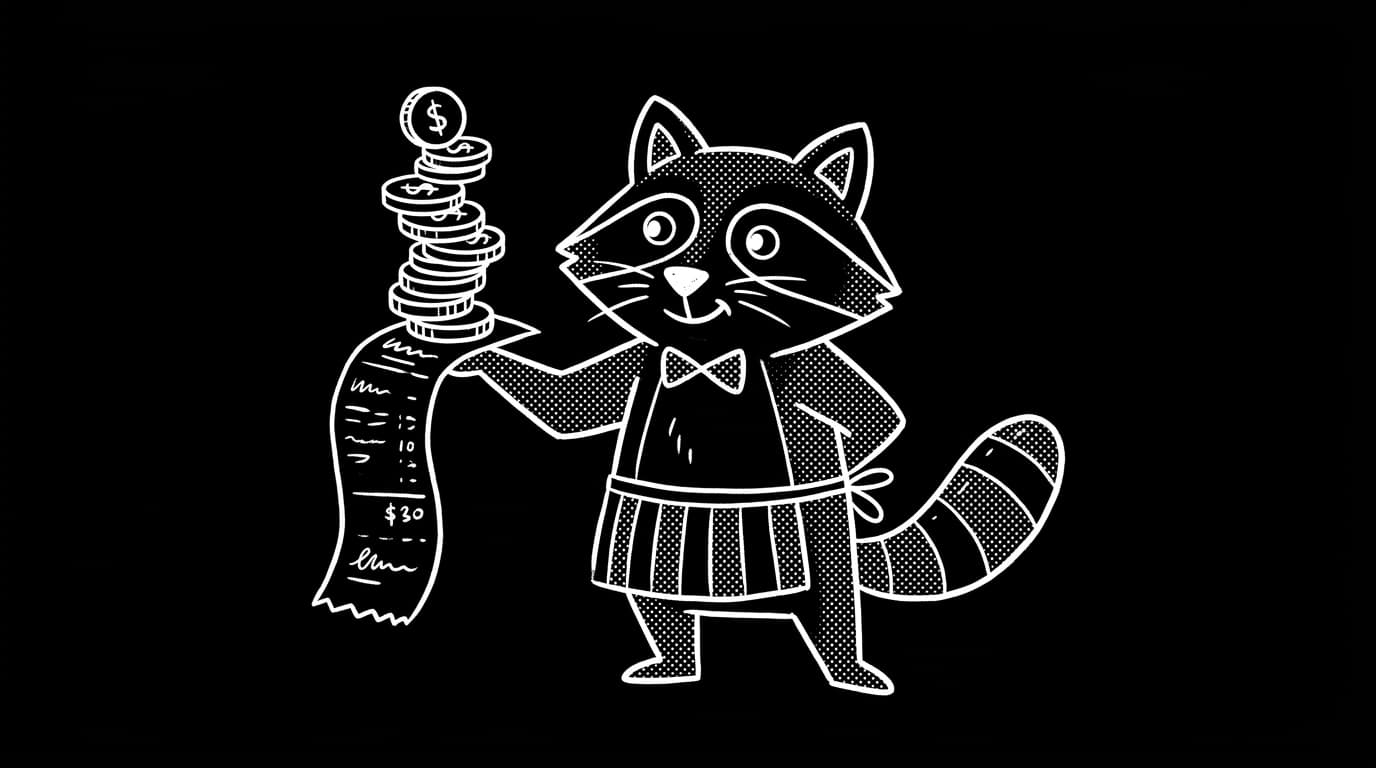
The bill lands, three friends stare at you, and the pen hovers. You do not need a calculator and you do not need to round down out of panic. Every tip from 10% to 25% collapses into one reflex: find 10% of the bill, then move up or down from there. The three variations below cover 15%, 18%, and 20% in under four seconds, which is faster than unlocking a phone.
Start With the One Move That Powers Everything: 10%
Ten percent is the anchor for every tip calculation worth doing in your head. For any bill, you shift the decimal one place left. A $47.80 bill becomes $4.78. A $126 bill becomes $12.60. A $9.44 coffee becomes $0.94. That is the whole operation, and it works because our currency is base-ten and tipping lives in percentages. If you cannot do this instantly, no further trick helps, so drill it on five bills in a row before leaving the house.
Round the 10% value to a clean number before you build on it. On a $47.80 check, treat 10% as $4.80 and move on. On a $126.37 check, treat 10% as $12.64 or even $12.60 depending on how generous you feel. The two or three cents you lose in rounding will never matter, and the speed you gain will. This is the same reflex you can train on short drills in the daily puzzle, where every second of hesitation costs score.
The 20% Tip: Double the 10% and Stop
Twenty percent is the easiest tip in American dining and the one most people overcomplicate. Find 10%, then double it. A $47.80 bill gives you $4.78, doubled to $9.56. Call it $10 if you want to leave a round total of $57.80, which is often how diners settle up. A $126 bill gives $12.60, doubled to $25.20. A $9.44 coffee gives $0.94, doubled to $1.88, which rounds to $2.
Doubling a two-digit decimal is the only sub-skill you need, and it reuses the same reflex you build in mental math drills. Doubling 4.78 means doubling 4 (8), doubling 0.78 (1.56), adding them (9.56). You can also decompose: $4.78 is $5 minus $0.22, so double is $10 minus $0.44, which is $9.56. Either path lands in under two seconds with practice.
The 15% Tip: 10% Plus Half of 10%
Fifteen percent is still the default in diners, cafes, and most casual counters outside large US cities. The move is take your 10% number and add half of it. A $47.80 bill gives you $4.78, plus half ($2.39), total $7.17. A $126 bill gives $12.60, plus $6.30, total $18.90. A $38 lunch gives $3.80, plus $1.90, total $5.70. The halving step is where most people slow down, so train halves of two-digit decimals specifically.
If halving decimals annoys you, there is an equivalent path: compute 15% as (bill divided by 2) divided by 10, then times 3. That is clunkier in prose but cleaner if your brain prefers divisions. For a $40 bill, half is $20, divided by 10 is $2, times 3 is $6. Pick whichever path your working memory likes better and stick with it, because mixing methods mid-calculation is where errors creep in.
The 18% Tip: The One Most People Guess On
Eighteen percent is now the standard autosuggested tip on card readers at mid-tier restaurants, and almost nobody computes it correctly in their head. The clean trick is take your 20% number and subtract 10% of it. A $47.80 bill has 20% of $9.56, minus 10% of that ($0.96), lands at $8.60. A $126 bill has 20% of $25.20, minus $2.52, lands at $22.68. The subtraction step reuses your decimal-shift reflex, so no new skill is required.
There is a lazier approximation that works for most meals: 18% is roughly 20% minus a dollar for every $10 of bill. On a $50 check, 20% is $10, minus about $1, call it $9. On a $100 check, 20% is $20, minus about $2, call it $18. The exact 18% on a $100 check is $18, so the approximation is tight. On larger bills the gap widens slightly, but you will still land within fifty cents of the real number, which is better accuracy than most Americans manage with a card-reader.
The Three Mistakes That Blow the Calculation
The first mistake is calculating tip on the post-tax total instead of the pre-tax subtotal. Etiquette does not require tipping on tax, and in high-tax states (over 9%) this inflates your tip by 10% or more. Look at the subtotal line, not the total line, and apply the percent there. The second mistake is forgetting that service charges and auto-gratuities already include a tip, so an additional 20% double-tips the server. The third mistake is anchoring to the suggested tip on the card reader, which is almost always calculated on the post-tax total and sometimes rounds aggressively up.
- Compute 10% first, always. Shift the decimal one place left and round to a clean number.
- For 20% double it, for 15% add half, for 18% subtract 10% of 20%.
- Tip on the subtotal, not the total. Taxes do not deserve gratuity.
- Check for pre-added service charges on parties of six or more before adding anything.
- Round the final tip up to a clean total if the math landed on an ugly number.
Why This Beats Pulling Out Your Phone
Phone-based tip apps take three to five seconds to open, which is slower than the full mental calculation. The pen is already in your hand, the bill is already in front of you, and the social cost of hunching over a phone during a dinner is real. People who tip quickly and competently signal fluency with numbers in a way that cannot be faked, and that signal carries weight at work tables, dates, and client dinners.
The deeper reason to drill this is that tip calculation is a weekly reality for most adults, so the compounding return on four seconds of practice beats almost any other mental-math skill. If you can also run these drills to a time pressure, as the leaderboard formats force you to, you build the habit of running the computation without flinching. The restaurant table stops being a math test and becomes exactly what it should be, which is dinner.