Mental Math for the GRE: Shortcuts That Save Real Time

The GRE Quant section gives every test-taker an on-screen calculator, and most Quant mistakes still come from clumsy arithmetic rather than conceptual gaps. Each calculator use costs six to ten seconds between opening the panel, typing cleanly, reading the result, and returning to the answer choices. Twelve mental shortcuts recover forty to sixty seconds across a thirty-five-question section, which is roughly the margin between a 160 and a 165 for most takers.
What the GRE Calculator Costs You in Seconds
The GRE on-screen calculator opens with a click, pulls focus from the question stem, and demands precise keystrokes. Each full use runs six to ten seconds end to end. A test-taker who reaches for it on fifteen questions burns ninety to one hundred fifty seconds across the section, which equals two or three full questions at the GRE's seventy-second per-question pace. The device also masks approximation habits. Many Quant answers invite estimation to prune the five choices to one, and the calculator pushes test-takers into exact arithmetic they never needed to run.
Six Shortcuts That Replace the Calculator
Six moves cover the arithmetic on the majority of GRE Quant items. Each one runs in under three seconds once drilled, and all six fit on a single index card. The list below pairs the identity with a concrete example at GRE difficulty.
- Ten-percent anchor: slide the decimal one place to find 10 percent, then double or halve to reach 5, 20, and 25 percent. 15 percent of 240 = 24 plus 12 = 36.
- The a% of b = b% of a swap: 18 percent of 50 becomes 50 percent of 18, which is 9. The identity collapses hostile percentages into friendly ones.
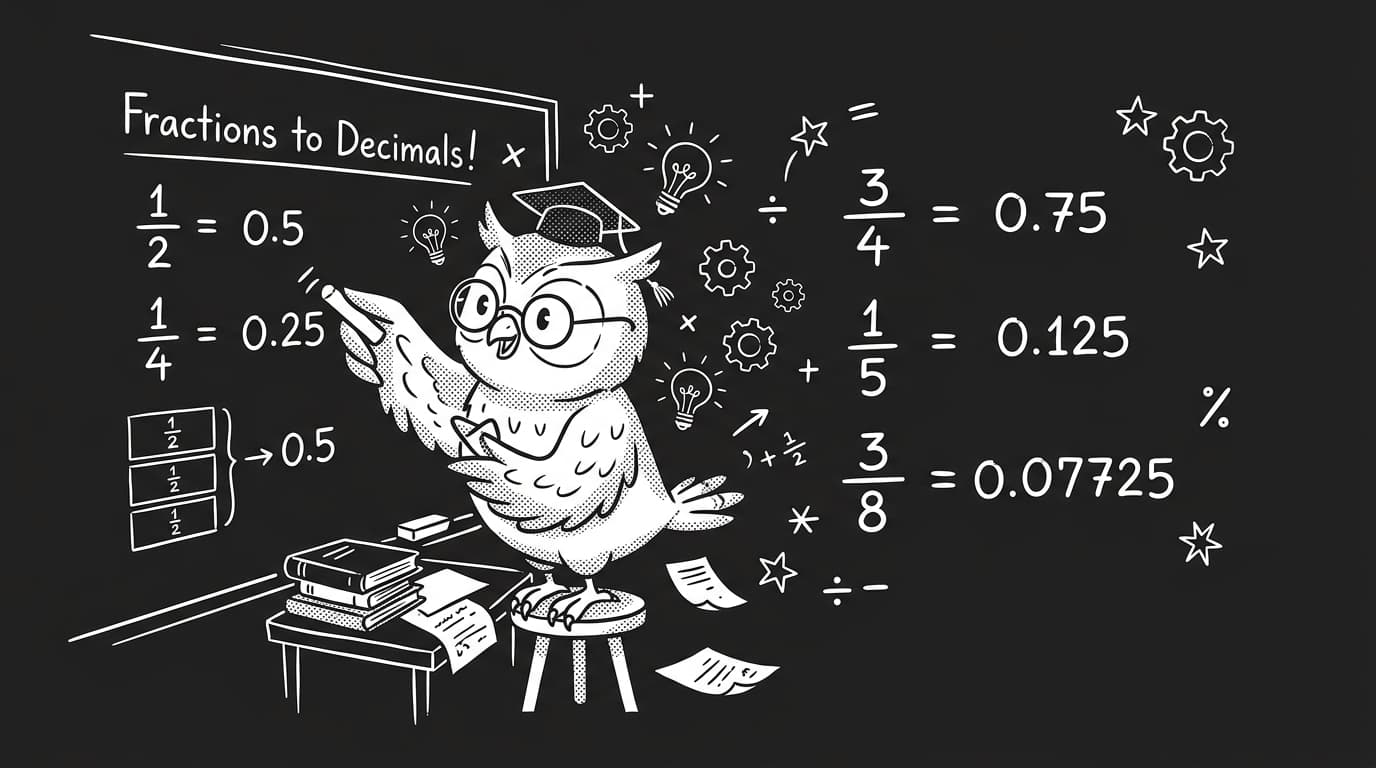
- Fraction-decimal equivalents: hold 1/8 = 0.125, 1/6 ≈ 0.167, 1/7 ≈ 0.143, 1/9 ≈ 0.111, 3/8 = 0.375 in memory to skip the calculator on fraction comparisons.
- The Rule of 72: a 6 percent compound rate doubles capital in 12 years, 9 percent in 8 years. See the rule of 72 explained.
- Difference of squares: 51 × 49 = 2500 − 1 = 2499, and 102 × 98 = 10000 − 4 = 9996, each in two seconds flat.
- Round-and-correct: 48 × 7 becomes 50 × 7 minus 2 × 7 = 350 − 14 = 336. The same move handles 97 × 13, 203 × 14, and most two-digit multiplications on the test.
Fraction and Decimal Equivalents Worth Memorizing
GRE Quant fraction questions typically force a comparison or a conversion. Two fractions resolve to the same decimal to three digits once you know the standard anchors. The core set covers halves, thirds, quarters, fifths, sixths, eighths, ninths, tenths, and twelfths, which is eighteen values in total. Memorize these to three decimal places and most compare-the-quantity items collapse into a single mental subtraction. The percentage shortcut guide covers the full anchor set and a four-day drill that locks every value under one second of recall.
Percent and Rate Problems in Three Seconds
Chained-percent problems destroy time when fed through the calculator one step at a time. A 20 percent discount followed by a 15 percent tax becomes one multiplication: 0.80 × 1.15 = 0.92, so the final cost is 92 percent of the sticker price. Rate problems collapse the same way. A car that covers 60 miles in 75 minutes converts to 1.25 hours, and 60 divided by 1.25 equals 48 miles per hour. The two moves finish inside four seconds with the halving-and-doubling identity, since 60 divided by 1.25 is the same as 240 divided by 5. Compound-growth questions reduce to the Rule of 72 for anything near a doubling, and to a single multiplication of the form 1.05^n for shorter horizons where n is three or less.
Estimating Answers to Catch Trap Choices
GRE Quant answer choices are built with distractors clustered near the correct value. The question 15 percent of 240 offers 24, 36, and 48 on nearly every official practice set, and only one choice survives a one-second check: 10 percent of 240 is 24, plus half of that for the 5 percent, totals 36. Estimation also kills most compare-the-quantity items without computation. Column A at (3/7)² against column B at (2/5)² resolves instantly because 3/7 ≈ 0.43 beats 2/5 = 0.40, and squaring preserves order on positive values. The fermi estimation playbook extends the technique to word problems where every answer looks reasonable at first glance.
A Twelve-Minute Daily Drill
Twelve minutes a day for four weeks installs the full shortcut set at test speed. Three minutes on the percent anchor, three on fraction-decimal recall, three on round-and-correct multiplication, and three on quick estimation. Run the Mathness daily puzzle at the start of the session as a timed warmup for target-number arithmetic, then pick a speed drill from the Mathness menu and set the round timer to twenty seconds. Finish each session with ten rapid-fire percent items pulled from any official GRE prep book, aiming for under eight seconds each by the end of week four. Track the week-four average: students who reach six seconds per item on the drill reliably finish Quant with four minutes of review time left on the clock.