Mental Math Games for Kids: A Grade-by-Grade Guide
A seven-year-old and a fourteen-year-old should never play the same math game. The number range, the operations, and the round length that hold attention at grade 2 collapse at grade 8, and the reverse is worse. This guide breaks mental math games down by school year, names the specific skill each stage builds, and points to formats that fit the developmental window instead of fighting it.
Grade 2 (Age 7 to 8): Number Bonds and Skip Counting
The core arithmetic target at grade 2 is fluent addition and subtraction inside 100, plus the earliest form of multiplication as skip counting. Games at this age work best when a full round finishes in under 30 seconds and the number range stays under 20. Bond drills to 10 and to 20 pay compound interest for the next four years of school, so anchor the practice here. Two dice and a stopwatch cover most of what a kid needs: roll, race to name the sum, then race to name every pair that adds to 10. Skip counting by 2s, 5s, and 10s becomes a rhythm chant that transfers straight into times tables the following year. Formal target-number puzzles like Mathness sit one grade above this band, though a stripped single-operation version can bridge a strong seven-year-old in.
Grade 3 (Age 8 to 9): Multiplication Tables and Doubling
Grade 3 is where the times tables land, and this is the year a kid either builds a lifetime reflex or installs permanent lag. Ten minutes of drilled recall a day beats a two-hour weekend cram by a factor of five in retention studies. Card games, dice races, and Bingo variants that force naming a product in under three seconds all work if the feedback is immediate. Doubling chains (2, 4, 8, 16, 32, 64) install a skill that later carries times-4, times-8, and times-16 without extra memorization work. Skip the 7 and 8 columns at first and circle back once 2 through 6 run automatic, because the 7s absorb faster once anchored by 5s. A three-minute daily streak on a puzzle app gives structure without turning practice into homework.
Grade 4 (Age 9 to 10): Two-Digit Work and the Distributive Property
Grade 4 introduces two-digit multiplication and long division on paper, and the mental version needs to follow within months or the paper method stays a crutch forever. The most valuable game at this age is the box method played out loud: name 23 times 47 as (20+3) times (40+7), work each of the four partial products, then sum. That is the distributive property in disguise, and mastering it in grade 4 makes algebra readable by grade 7 without extra intervention. Estimation games where a kid rounds each factor and lands within 10 percent of the true answer build number sense that pure recall drills never touch. Target-number puzzles enter the picture at this stage: keep the target under 100 and use four tiles, then work up. The 24 Game, covered in this comparison piece, fits grade 4 almost perfectly.
Grade 5 (Age 10 to 11): Fractions, Decimals, and Percent Anchors
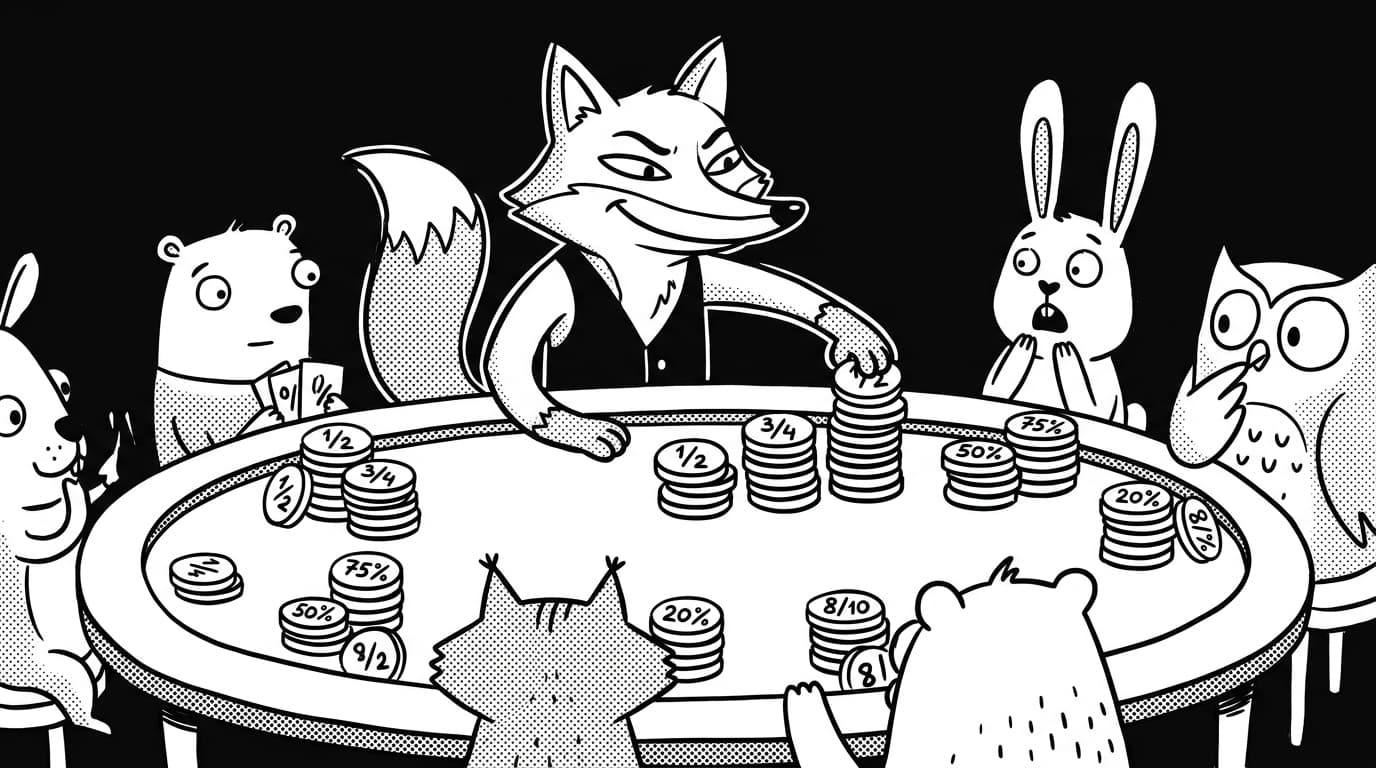
Grade 5 splits kids into two lifelong groups: those who see 3/4, 0.75, and 75 percent as the same number and those who never quite do. Games that convert between the three forms in a single round build the bridge, and the practice compounds through every science and money problem after it. Roll two dice for a numerator and denominator, name the decimal, name the percent, name a real-world example (75 percent off a $40 jacket lands at $10). The 10 percent anchor method belongs at this age: 10 percent of any number is a shift of the decimal, so 15 percent is 10 plus half of 10, and 30 percent is three of those tens stacked. Full target-number puzzles with six tiles and three-digit targets become age-appropriate here, and the additional load matches the new arithmetic capacity.
Grade 6 to 8 (Age 11 to 14): Speed, Strategy, and Formats That Scale
Middle school is where mental math either becomes a sport or fades into calculator dependence for the rest of a kid's life. Competitive short-round formats keep the reflex alive, and they map onto the way math contests and standardized tests run under real time pressure. Countdown-style number rounds with 30 seconds and six tiles fit this age window cleanly, and so do daily leaderboard climbs. Ranking loops match the social wiring of adolescence in a way that solitary worksheets cannot compete with, which is why a public leaderboard drives more daily reps at this age than any parent-imposed schedule. This is also the right window to introduce named methods like Vedic sutras or Trachtenberg patterns for kids who want to go deeper than the school curriculum offers. Weekly problem-of-the-week formats at grade 7 and 8 often outperform daily short drills for long-term retention, because the extra sitting time forces genuine strategy work.
A handful of formats stay age-flexible when the number range scales with the child. The seven below hold up from grade 2 through grade 8 with only the difficulty knob turned. Any of them run with a deck of cards, two dice, a printed worksheet, or a puzzle app on a phone. The rule underneath all of them is the same: short rounds, immediate feedback, and a small ladder to climb the next day.
- Target-number puzzles (24 Game, Countdown, Mathness) with tile count scaled to age
- Bond drills for pairs to 10, 100, and 1000 run as timed flash rounds
- Skip counting races by 2s, 5s, 7s, and 25s against a stopwatch
- Dice-roll races to name a product, sum, or difference in three seconds
- Rounding and estimating the total of a shopping list before the register does
- Daily one-puzzle streak formats that reward showing up over speed
- Bingo boards where the caller names an expression like 6 times 7 instead of a number
What to Skip and the Common Mistakes
Timed tests run as high-pressure standalone events install math anxiety in roughly a third of kids by grade 4, and the research on this has been consistent for two decades. Race-the-teacher formats where the losing child sits down are the worst offenders, and the shame loop outlasts the arithmetic gain by years. Long worksheets that pile 60 problems into one sitting kill the dopamine loop that daily short rounds build so effectively. Word problems dressed up as games are usually neither a game nor useful practice, so treat them as reading comprehension work with math attached. If a kid dreads the timer, drop the timer and keep the game intact. If the game itself feels like a worksheet, drop it entirely and pick a format from the list above.