Multiplying by 8 in Mathness: The Triple-Double Reflex
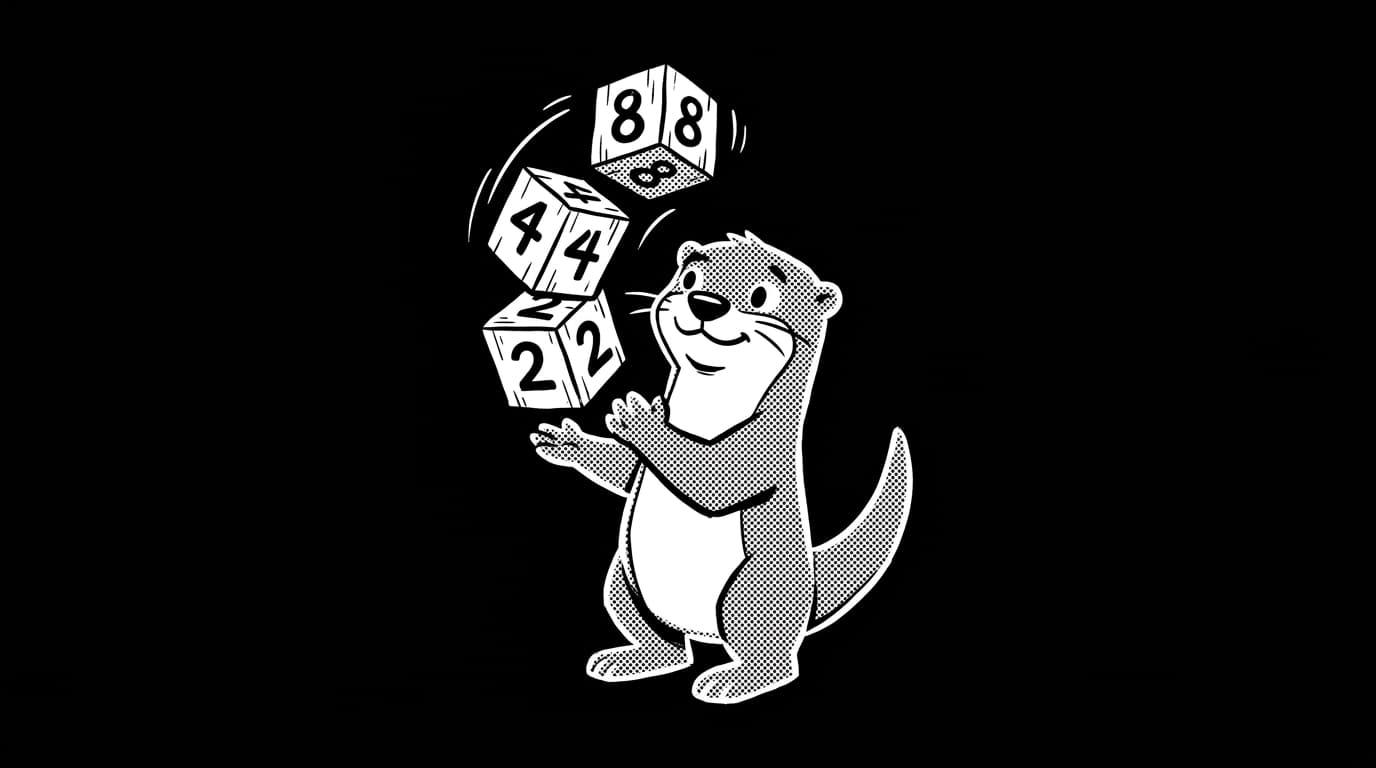
Multiplying by 8 in Mathness looks intimidating until you stop treating it as one operation. Three consecutive doublings replace the entire 8-times table, and each doubling costs under half a second once trained. The triple-double reflex takes 43 × 8 from a mid-round pause to a one-beat move that arrives faster than reading the tiles.
The Triple-Double Method
The formula is x × 8 = ((x × 2) × 2) × 2. Every step is a doubling of a value your working memory already holds, so the total load is three doublings and one final answer. For 37, the chain runs 37 to 74 to 148 to 296, and each step lands in under 0.4 seconds after two weeks of drill. The method beats direct 8-times recall above 12, because most players never memorized past 12 × 8 = 96. It also beats column arithmetic because there is no carry stack to track.
The times-table lookup fails on 13 through 99, the range that dominates Mathness boards from round 15 onward. Standard left-to-right multiplication requires a two-digit multiplier and a mental partial-products stack, which costs three to five seconds. The left-to-right method still wins on adds and subtracts, but it loses to the triple-double on any factor of 8. Doubling is a single-digit reflex trained by age eight in most players, so this chain compounds an existing strength instead of building a new one.
The Reflex Table
Twenty products cover roughly 90 percent of times-eight moves seen in ranked Mathness. Memorize the direct answer for the small end and use the triple-double for the middle range. Above 100, a double-then-shift variant runs faster, since 8 × 125 collapses to 1000 in one shift and 8 × 250 collapses to 2000.
- 2 × 8 = 16
- 3 × 8 = 24
- 5 × 8 = 40
- 7 × 8 = 56
- 11 × 8 = 88
- 13 × 8 = 104
- 17 × 8 = 136
- 19 × 8 = 152
- 23 × 8 = 184
- 25 × 8 = 200
- 29 × 8 = 232
- 37 × 8 = 296
- 43 × 8 = 344
- 47 × 8 = 376
- 53 × 8 = 424
- 59 × 8 = 472
- 67 × 8 = 536
- 79 × 8 = 632
- 83 × 8 = 664
- 97 × 8 = 776
Where It Wins on the Board
The triple-double dominates any Mathness board that pairs 8 with a two-digit tile in the 20 to 90 range. On ranked boards, roughly one in four rounds contains an 8 tile with a productive doubling path to the target. Three-digit targets between 200 and 800 often land in one operation once the triple-double delivers the near-value, and the three-digit targets guide covers the anchor-and-adjust step that follows.
Two board shapes reward the reflex most. First, a target ending in 6, 4, 2, 8, or 0 combined with an 8 tile signals a clean triple-double landing, because the units digit of 8x follows the same doubling pattern. Second, when 8 sits next to a 25 or 125, the shortcut collapses to a shift, since 8 × 25 = 200 and 8 × 125 = 1000. These two multiples remove one full doubling step and cut the round by two seconds.
Failure Modes Above 125
Triple-double breaks down when the second doubling crosses a hundred boundary and the third crosses a thousand. For 87 × 8, the chain runs 87 to 174 to 348 to 696, and the 174 to 348 step trips players who did not lock the doubling of 74. Doubling 74 to 148 requires an internal carry from the units to the tens, and misreading it as 138 kills the round. Drill the doubling ladder from 50 to 99 as a separate reflex before combining it with the full triple-double chain.
The second failure appears above 125, where the third doubling produces a four-digit number. For 143 × 8, the chain runs 143 to 286 to 572 to 1144, and the 572 to 1144 step demands a tens-to-hundreds carry plus a thousands digit. Switch to the shift-and-subtract method here: 143 × 8 = 143 × 10 minus 143 × 2 = 1430 minus 286 = 1144. The ten-minus-one style reflex generalizes to this range, and shift-and-subtract runs cleaner than a fourth doubling above 125.
The Seven-Day Drill
The drill takes four minutes a day and installs the reflex inside a week. Day one covers doubling every integer from 10 to 50 in random order, one per second. Day two adds 51 to 99. Days three and four run the full triple-double chain on twelve factors between 15 and 60. Days five and six add 61 to 99 and time the full chain to a 1.5-second ceiling. Day seven runs mixed boards on the /daily mode and counts times-eight moves that landed inside two seconds.
Track results in a three-column log: factor, elapsed seconds, final answer. Missed answers get flagged, and flagged factors move into the next morning's warmup as the first ten reps. After 14 days, the chain runs sub-second on 90 percent of factors under 100, and error rate drops below one miss per fifty attempts. At that point the times-eight tile stops being a decision point and becomes a reflex, freeing five to seven seconds per round for target search and endgame planning.