Near-Fifty Multiplication in Mathness: The Fifty-Base Method for 41 to 59
Mathness boards routinely drop factor pairs like 47 × 53 or 48 × 54 into your lap, and long multiplication burns four to six seconds you cannot spare. The fifty-base method turns any pair inside the 41 to 59 window into one adjustment and one small product, finishing in about two seconds once the reflex settles. It piggybacks on the same anchoring instinct that powers the near-hundred base method for 91 to 109, tuned to a smaller centerpoint. The identity is fixed and the failure modes are two known cliffs. Twenty minutes of drill locks the reflex for every daily round that hands you a mid-range multiplication.
The identity that makes it work
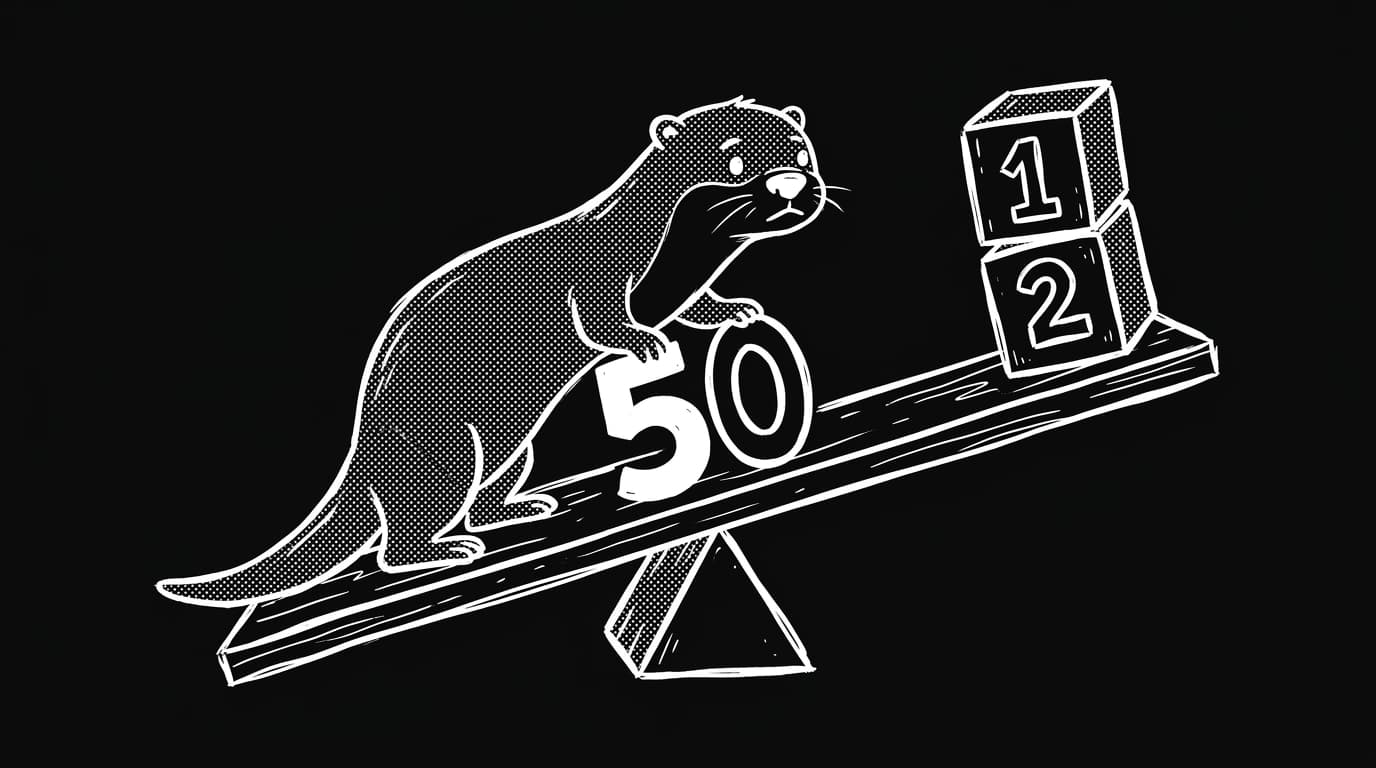
The fifty-base method rests on one algebraic move. Write each factor as 50 plus a signed offset, so 47 becomes 50 minus 3 and 54 becomes 50 plus 4. Multiply out (50+a)(50+b) and it splits into 2500, plus 50 times the sum of the offsets, plus the product of the offsets. Every calculation is a fixed 2500, one multiplication of a small integer by 50, and one product of two single-digit numbers. No column carries and no partial products enter the round.
The offsets stay between negative nine and positive nine by construction, so their sum sits in the range of eighteen either side of zero, and their product sits between negative 81 and positive 81. Nothing you handle exceeds two digits after the offset step. A player who can hold three numbers on a scratchpad has enough headroom. The whole calculation runs left to right, matching the left-to-right arithmetic direction already trained into ranked play.
The two-second execution
The reflex runs in three beats. Beat one, read both factors and stamp their offsets from 50. Beat two, add the offsets, multiply that sum by 50, and add the result to 2500. Beat three, multiply the two offsets and add or subtract by their signs. Say 47 × 53. Offsets negative three and positive three. Sum zero. Add nothing to 2500. Product negative nine. Final answer 2491. The whole thing takes about two seconds cold, closer to one and a half once the identity fires without conscious parsing.
The 50 times sum step is friendlier than it looks. If the offset sum is even, 50 times it lands on a hundreds multiple immediately, so a sum of four gives 200 and a sum of negative six gives negative 300. If the sum is odd, 50 times it lands on a half hundred, so a sum of three gives 150 and a sum of negative five gives negative 250. Adding a half hundred to 2500 keeps the running total on the fifty line, which is fine, because the offset product will always shift the result off it back to a clean integer.
Twelve pairs it wins on
A short list of the pairs that show up most on Mathness boards makes the reflex sticky. Every one of these solves under two seconds once the identity is reflex, and every one traces the same three beats above.
- 43 × 47 → offsets negative seven and negative three, sum negative ten, product 21 → 2500 minus 500 plus 21 equals 2021
- 44 × 46 → offsets negative six and negative four, sum negative ten, product 24 → 2500 minus 500 plus 24 equals 2024
- 46 × 54 → offsets negative four and positive four, sum zero, product negative sixteen → 2500 minus 16 equals 2484
- 47 × 53 → offsets negative three and positive three, sum zero, product negative nine → 2500 minus 9 equals 2491
- 48 × 52 → offsets negative two and positive two, sum zero, product negative four → 2500 minus 4 equals 2496
- 48 × 54 → offsets negative two and positive four, sum two, product negative eight → 2500 plus 100 minus 8 equals 2592
- 49 × 51 → offsets negative one and positive one, sum zero, product negative one → 2500 minus 1 equals 2499
- 52 × 58 → offsets positive two and positive eight, sum ten, product 16 → 2500 plus 500 plus 16 equals 3016
- 53 × 57 → offsets positive three and positive seven, sum ten, product 21 → 2500 plus 500 plus 21 equals 3021
- 54 × 56 → offsets positive four and positive six, sum ten, product 24 → 2500 plus 500 plus 24 equals 3024
- 55 × 55 → offsets positive five and positive five, sum ten, product 25 → 2500 plus 500 plus 25 equals 3025
- 56 × 58 → offsets positive six and positive eight, sum fourteen, product 48 → 2500 plus 700 plus 48 equals 3248
Three sub-patterns emerge from the list. Pairs symmetric around 50 collapse to 2500 minus the offset squared, which is a direct application of the difference of squares identity. Same-tens pairs where both factors sit in the 50s with units summing to ten all land at 3025, 3024, 3021 style targets, overlapping the same-tens units-sum-to-ten trick exactly. Squares from 41² to 59² fall out as a special case where both offsets match, so the method doubles as an in-range squaring shortcut.
The two failure modes
The reflex breaks in exactly two places. Failure mode one is the sign flip on the offset product. When one factor sits below 50 and the other above, the offset product is negative and gets subtracted from the running total. When both sit on the same side of 50, the offset product is positive and gets added. Players lose ten to fifteen seconds every session by adding when they should subtract. Failure mode two is stepping outside the 41 to 59 window. At 40 or 60 the offset hits ten and the offset product balloons to 90 or higher, dragging you into two-digit adjustment territory and killing the two-second budget.
Both failures get caught by the standard verification pass. A last-digit check catches sign-flip errors on the offset product almost every time, because the units digit of the final answer is fully determined by the units digits of the two factors. Casting out nines on the result catches offset arithmetic mistakes inside the same one-second budget. Anything past the 41 to 59 window belongs to standard two-digit multiplication, not this method, so the range guard is the first check to install.
The seven-day drill
The drill fits inside a three-minute warm-up block. Day one, write the twelve pairs above on paper without answers and solve each one aloud, timed. Target under three seconds each on cold reads. Day two, add the six symmetric pairs (41 and 59), (42 and 58), (43 and 57), (44 and 56), (45 and 55), (46 and 54) and drill both directions. Day three, add the eight same-tens pairs where both factors sit in the 50s with units summing to ten. Day four, mix the three sets and hit 30 problems in three minutes. Day five, sit down cold and hit 40 problems in four minutes, tracking only errors. Day six, run the drill inside a live /daily session and log every board where the reflex fired. Day seven, retest cold with the pool from day five and confirm the average solve time dropped by two seconds on any 41 to 59 pair.
Two weeks of that block installs the reflex into the pattern-scan that opens every round. Once the eye flags a mid-range pair the moment the board loads, the fifty-base method fires before the round timer hits three seconds. The drill costs 21 minutes across seven days and pays back four to six seconds per round on every board where a mid-range pair shows up, which is roughly one round in five on ranked and one in four on daily. Keep the block until the identity feels automatic, then rotate to the next range.