Pattern Recognition in Mathness: Read the Board Before You Compute
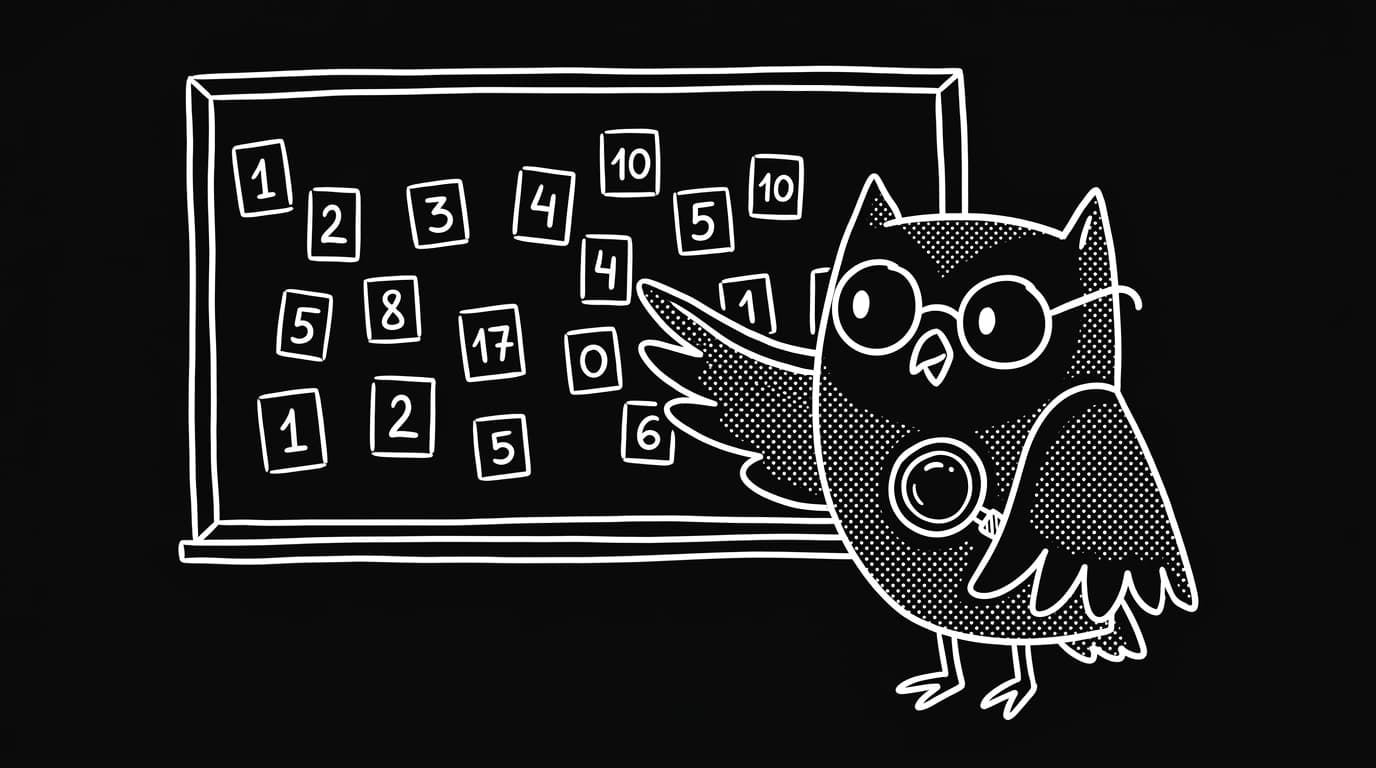
The fastest Mathness players do not compute faster, they read the board faster. By the time a strong player has glanced at the target and the five tiles, they have already spotted the factor pair, the near-double, or the complement that produces an exact match. The arithmetic that follows takes two seconds because the search space has collapsed to one candidate expression. Weak players treat every board as a fresh combinatorial problem and burn ten seconds rotating through random combinations. This post is the field guide to the five patterns that show up on most boards, and the drills that train you to see them at a glance.
Scan the target for factor pairs first
The first move on any board is a one-second check: does the target factor into a clean pair within reach of your tiles. A target of 84 has factor pairs 7 times 12, 6 times 14, and 4 times 21, and a typical board contains at least one of those numbers. A target of 91 has only two useful factor pairs, 7 times 13 and 1 times 91, so seeing a 7 or a 13 in the tiles locks the answer immediately. Players who skip this scan and start adding tiles forfeit eight to twelve seconds on boards where the factor pair was sitting in plain sight. The scoring breakdown rewards exact matches above every other front, which makes the factor scan the single highest-return habit you can build. Memorise the factor pairs of every two-digit number up to 100 and the scan becomes automatic within two weeks.
Spot the near-double pattern in your tiles
Near-doubles are pairs of tiles within two of each other, like 8 and 9, or 12 and 13. They produce two scoring patterns at once. Their sum is double the smaller plus one or two, and their product is the smaller squared plus the smaller. For a target of 17 with tiles 8 and 9, the sum hits the target exactly using two tiles. For a target of 72 with tiles 8 and 9, the product 72 hits with two tiles and saves three for the variety tier. Near-doubles also work as bridges, because 12 plus 13 equals 25, and a 25 is one of the most useful intermediate values in the game given how many targets are multiples of 5 or sit close to 100. Train the reflex to circle near-doubles on every board within the first three seconds and the rest of the round becomes a routing problem rather than a search problem.
Use complements of ten to shrink the board
Tiles that sum to 10, such as 3 and 7, 4 and 6, or 1 and 9, are scoring shortcuts in disguise. Any time you spot a complement pair, treat it as a single 10 in your mental search. A board with tiles 6, 4, 8, 3, 11 against a target of 28 becomes manageable when you collapse 6 and 4 into 10, because the search reduces to combining 10, 8, 3, 11 to reach 28. The expression 11 plus 8 plus 6 plus 3 hits 28 exactly with four tiles and earns the numbers-used credit on top of the accuracy bonus. The complement habit also chains, because a pair that sums to 10 and a pair that sums to 20 combine into 30 in one operator step with four tiles, which scores well across accuracy and variety. Practice spotting complements with the daily puzzle, where every player shares the same board and you can compare your read time to the leaderboard.
Recognise the one-tile-too-many board
Some boards seed the exact match with two tiles and put three decoys on the board to tempt you into spending them. The signal is when a quick factor scan or near-double check produces a clean two-tile exact match before you have looked at the remaining tiles. The temptation is to absorb the extras to claim the numbers-used bonus, but the math rarely tips in your favour. An exact match earns around 600 points from accuracy plus the elegance credit, while the numbers-used bonus for three extra tiles caps near 80 points and only pays when those tiles cancel cleanly. The tradeoff works in your favour when the extras absorb without breaking the result, which usually means a tile worth 1 you can multiply by, or two tiles whose subtraction nets to zero. Our target-miss guide covers this tradeoff in more detail under the numbers-used heading and gives the cutoff at which extras stop paying.
Memorise the multiplication grid eleven through nineteen
Targets above 100 are where weaker players lose the most points, because multiplication recall thins out past the standard 12 by 12 grid. Boards with tiles in the 11 to 19 range produce targets like 143 from 11 times 13, 187 from 11 times 17, 221 from 13 times 17, and 247 from 13 times 19. Players who have memorised the 11 through 19 grid see these targets instantly. Players who have not memorised the grid spend twelve seconds testing combinations and usually settle for a four-point miss. The grid contains 45 unique products and locks in after about two weeks of five-minute drills. Once the recall is automatic, your ceiling on hard boards rises by roughly 200 points per round because you stop bleeding accuracy points to triple-digit targets.
Train the patterns with deliberate reps
Pattern recognition is not innate, it builds from concentrated reps on the same shapes. The most efficient drill is to play five solo rounds where your only goal is to name the pattern within three seconds, even if your full expression takes longer. Say the pattern out loud: factor pair, near-double, complement, decoy, big-grid target. After two weeks of that drill, the call becomes automatic and your time to first candidate expression drops from twelve seconds to four. The global leaderboard shows the result clearly, because top-100 players hold submission times under twenty seconds on hard boards by reading patterns subconsciously. The difference between computing under pressure and executing a sight-read is two weeks of deliberate reps, not a year of raw practice.
- Scan the target for factor pairs in the first second of every round.
- Circle any near-double pair in the tiles before reading the target a second time.
- Treat complement-of-ten pairs as a single 10 to shrink the search space.
- Walk away from extras when a clean two-tile exact match is already in hand.
- Memorise the eleven through nineteen multiplication grid for triple-digit targets.
- Drill pattern calls aloud for five rounds a day until the read becomes subconscious.