Squaring Numbers Ending in 5 in Mathness: The n×(n+1) Shortcut
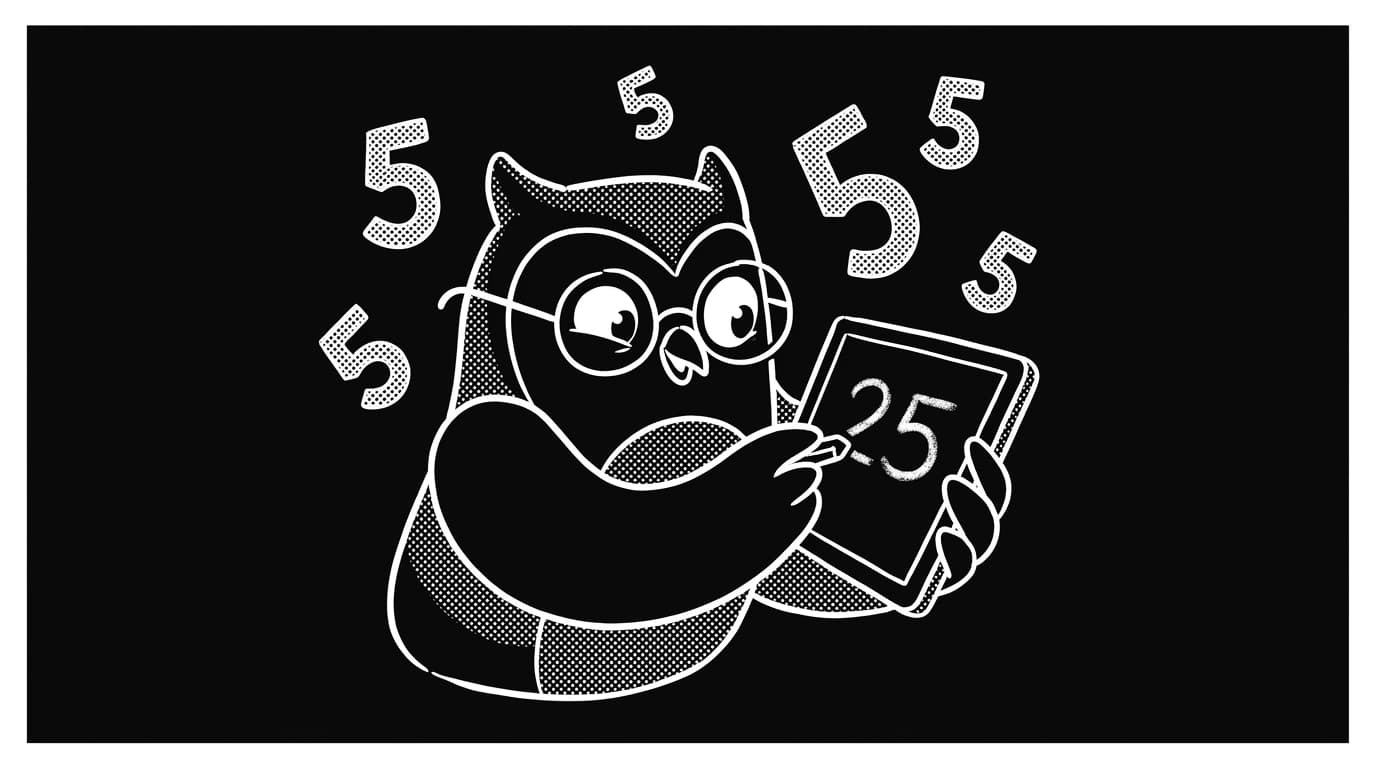
The identity (10n+5)² = 100·n·(n+1) + 25 turns every square ending in 5 into a single small multiplication plus an appended 25. In Mathness a squaring move that lands in one second beats a two-step tile chain by four to six seconds per round. This post covers the rule, the nine squares from 15² to 95², the boards where the shortcut wins, the slips it invites, and a seven-day drill.
The n-Times-(n+1) Rule
Every number ending in 5 has the form 10n+5, where n is the digit block before the 5. Squaring gives (10n+5)² = 100n² + 100n + 25 = 100·n(n+1) + 25. Written as a two-step move: multiply the digit block by the next integer, then append 25. 35² is 3·4·100 + 25 = 1225. 65² is 6·7·100 + 25 = 4225. 85² is 8·9·100 + 25 = 7225. The product step needs one entry from the times table under 12×12 for every two-digit target from 15 through 95. The proof is one line of algebra and the pattern holds for any base ending in 5, so 105² is 10·11·100 + 25 = 11025 and 115² is 11·12·100 + 25 = 13225.
The Nine Two-Digit Squares to Reflex
Nine numbers between 10 and 99 end in 5. Their squares appear as Mathness targets, as products inside decomposition paths, and as anchor values for nearby targets. Memorizing the outputs collapses the shortcut into pure recall, so the reflex fires before the multiplication does. Cross-reference the perfect squares from 11 to 30 post; those two lists overlap at 15² and 25², and pair well with 20², 24², and 30² for wide target coverage.
- 15² = 225 (1·2 then 25)
- 25² = 625 (2·3 then 25)
- 35² = 1225 (3·4 then 25)
- 45² = 2025 (4·5 then 25)
- 55² = 3025 (5·6 then 25)
- 65² = 4225 (6·7 then 25)
- 75² = 5625 (7·8 then 25)
- 85² = 7225 (8·9 then 25)
- 95² = 9025 (9·10 then 25)
Where the Shortcut Wins on the Board
Three Mathness shapes call for a squaring move ending in 5. First, when the target itself ends in 25 and one of your tiles is a multiple of 5 near a known n5 value, the shortcut names the square candidate in under a second. A target of 5625 with a 75 tile is one product, not a search. Second, when a factor path collapses to n·(n+2) around a 5-tail center, difference of squares plus the n5² anchor closes the target in two moves. 24·26 reads as 25²-1 = 624, and 74·76 reads as 75²-1 = 5624. Third, when the target sits inside twenty of a known n5² value and a small tile can adjust, the anchor plus one operation lands the answer. 2030 becomes 45² + 5, and 3020 becomes 55² - 5.
Slips the Shortcut Invites
Three failure modes cost points inside otherwise clean rounds. Off-by-one on the next-integer multiplication: 65² is 6·7·100 + 25, not 6·6·100 + 25. Drill the pair (n, n+1) as a single unit so the hand writes both digits together. Wrong tail length: appending 5 instead of 25 is the most common slip under time pressure. The tail is always two digits because 5·5 = 25 and the 2 carries forward, so any square of a 5-tail number ends in 25. Base confusion above 100: 105² is 10·11·100 + 25 = 11025, with four digits before the 25 tail, not three. When the block n hits ten or higher, the 100 factor still applies; write the full product. A one-second last-digit check catches the 5-vs-25 slip because any square whose root ends in 5 must end in 25.
The Seven-Day Drill
Day one: write the nine squares from 15² to 95² by hand, twice, without reference. Day two: mixed recall of 20 prompts drawn from the nine values, target under 15 seconds total. Day three: pattern spotting. Take 30 random four-digit numbers and mark which are exact n5² values, which sit within ten of one, and which are unreachable by this shortcut. Day four: apply the shortcut inside five daily Mathness rounds and log which targets triggered it. Day five: extend past 100 with 105², 115², 125², and 135². The pattern holds, and the practice locks the three-digit case for post-100 targets that appear in higher difficulty modes. Day six: mix the shortcut with anchor-and-adjust plays, using n5² as the anchor and a small tile as the adjust. Day seven: rest arithmetic, review the log, and mark which of the nine still take more than half a second on cold recall.
When Another Method Beats This One
The shortcut is a squaring tool, not a general multiplier. If a target needs 35·48, cross multiplication and doubling chains win because 48 does not end in 5. If the target sits far from any n5² value and no tile bridges the gap in one operation, reach for a wider approach from the game menu and move on within your round budget. Prime targets near an n5² sometimes yield to the anchor plus a small addition or subtraction, but a target more than thirty away from the nearest n5² usually loses ground because the adjust step costs a tile that another path would have kept in reserve. The heuristic on the board is short. See a 5-tail target or a multiple of 5 in your tile set: check the shortcut first. See neither: skip it and choose another opener.