The Countdown Numbers Round: How to Solve It Fast (A Mental-Math Guide)
The Countdown numbers round gives you 30 seconds, six tiles, and a three-digit target between 100 and 999. An exact solve scores 10 points, within five scores 7, within ten scores 5, and anything further scores zero. The gap between a top solver and a confused player is not raw calculation speed. It is a short set of search habits that compress the problem before the clock gets dangerous. This guide covers the four anchors, a full worked example, the three clock-killing mistakes, and the drills that move you from occasional solver to reliable scorer.
What the Numbers Round Asks You To Do
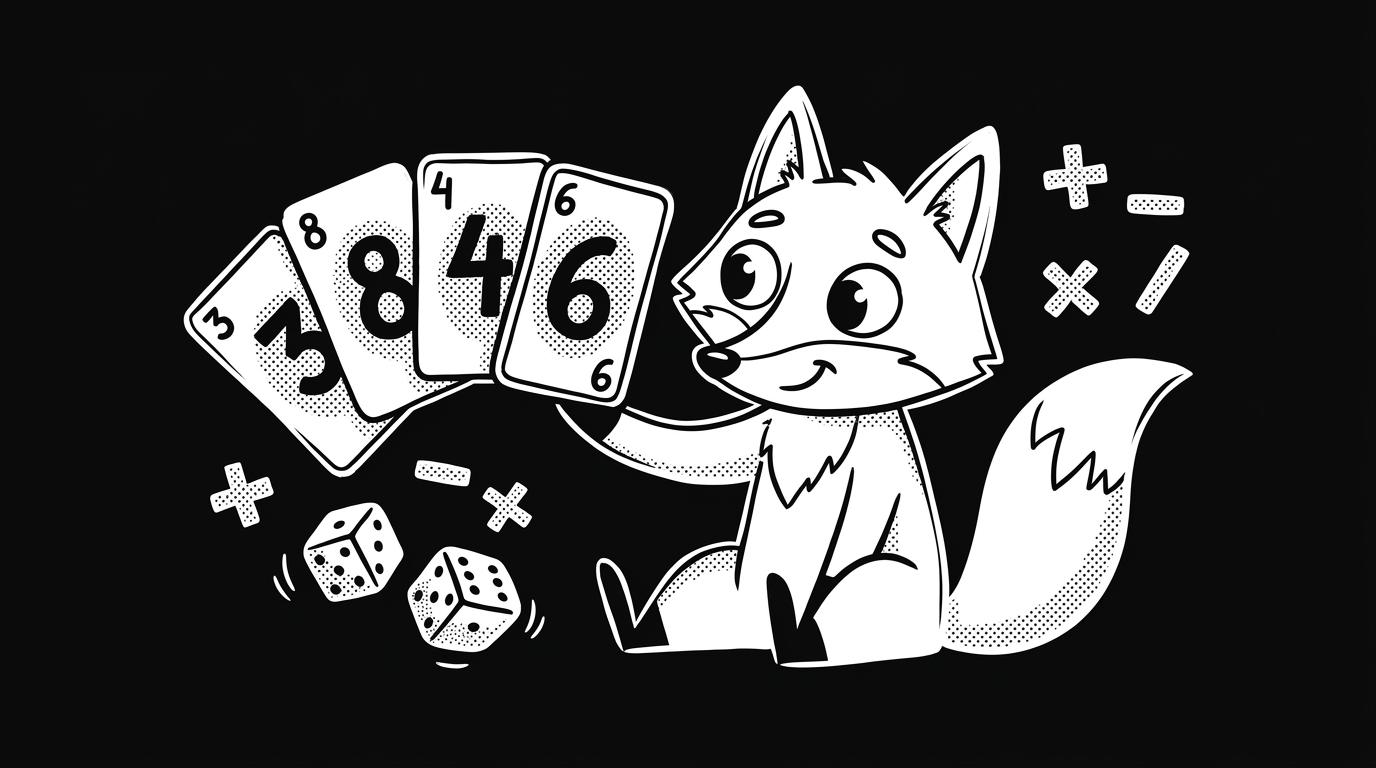
You pick six tiles from two pools: large numbers (25, 50, 75, 100) and small numbers (1 through 10, each duplicated once in the full deck). A random generator then produces a target in the 100 to 999 range. You have 30 seconds to combine any subset of the six tiles with +, -, ×, and ÷ in any order, using each tile at most once, and every intermediate result must be a positive integer. Rachel Riley, the show's current numbers host, has publicly solved rounds inside ten seconds on air. The round rewards structural thinking over drill-grind arithmetic. Most mental math apps, including Mathness, train the arithmetic layer underneath. The search problem on top is what separates clean solvers from the pack. Recent cognition research on mental math practice suggests the structural-search gain transfers to adjacent problem solving, not to general intelligence.
The Four Anchors Every Solver Uses
Elite Countdown solvers work from four reusable anchors, applied in roughly this order. Build the anchor first, correct for the gap second. Each anchor compresses a wide search tree into a short checklist that a trained brain can run inside five seconds.
- Multiplicative anchor: pick a large tile and a small tile whose product sits within 100 of the target. A 75 and a 9 land you at 675, a 50 and a 7 land you at 350, a 100 and an 8 land you at 800.
- Additive correction: use the remaining tiles to add or subtract the shortfall. Pair small tiles into a quick sum or difference that closes the gap.
- Overshoot and divide: when the anchor overshoots, look for a dividing tile that cleanly reduces the product. A target near 150 from 75 × 4 = 300 wants a divisor of 2.
- Factor the target: if the target decomposes cleanly (528 = 16 × 33, 672 = 32 × 21), the tiles often hand you one factor directly.
A Worked Example With a Target of 528
Target: 528. Tiles: 100, 25, 6, 4, 3, 1. Scan for a multiplicative anchor. 100 × 5 is 500, close to the target. You lack a 5 tile but can build one from 6 - 1 = 5. That gives 100 × (6 - 1) = 500, which leaves a 28-point gap. From the remaining tiles 25, 4, and 3, you can hit 28 as 25 + 3, leaving 4 unused. The full expression is 100 × (6 - 1) + 25 + 3 = 528. The round rewards keeping one tile in reserve, since forced-use rules do not apply. A player trained on daily reflex drills will spot the (6 - 1) subassembly inside three seconds, then the 25 + 3 close inside five. The remaining 20 seconds becomes insurance against a miscount. A second valid path uses the factor route: 528 = 16 × 33, so building 16 from (4 × 4) is blocked by the single 4 tile, and (25 - 3 × 3) also fails without a second 3. The anchor path is simply shorter, which is why trained solvers try it first and fall back to factors when the anchor leaves no clean correction.
The Mistakes That Burn the Clock
Three mistakes account for most zero-point rounds. First, chasing the exact solve past the 20-second mark when a within-five answer is already locked in. Within five scores 7 points, which is a real asset in a tight game. Second, forcing a non-integer intermediate step. Dividing 75 by 2 breaks the integrality rule and voids the attempt, so any division has to resolve cleanly across the board. Third, scanning tiles in random order. Trained solvers always identify the large tiles first, bind one to a multiplicative anchor, then let the small tiles do the additive correction. Searching uphill from the small tiles leads to long, failed chains. A fourth, quieter mistake is forgetting that you do not have to use every tile. Many beginners waste cycles trying to combine all six when four would suffice, which inflates the search space without adding scoring value.
How to Train the Numbers-Round Reflex
Three drills close the gap between hobby solver and tournament solver, and they map onto what elite mental calculators practice. First, times-table expansions up to 25 × 20. Most Countdown anchors use 25, 50, 75, or 100 as a multiplier, so the product tables for those four cover a large share of the target space. Second, factorisation of three-digit numbers. If you can decompose 528 as 16 × 33 or 24 × 22 inside two seconds, the factor-first route becomes a viable path alongside anchor-and-correct. Third, timed drills under 30 seconds, which forces mental sequencing before you need it live. The Mathness leaderboard rewards exactly this kind of time-bound accuracy, and the drill patterns transfer across formats. Daily repetition beats long weekly sessions, which matches the spaced-practice signal in the cognition literature.