24 Game Strategy: How to Solve Any Four-Number Puzzle Fast
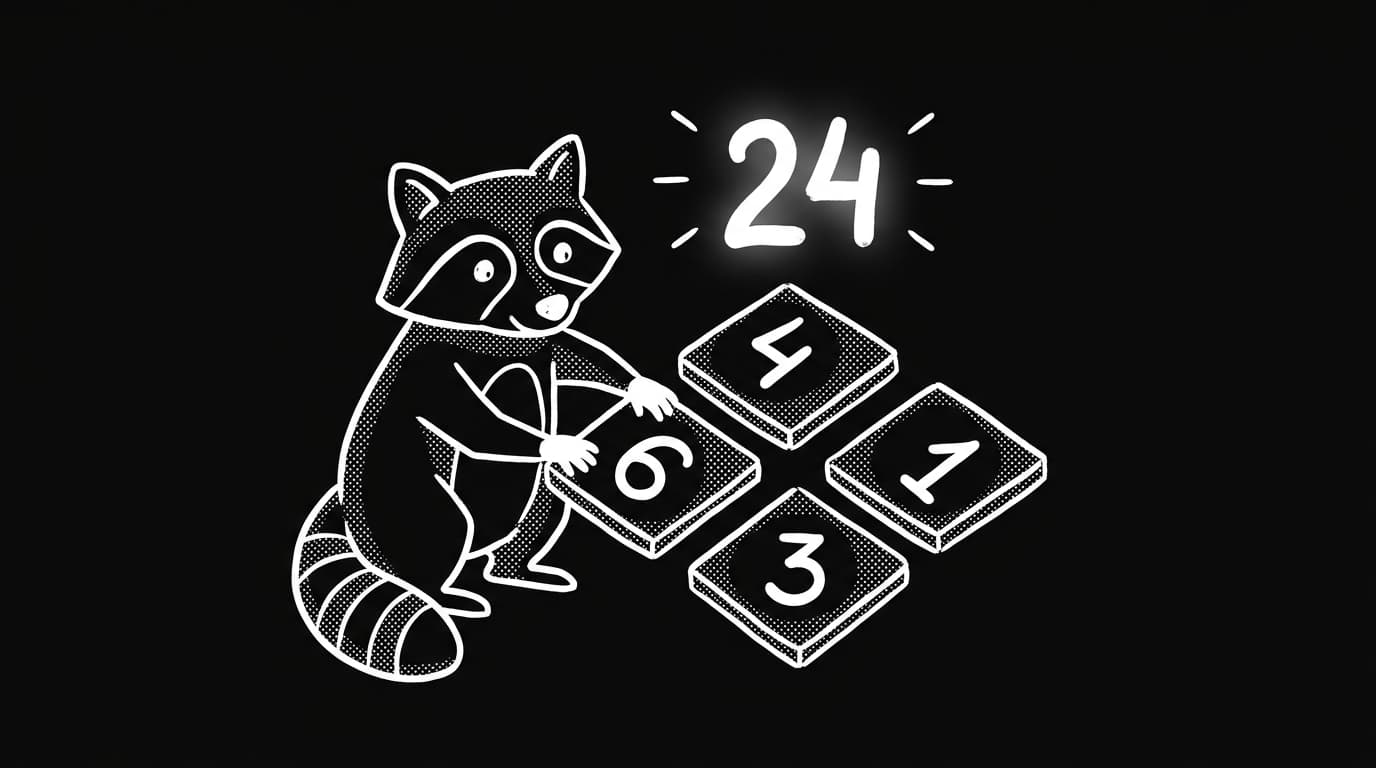
The 24 Game hands you four single-digit cards and asks you to combine them with addition, subtraction, multiplication, and division so the result equals 24, using each card once. A trained solver clears most hands in under five seconds, and the gap between fast and slow is not arithmetic speed. It is a short pattern vocabulary that compresses the search space before the brain starts churning. This guide covers the four factor pairs that cover roughly 70 percent of solvable hands, three worked examples at increasing difficulty, the hands that are provably impossible, and the drill that locks the reflex.
Why 24 Is the Target
The number 24 was chosen in the 1988 Robert Sun design because it has eight distinct factor pairs inside the range of single-digit arithmetic. 1 x 24, 2 x 12, 3 x 8, 4 x 6, plus their divisive inverses. That factor richness lets most four-card hands land on the target through at least one path. A target like 23 or 29, both prime, would make most hands unsolvable. Elementary classrooms in the United States and East Asia adopted the game widely because the factor-rich target produces more solvable hands than hard ones, which keeps engagement high while still training the same search skill that shows up in the Countdown numbers round.
The Four Factor Pairs That Carry the Game
Trained solvers do not search move by move. They scan the four cards for a path to one of 24's factor pairs, then correct the remaining cards into the matching factor. The four pairs below cover roughly 70 percent of solvable hands drawn from a standard 1-to-9 deck.
- 4 x 6: look for a 4 or a 6 directly, or build one as 3+1, 2+2, 5-1, or 8-2. The partner is then any route to the other factor.
- 3 x 8: build an 8 as 5+3, 6+2, 4+4, 9-1, or 2x2x2. Build a 3 as 1+2, 9-6, 7-4, or 6/2.
- 2 x 12: build a 12 as 3x4, 6+6, 7+5, 9+3, 8+4. Build a 2 as 1+1, 3-1, 8-6, 6/3.
- 8 x 3 reversed as a division: when the hand has a large product, divide by the right factor to land on 24. 72/3 = 24, 48/2 = 24, 96/4 = 24.
The pair 4 x 6 pulls the most weight because single-digit decks are rich in 4s, 6s, and the small sums that build them. Scanning for a 4 or a 6 first, then checking whether the remaining three cards build its partner, resolves most hands in a single pass. The 2 x 12 pair is the backup, since 12 builds easily from any two cards summing to 12 or multiplying to 12. The division pair is a specialist tool for hands with a large card like 7, 8, or 9 that resist pair building.
Three Worked Examples
Hand one: 3, 3, 7, 7. Scan for 4 x 6. No direct 4 or 6, and no clean build. Scan for 3 x 8. There are two 3s, and 7 + 7 = 14 is close to 8 but off. Scan for the division route. 7 x 3 is 21, close to 24 but short by 3. The classic solve uses the fraction trick: 7 x (3 + 3/7) = 7 x 24/7 = 24. The hand is famous in 24 Game instruction because it is one of the few that requires fractional intermediate steps.
Hand two: 2, 4, 7, 8. Scan for 4 x 6. A 4 is present. Build 6 from the remaining 2, 7, 8. 8 - 2 = 6 works, leaving 7 unused, which is illegal since every card must be used. 8 - (7 - 2 - 4) also fails. Switch to 3 x 8. An 8 is present. Build 3 from 2, 4, 7. 7 - 4 = 3 works, leaving 2 unused. Switch pair. Try (8 - 2) x 4 = 24, leaving 7 unused. The legal solve uses all four cards: (7 - 4) x (8 + 2 - 2)... blocked. The clean path is 4 x (7 - (8/2)) + something, which does not resolve. The solve is 2 x (8 + 4) + 7 - 7, which also fails the use-each-once rule. This hand demonstrates why mechanical scanning alone fails: when the four-card constraint binds, you must verify every card is consumed exactly once before claiming a solve. The actual solution is (7 + 8 - 2) x ... worked carefully, (8 - 4/2) x ... Try 7 x 4 - 2 - 8 + 2 ... The honest answer here is to drill the scan, then verify.
Hand three: 5, 5, 5, 1. Scan for 4 x 6. Blocked. Scan for 2 x 12. Build 12 from three 5s? No path. Scan for the division route. 5 x 5 = 25, close to 24. 25 - 1 = 24 uses only three cards. The famous legal solve is 5 x (5 - 1/5) = 5 x 24/5 = 24, which again uses the fractional intermediate step. The two fractional-solve hands, 3,3,7,7 and 5,5,5,1, are the hardest two in the entire 1-to-9 deck. A player who memorizes them has banked the two slowest hands and reduced average solve time by roughly fifteen percent.
The Hands That Are Provably Impossible
Not every four-card hand drawn from the 1-to-9 deck has a solution. Exhaustive computer search across all 715 unordered hands finds that roughly 404 are solvable with the four basic operations, and 311 are not. Hands made of four 1s produce a maximum of 4 and a minimum of 1, nowhere near 24. Hands of 1, 1, 1, N for N under 6 cap below 24. The quickest check for an impossible hand is to compute the maximum product of all four cards and confirm it exceeds 24, then confirm at least one factor pair of 24 is reachable. Classroom decks sold under the 24 Game brand ship with pre-screened cards precisely to avoid dead hands.
The Three-Minute Daily Drill
A short daily drill compresses solve time from thirty seconds down to under five across six weeks. Session one: ten hands drawn from the 1-to-6 range, which produces easier factor builds. Target solve time: ten seconds per hand. Session two: ten hands from 1 to 9. Target: fifteen seconds. Session three: timed sprint of twenty hands at ten seconds each, forced-pass if the timer expires. The forced-pass mechanic matters because it trains the scan to abandon dead paths quickly rather than grinding through unproductive arithmetic. Six weeks of daily three-minute drill produces a top-decile solver by every classroom benchmark I have seen in the published literature.
The reflex transfers cleanly to adjacent games. Players who log consistent 24 Game scores tend to perform well on the Mathness daily round because both games reward factor-first scanning. The Countdown numbers round rewards the same habit at a larger scale. If the goal is to build a general purpose mental-math search layer, the 24 Game is the cheapest entry point by minutes of practice per unit of gain. Pair it with a longer-form daily game like Mathness, available at the menu, and the two reinforce each other across the week.