Endgame Mathness: Closing the Target With Two Tiles Left
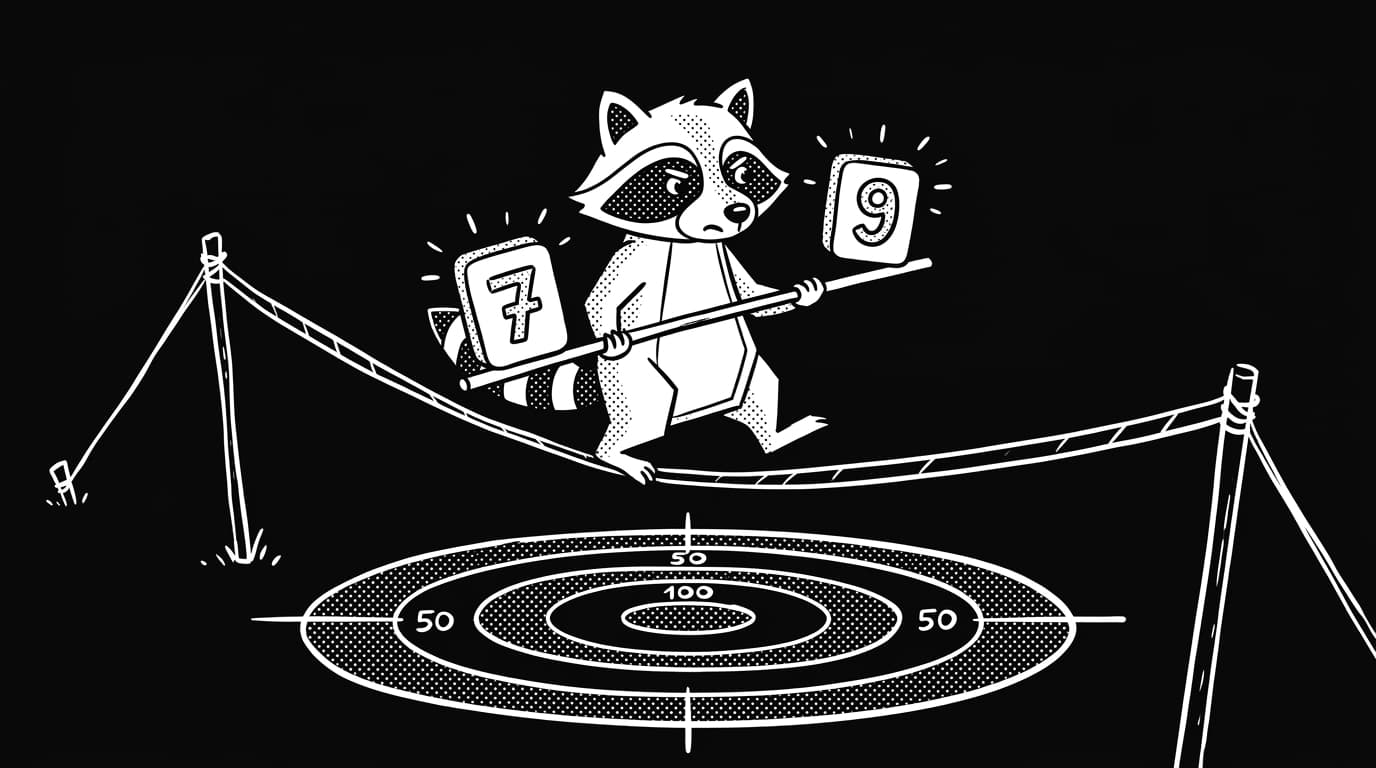
Most Mathness rounds are won or lost on the final two tiles. The first three operations set up a working number close to the target, but the last move is where the round closes or where it collapses. Endgame play has its own rules: tile size matters more than operation flexibility, and the gap between your working number and the target dictates the operator before you pick the tile. Lock the endgame and round times drop by two to four seconds.
Why the last two tiles decide the round
Mathness scoring rewards exact hits over near misses, and a near miss with two tiles left forces a salvage play that burns the clock. A round at twelve seconds in with two tiles remaining has roughly four to six seconds of decision budget. That budget collapses if you start computing options instead of reading the gap. The gap between your current working number and the target is the single most important value at this stage. Read the gap first, pick the operator that closes it, then pick the tile.
The other reason the endgame matters: most leaderboard players hit the same first three moves on a given board. The differentiation happens in the last two tiles. A clean endgame on a round everyone else stalls on adds twenty to forty leaderboard points per session. See Clock Management in Mathness for how the round budget allocates seconds to each window. The endgame window is the narrowest, around four seconds, and it carries the most weight.
The four endgame shapes
Every two-tile endgame falls into one of four shapes based on how far your working number sits from the target and what tiles remain. The shapes are: small gap with small tiles, small gap with large tiles, large gap with small tiles, large gap with large tiles. Each shape has a default operator and a backup. Memorize the defaults so the first second of the endgame is decision-free.
- Small gap, small tiles: addition or subtraction. The operator equals the sign of the gap.
- Small gap, large tiles: division if the target is a clean multiple, otherwise a salvage and skip read.
- Large gap, small tiles: multiplication on the gap-direction tile.
- Large gap, large tiles: subtraction if working exceeds target, addition if working sits below.
A small gap is roughly anything under fifteen. A large gap is anything above. The line shifts with the remaining tiles, but fifteen is the practical cutoff for instant pattern reads. If the gap sits between twelve and eighteen, treat it as small when one tile is under ten, large when both tiles are ten or above. See Anchor Numbers in Mathness for which round multiples create clean small-gap endings.
Operation choice when both tiles are large
Two tiles in the twenty to ninety-nine range are the hardest endgame shape because multiplication blows past most targets and division rarely lands exact. The default move is subtraction when your working number exceeds the target, addition when it sits below. Test multiplication only if the gap equals the product of the two tiles, which is rare but worth a half-second check. Division works when one tile divides the other cleanly and the quotient closes the gap.
A common trap: forcing a multiplication because the tiles look like they should multiply. If 23 and 47 remain and the gap is 18, neither product nor quotient lands. Subtract the smaller tile, then accept that the round closes with a near miss or a skip. See When to Skip a Mathness Round for the salvage thresholds. A six-point near miss beats a fourteen-second multiplication that still misses.
Operation choice when one tile is small
A small tile in the one to nine range paired with a large tile is the friendliest endgame because the small tile acts as a fine-tuner. Use the large tile first if the gap is over twenty, then close with the small tile. If the gap is under ten, lead with the small tile and use the large tile only as a multiplier on the small tile against the working number. The small tile inside a multiplication can shift the working number by a factor of two through nine, which covers most large-gap closes.
The trap on small-plus-large boards is using the small tile too early. Two and three are the most misplayed tiles in Mathness because players burn them on the first move and lose the fine-tune option. Hold one-digit tiles for the endgame whenever the round has a path that does not need them upstream. The exception is a small tile that lands the gap on a clean anchor like 100 or 50 with one move.
The recovery move when the gap is wrong
Sometimes the third move leaves a gap that no two-tile combination closes. The recovery move is to find the closest reachable number and accept the partial score. Mathness awards points for proximity within a defined band, and a four-point recovery beats a zero-point skip on rounds where the next round is harder. Compute the maximum reachable number from the sum of remaining tiles and the minimum reachable from the difference, then pick the operator that lands inside the partial-credit band.
The recovery move also tells you when to skip outright. If neither the max nor min reachable falls inside the partial band, skip immediately and bank the clock for the next round. See Operation Order in Mathness for how to avoid getting into recovery shape in the first place. A round that hits recovery shape twice in a row is a sign the first-move habit needs work.
The seven-day endgame drill
Lock the endgame with a focused seven-day drill on /daily mode. Day one through three: play only the last two tiles of recorded rounds, reading the gap aloud before picking the operator. Day four and five: add a three-second cap on the endgame window. Day six and seven: play full rounds with the endgame cap in place. The cap forces the pattern read to become reflexive.
- Day 1-3: gap-read drill, no time cap.
- Day 4-5: three-second endgame cap.
- Day 6-7: full rounds with the cap.
- Track endgame close rate, target 80% by day seven.
Most players who run this drill see their average round time drop by three to four seconds within ten days. The leaderboard climb that follows shows up faster on ranked sessions than on daily mode because ranked compresses the time pressure. Pair the endgame drill with a clean opener and the round-time floor drops below eight seconds on standard boards. Run a check on round 100 of the drill to confirm the gap-read stays sub-second.