Mental Math for Nurses: Dosage Calculations Without a Calculator
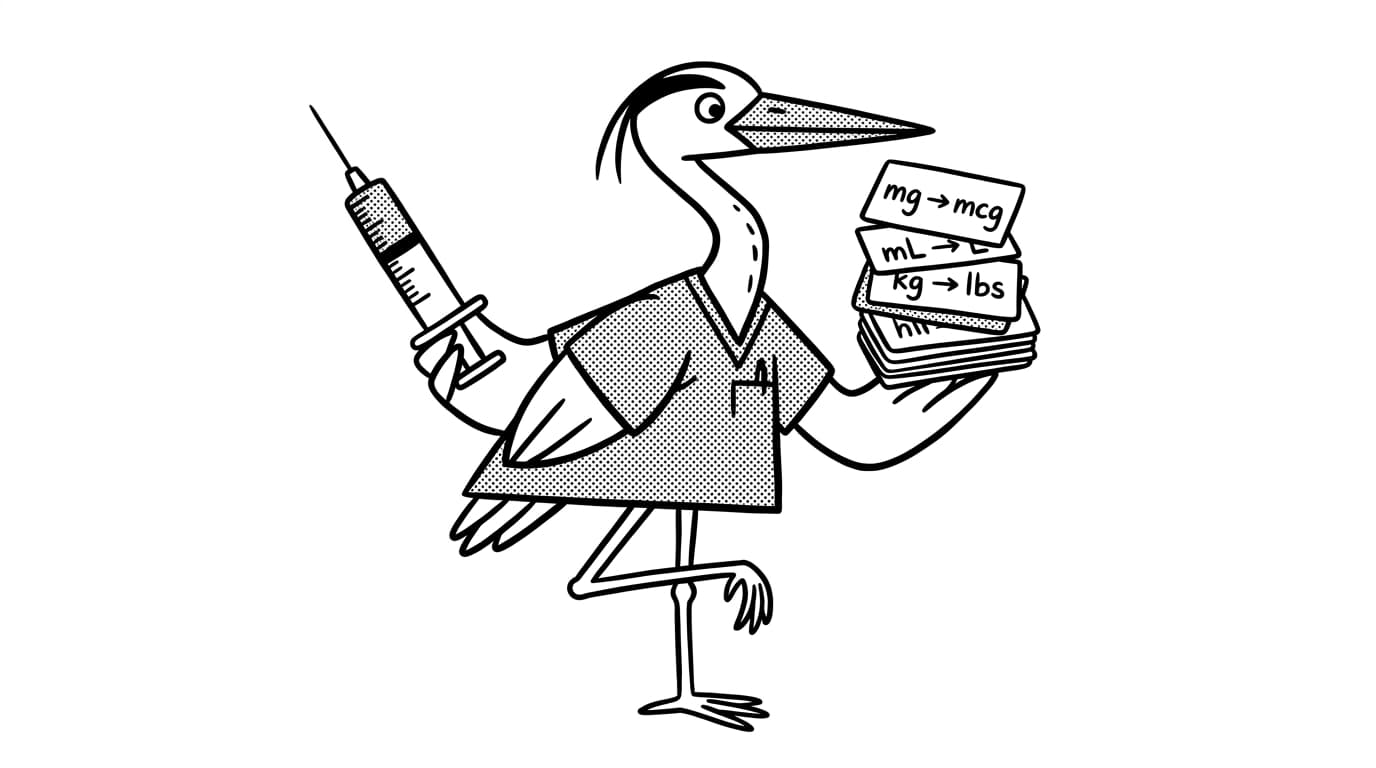
A nurse at the medication cart has about twelve seconds to confirm a dose before the patient is waiting too long and the next task is waiting too hard. Calculator apps add roughly eight seconds per use and introduce a transcription error on about one in forty entries. Three ratios, four drug-concentration anchors, and one last-digit safety check cover the vast majority of real floor math and keep every answer reproducible in the head.
The Three Ratios Behind Every Dose
Almost every nursing calculation reduces to one of three ratios: desired over have, dose over weight, or volume over time. Desired over have takes the ordered dose, divides by the vial concentration, and multiplies by the vial volume. Dose over weight takes a milligram-per-kilogram order, multiplies by patient weight in kilograms, and lands the total daily or per-dose amount. Volume over time takes an infusion volume, divides by hours, and returns milliliters per hour for the pump. Memorizing which ratio belongs to which order type cuts the computation to a single division and a single multiplication, with no formula lookup.
The desired-over-have ratio handles tablet counts, injectable volumes, and liquid oral doses. If the order reads 500 mg and the vial reads 250 mg in 2 mL, the math is 500 divided by 250, which equals 2, times 2 mL, which equals 4 mL. The dose-over-weight ratio handles pediatric antibiotics, heparin, and most ICU drips. If the order reads 15 mg per kilogram on a 72 kg patient, double the weight to 144, drop one tenth to 14.4, and the dose lands at 1,080 mg without touching a keypad. These are the same arithmetic primitives trained in left-to-right arithmetic, applied to clinical constants.
Drip-Rate Shortcuts That Beat the Pump Screen
Gravity drips use drops per minute, calculated from total volume, drop factor, and infusion time. The formula is volume in mL times drop factor divided by time in minutes. The shortcut: for a 15 drops-per-mL set, drops per minute equals mL per hour divided by 4. For a 10 drops-per-mL set, divide by 6. For a 20 drops-per-mL set, divide by 3. These three divisions replace a four-variable formula and land every answer in under two seconds.
Pump-infusion rates arrive as mL per hour. For a 1,000 mL bag over 8 hours, divide 1,000 by 8 to get 125 mL per hour. For 500 mL over 4 hours, same answer. Note the identity: halving both the volume and the time keeps the rate constant, which is a direct application of doubling-and-halving covered in doubling and halving. When an order reads over 20 minutes, convert to the hour by multiplying by 3. A 50 mL dose over 20 minutes runs at 150 mL per hour on the pump.
- 15 gtt/mL set: mL/hr divided by 4 = gtt/min
- 10 gtt/mL set: mL/hr divided by 6 = gtt/min
- 20 gtt/mL set: mL/hr divided by 3 = gtt/min
- 60 gtt/mL microdrip: gtt/min equals mL/hr exactly
- Over 20 min: multiply volume by 3 for the hourly pump rate
- Over 30 min: double the volume for the hourly pump rate
Four Concentration Anchors Worth Memorizing
Four drug concentrations show up often enough that memorizing them saves real floor time. Heparin bolus is commonly 1,000 units per mL, so a 5,000 unit order equals 5 mL and a 2,500 unit order equals 2.5 mL. Insulin in standard vials is 100 units per mL, so 10 units equals 0.1 mL. Lidocaine 1 percent is 10 mg per mL, meaning a 50 mg dose is 5 mL and a 100 mg dose is 10 mL. Epinephrine 1:1,000 is 1 mg per mL, and epinephrine 1:10,000 is 0.1 mg per mL, which is the single most error-prone pair in acute care and should be verified twice before every push.
Anchors convert multiplication into recognition. Reading 1,000 units of heparin as 1 mL is a one-second reflex, the same way a Mathness player sees 25 and reaches for the halve-and-shift. The clinical twist is that the same drug comes in different concentrations by setting: ED stocks a different lidocaine than the OR. Confirming concentration before computing is the step that prevents an anchor-based miscalculation.
Pediatric Weight Scaling
Pediatric doses almost always use mg per kilogram, which makes the weight the main variable. For a child of 18 kg on 10 mg/kg, the answer is 180 mg. For 24 kg on 15 mg/kg, double 24 to 48, add half of 48 (which is 24) to reach 72, then shift one decimal to land 360 mg. This is round-and-correct applied to drug math and runs in under three seconds without paper. The safety ceiling to memorize is the adult max for every common pediatric drug, since a weight-based calculation on a 50 kg adolescent can quietly exceed the adult cap.
Body surface area dosing for chemo and some pediatric drugs follows mg per square meter. The Mosteller shortcut for BSA is the square root of height in cm times weight in kg divided by 3,600. Mental square roots within 0.05 are covered in the square root method. For most ward settings, bedside charts or EMR values are available; the mental version is a backup when the chart is slow and the dose is time-critical.
The One-Second Safety Check That Catches Tenfold Errors
The single most dangerous arithmetic error in nursing is the decimal-place slip, which turns 0.25 mg into 2.5 mg or 1.5 mL into 15 mL. The last-digit check catches the second kind, since 15 mL as a push dose feels wrong before the plunger moves. The order-of-magnitude check catches the first kind: for every answer, state the expected range aloud before the computed answer. If the ordered opioid is 1 to 4 mg and the math returns 25 mg, the ratio is reversed somewhere.
The same last-digit verification used in one-second answer checks applies to dose math. Multiply the two factors modulo 10 in your head, compare to the final digit of the answer, and reject on mismatch. For 72 kg times 15 mg per kg, the last-digit product is 2 times 5, which is 10, meaning the answer ends in 0. The real answer is 1,080, which matches. A quick mod-10 pass costs under one second and catches most multiplication slips before they reach the patient.
How to Drill the Reflex
The fluency comes from frequency, not from understanding. Ten minutes of drill a day for three weeks installs the reflex more reliably than reading five dosage textbooks. Alternate blocks: five minutes of desired-over-have with made-up vials, five minutes of weight-scaling across pediatric and adult ranges, two minutes of drip-rate divisions, three minutes of concentration-anchor flashcards. Daily consistency beats weekly volume by the same two-to-one ratio seen across spaced-practice research. Short targeted sessions on something like a daily number puzzle keep the arithmetic circuits warm between shifts.
After three weeks, the three ratios, the four anchors, and the safety check run below the level of conscious computation. The medication-cart interval drops from twelve seconds to under five, the calculator becomes a backup for the odd case rather than the default for every dose, and the one error-type that still causes most harm, the decimal-place slip, has a mandatory check in front of it. Mental math for nurses is not a party trick; it is the difference between a dose that gets questioned at the bedside and one that gets questioned in a chart review.