Mental Math for Poker: Pot Odds, Outs, and Equity in Two Seconds
Poker punishes slow arithmetic. Every call, raise, and fold needs a fraction, a probability, and a comparison inside a few seconds. Live tables give about seven seconds before pressure builds, and online cash games often give three. The math simplifies once you drop percentages for one clean ratio and memorize six numbers. The whole system runs on single-digit multiplication and one compare step.
Pot Odds as a Single Ratio
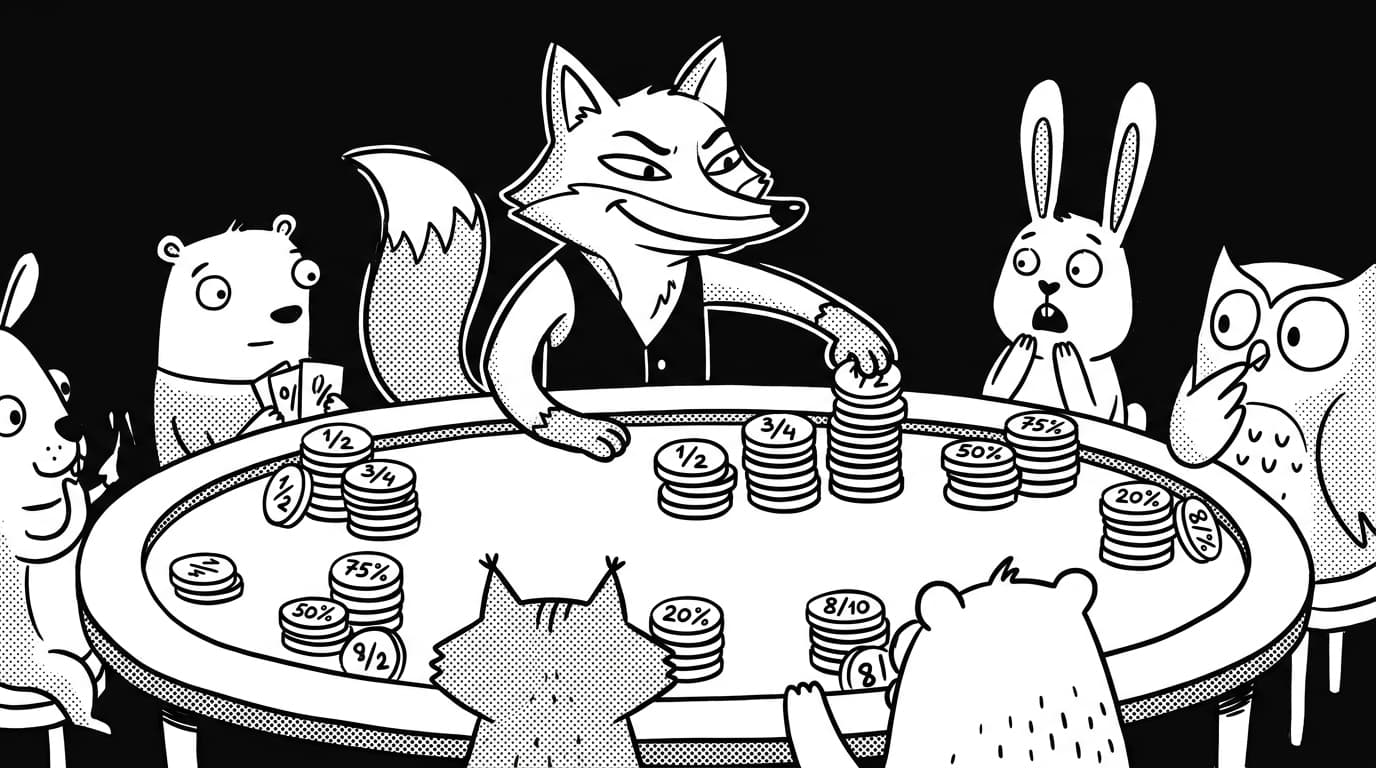
Pot odds are the price the pot offers on a call. The formula is your call amount divided by the final pot after that call. If the pot holds 100 and you face a bet of 25, the final pot is 150 and your call is 25, so you get 25 in 150, or 1 in 6, which reads as 16.7 percent. Convert once, remember the number, stop reconverting mid-hand. The five ratios that cover 90 percent of situations are 1:1 at 50 percent, 1:2 at 33 percent, 1:3 at 25 percent, 1:4 at 20 percent, and 1:5 at 16.7 percent. Two-thirds pot bets sit near 1:2.5 or 28.6 percent, and half-pot bets land at 1:3 or 25 percent.
Overbets and small blocks fall outside the clean anchors. A 1.5x pot overbet forces 37.5 percent equity, and a quarter-pot block bet only asks for 16.7 percent. Left-to-right division from the mental long division guide handles messy sizings without borrowing across digits. Round the call amount up by 5 percent when in doubt, since underestimating the price is the costly direction of error. Fluent players precommit to the five anchors and treat every other sizing as a small offset from the nearest one.
Outs and the Rule of Four and Two
Outs are the cards that improve your hand to a likely winner. A flush draw has nine outs. An open-ended straight draw has eight. A gutshot has four. Two overcards give six raw outs, discounted to four when the opponent's range is strong. The rule of four and two multiplies outs by 4 on the flop for a two-street percentage, and by 2 on the turn for one street. Nine outs on the flop is 36 percent to the river; the same nine outs on the turn is 18 percent to the river.
The rule undershoots above 12 outs, so subtract one percent for every out above eight when using the flop multiplier. A combo draw with 15 outs looks like 60 percent by the raw multiplier, but real equity sits near 54 percent. The multiplication stays single-digit, which drills fast; the same left-to-right instinct trained in two-digit multiplication practice transfers directly to counting outs under pressure. Dead outs, cards that complete your hand and also complete someone else's, reduce the count by one or two. Recount before committing chips, since one missed out is a full 4 percent equity swing on the flop.
Compare and Go
The full decision reduces to one comparison: is your equity higher than the price? Equity is your win percentage, and price is the pot-odds percentage. A nine-out flush draw on the flop holds 36 percent equity, and a half-pot bet costs 25 percent; call. The same draw on the turn drops to 18 percent, and the same half-pot bet still costs 25 percent; fold, unless implied odds shift the number. Line the two figures in a mental ladder, top to bottom, and act. Percentages follow the same anchor method detailed in the three-second percentage guide.
Implied and Reverse Implied Odds Without a Spreadsheet
Implied odds add expected future winnings to the pot when the draw hits. Working rule: if the opponent's remaining stack is at least three times the current pot and they will pay off a strong second-best hand, add half their remaining stack to the pot before dividing for pot odds. Reverse implied odds discount equity when hitting still sometimes loses the pot. A weak flush draw against an aggressive turn barrel loses one to two percent equity to board-pair redraws. A dominated straight draw, an open-ender on a paired board, loses three to five percent to full-house risk. Adjust once at the start of the street, and do not iterate mid-hand.
A Two-Week Table Drill
Table fluency needs off-table repetition. Fifteen minutes a day for two weeks moves most players from calculator dependence to two-second decisions. Use a shuffled deck, a phone timer, and a printed reference card of the five anchor bet sizes. Track hit rate first and speed second during week one, then flip the priorities during week two. Short warm-up sets on /daily or /menu keep number bonds and single-digit multiplication sharp between poker sessions.
- Days 1 to 3: Deal random flops. Count outs in five seconds. Target 90 percent accuracy before adding any bet sizing.
- Days 4 to 6: Add a bet size on each flop. Convert to pot-odds percentage in five seconds. Anchor to the nearest of the five ratios.
- Days 7 to 10: Compare equity to price. State call or fold in seven seconds. Log each decision and check with an equity tool afterward.
- Days 11 to 14: Add a turn decision after each flop. Full budget: ten seconds per full street. Miss rate under 10 percent means you graduate.
Where the Table Math Breaks
Compare-and-go ignores position, opponent ranges, and stack depth. Against a range that includes bluffs, your equity rises because marginal made hands gain showdown value against air. Deep stacks above 200 big blinds inflate implied odds and buy back three to five percent equity on speculative calls with strong redraw shape. Short stacks under 30 big blinds crush implied odds toward zero; treat pot odds as the full answer. Multi-way pots split future value, so subtract five percent equity for every extra caller past heads-up. When ranges are unknown, default to raw equity and treat implied odds as noise until a read forms in the second orbit.