Fastest Way to Do Long Division in Your Head
Long division on paper takes a full sheet and a steady pencil. In your head, that same algorithm collapses after two digits because the working-memory cost blows past what most people can hold. The fix is not faster arithmetic. The fix is a different algorithm that keeps fewer items live at once, plus three small shortcuts that skip work before it starts.
Why school long division fails without paper
The schoolbook method asks you to hold the running dividend, the current quotient digit, the product of divisor and that digit, the subtraction result, and the next digit to bring down. That is five active slots. Adult working memory averages four slots for numbers under stress. The algorithm was designed to be written, and its cognitive load only makes sense on paper. Mental division needs a version that keeps two or three items live at any moment, not five.
Chunk the dividend into friendly pieces
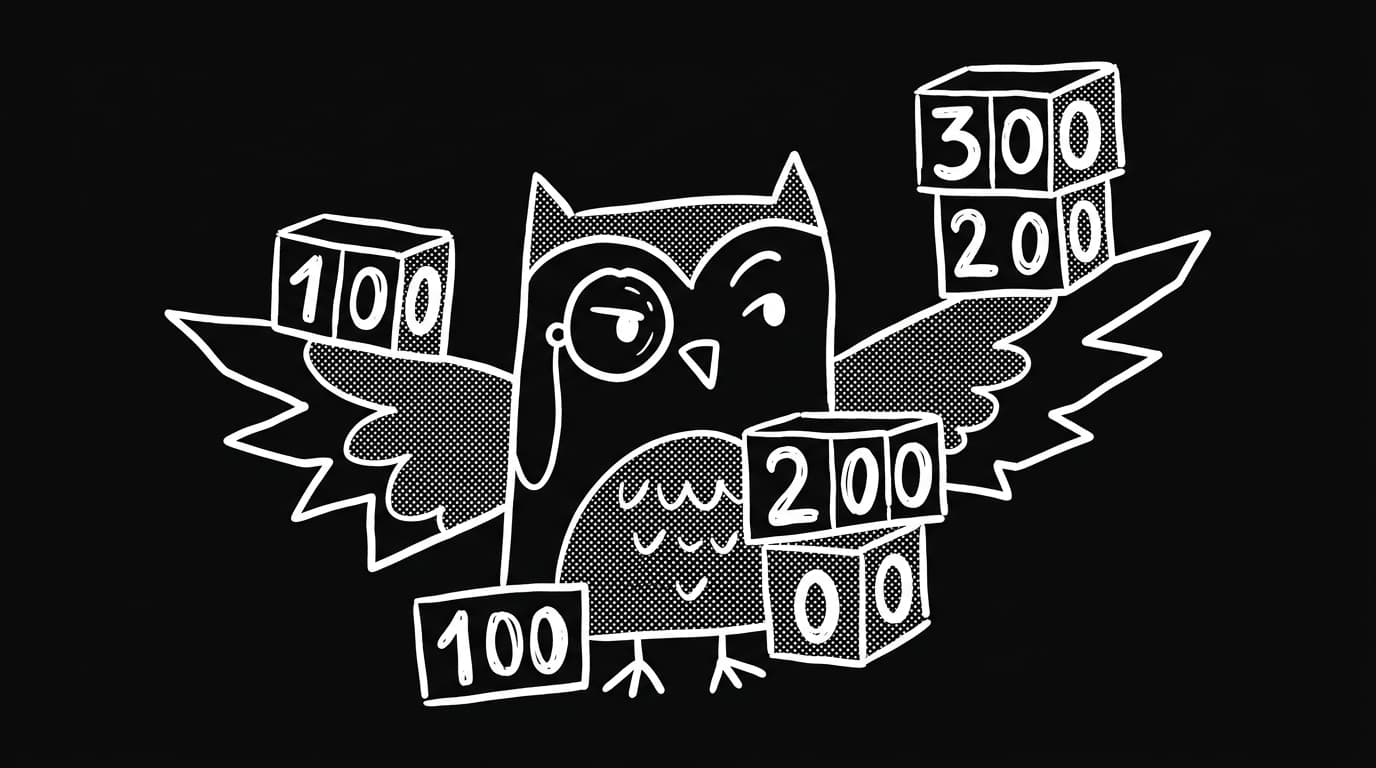
The chunking method splits the dividend into parts that the divisor eats cleanly, then adds the partial quotients. To divide 348 by 6, split 348 into 300 and 48. 300 divided by 6 is 50. 48 divided by 6 is 8. Answer 58. The method scales up. 1,764 divided by 7 splits into 1,400 and 364. 1,400 divided by 7 is 200. 364 divided by 7 is 52. Answer 252. The trick is choosing a first chunk that ends in a clean zero and lands on a multiple of the divisor you already know.
Chunking works because it converts one hard division into two easy ones and a sum. The mental register carries the running total and the remaining dividend, nothing else. For any dividend under 10,000 divided by a single-digit number, chunking finishes in three seconds once the reflex sets in. Practice by taking three-digit totals off a grocery receipt and splitting them at the nearest hundred.
The partial-quotient method for ugly divisors
When the divisor is a two-digit number, chunking gets harder because clean multiples are less obvious. The partial-quotient method fixes that by overshooting on purpose. To divide 892 by 23, estimate that 23 times 30 is 690. Subtract 690 from 892 to get 202. Estimate that 23 times 8 is 184. Subtract 184 from 202 to get 18. The quotient is 30 plus 8, which is 38, remainder 18. Every step uses a multiplication you already know and a subtraction under 200.
The overshoot rule keeps the method honest. If a partial product lands above the running dividend, drop the multiplier by one and try again. The method never asks for the exact quotient digit on the first try, which removes the choking point that breaks the schoolbook algorithm in your head. Speed comes from picking round multipliers like 10, 20, 50, and 100 that anchor each estimate. Pair this with fast two-digit multiplication and every partial-quotient step lands in under two seconds.
Six divisibility shortcuts that skip work
- Divisible by 2 when the last digit is even.
- Divisible by 3 when the digit sum is a multiple of 3.
- Divisible by 4 when the last two digits form a multiple of 4.
- Divisible by 5 when the last digit is 0 or 5.
- Divisible by 9 when the digit sum is a multiple of 9.
- Divisible by 11 when the alternating digit sum is 0 or a multiple of 11.
These tests take under a second each and often collapse a hard problem into a trivial one. To divide 2,376 by 8, first check that 376 is a multiple of 8 (it is: 8 times 47 is 376). Then the answer must end in 47 and start with 2,000 divided by 8, which is 250. Total 297. A divisibility check before you compute rules out wrong methods and points at the fast one.
Casting out nines doubles as an error check after the fact. Add the digits of the dividend, the divisor, and the answer. The relationship dividend equals divisor times quotient plus remainder holds under mod 9 as well. If the mod-9 arithmetic disagrees, one of the three numbers is wrong. This one-second sanity check catches most arithmetic slips before they cost a round.
Where mental division pays off
Restaurant checks split four ways use mental division constantly. So do unit-price comparisons at the supermarket, mileage calculations on a road trip, and target-hunting inside puzzle games like Mathness. Reaching a target of 84 with tiles 3, 7, and something else means asking whether 84 divides by 3 (yes, 28) or 7 (yes, 12) before you commit an operation. That is a divisibility check saving three seconds per round. Over a twenty-round session on the daily puzzle, those seconds decide leaderboard rank.
The pattern generalizes. Any target-hunting task rewards a division reflex more than an addition reflex, because division prunes options faster. The same holds when balancing recipe ratios, sizing images to fit a layout, or estimating whether a $47.20 tab plus 18 percent tip lands under $56. Mental division stacks with three-second percentages to cover most of daily arithmetic without paper.
A three-week drill to lock the reflex
Week one, twenty three-digit divisions by single-digit divisors every day, using chunking only. Time each set. Aim for under 90 seconds by day seven. Week two, twenty three-digit divisions by two-digit divisors using the partial-quotient method. Aim for under three minutes total by day fourteen. Week three, mix single- and two-digit divisors with a divisibility check first. Aim for under two and a half minutes total by day twenty-one.
Track only two numbers, total time and error count. Errors above three per set mean the method needs slowing down, not the drill needs more rounds. Once the twenty-second-per-problem mark holds for three sessions in a row, the reflex has set. From there, mental division stops feeling like arithmetic and starts feeling like reading. For target-hunting practice against a live clock, the leaderboard climb supplies infinite reps.