Multiplication Shortcuts for 11, 25, and 99 in Mathness
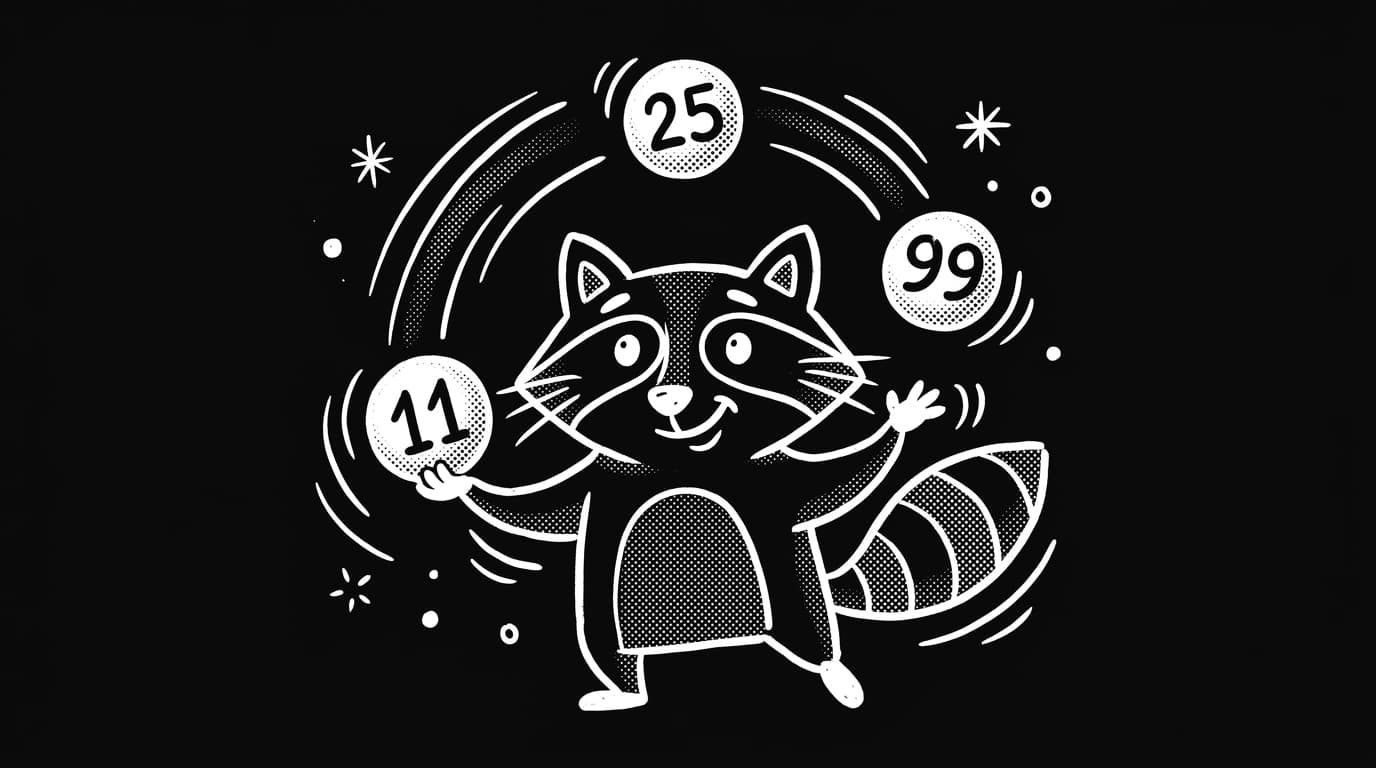
Three multiplier families show up in Mathness rounds far more often than their share of the number line suggests: anything times 11, anything times 25, and anything times 99. Each one has a one-second shortcut that replaces a full multiplication. Learn the three patterns, drill them for seven days, and you cut three to six seconds off every round that features them.
Why These Three Multipliers Earn a Shortcut
Mathness boards draw from a small pool of two-digit numbers because the engine favors clean targets like 132, 250, and 396. That bias surfaces 11, 25, and 99 (and their near-neighbors 22, 50, 100) more often than random sampling would suggest. A round with a 25 in the hand and a target ending in 00 or 50 is almost always solved by a times-25 move. The same is true for 11 when the target reads as a sum of two equal digits, and for 99 when the target sits one short of a clean hundred.
A shortcut earns its place when it replaces a two-step calculation with a one-step lookup. Times 11 turns into a digit slide. Times 25 turns into a divide-by-four with two zeros pinned on. Times 99 turns into a subtract-from-the-hundred-times version. None of these need the full algorithm, and none of them need you to write anything down. See the operation order rules for how these shortcuts fit alongside multiply-first openings.
The Times-11 Shortcut: Split and Add
For any two-digit number ab, multiplying by 11 gives a, a+b, b. So 34 times 11 reads as 3, 7, 4, which is 374. The middle digit is the sum of the outer two. When a+b reaches 10 or more, carry the 1 into the leading digit: 78 times 11 reads as 7, 15, 8, which collapses to 858. That is the whole rule.
The shortcut also works on three-digit numbers, but the carry chain gets long enough that the speed advantage shrinks. Inside Mathness, the two-digit case covers 90 percent of times-11 situations because the engine rarely hands you a three-digit factor and an 11 in the same round. Drill the two-digit form until it fires without thinking. The reflex is the prize.
The Times-25 Shortcut: Quarter the Hundred
25 is one-quarter of 100, so multiplying by 25 is the same as dividing by 4 and shifting two places. 36 times 25 reads as 36 divided by 4 (which is 9) followed by two zeros, giving 900. 48 times 25 reads as 48 divided by 4 (which is 12) followed by two zeros, giving 1200. The shortcut only feels strange for the first five reps; after that it becomes the default.
When the other factor is not divisible by 4, split it. 37 times 25 reads as (36 times 25) plus (1 times 25), which is 900 plus 25, which is 925. The split costs one extra second but still beats long multiplication by a wide margin. The same pattern handles 75 (three-quarters of 100) and 50 (half of 100), so the family scales. The doubling and halving post covers the close cousin of this technique.
The Times-99 Shortcut: Subtract From the Round Hundred
99 sits one short of 100, so any number times 99 equals that number times 100 minus the number itself. 47 times 99 reads as 4700 minus 47, which is 4653. The same logic handles 98 (subtract twice the number) and 999 (multiply by 1000, subtract the number). The shortcut wins because shifting a number two places and then subtracting it is faster than running a full two-by-two multiplication.
Inside Mathness, the times-99 shortcut also pairs with target decomposition. If the target ends in a digit close to the negation of your other factor (47 in hand, target 4653), the 99 path leaps out of the board. Watch for targets that sit in the high four-thousands or low five-thousands when a 99 or 98 sits in the hand. Those rounds are usually solvable in one move. Cross-check with factor-first target decomposition when the target looks engineered.
The Seven-Day Drill That Locks All Three
The drill runs five minutes a day for seven days. Open a notes app and write seven random two-digit numbers on each line. Day one through three: multiply each by 11. Day four and five: multiply each by 25. Day six and seven: multiply each by 99. Time each line and write the seconds next to it. Target under twenty seconds per line of seven by the end of day seven.
- Day 1-3: seven random two-digit numbers times 11, twice through.
- Day 4-5: seven random two-digit numbers times 25, twice through.
- Day 6-7: seven random two-digit numbers times 99, twice through.
- Each session: log the seconds for each line of seven.
- End of week: run one mixed line of 21 numbers across all three multipliers.
On day eight, take the reflex into a daily Mathness round and count the rounds where one of the three shortcuts fired without conscious effort. Three or more out of ten is the threshold for the drill having worked. Below that, repeat week one for one more cycle. Above that, move to the next reflex on your list. Then check your leaderboard position; a one-week climb of five to fifteen places is normal once the times-11 reflex stabilizes.
Common Mistakes With These Shortcuts
The most common times-11 mistake is forgetting to carry when a+b reaches 10 or more. 67 times 11 is 737, not 6137. The fix is to pause for half a second whenever the digit sum is six or higher. The most common times-25 mistake is shifting one place instead of two; 12 times 25 is 300, not 30. The fix is to mouth the words 'two zeros' as you finish the division. The most common times-99 mistake is forgetting to subtract; 47 times 99 is 4653, not 4700.
Each mistake has a fix that costs less than a second once you know to look for it. The drill above surfaces all three within the first three days, so you catch them while the stakes are zero. By the time you take the reflex into ranked rounds, the error rate sits below five percent. That is the difference between a shortcut that helps your score and a shortcut that costs you points when it misfires under time pressure. Start the rotation from the main menu once the drill is running.