Number Bonds in Mathness: Pairs to 10, 100, and 1,000

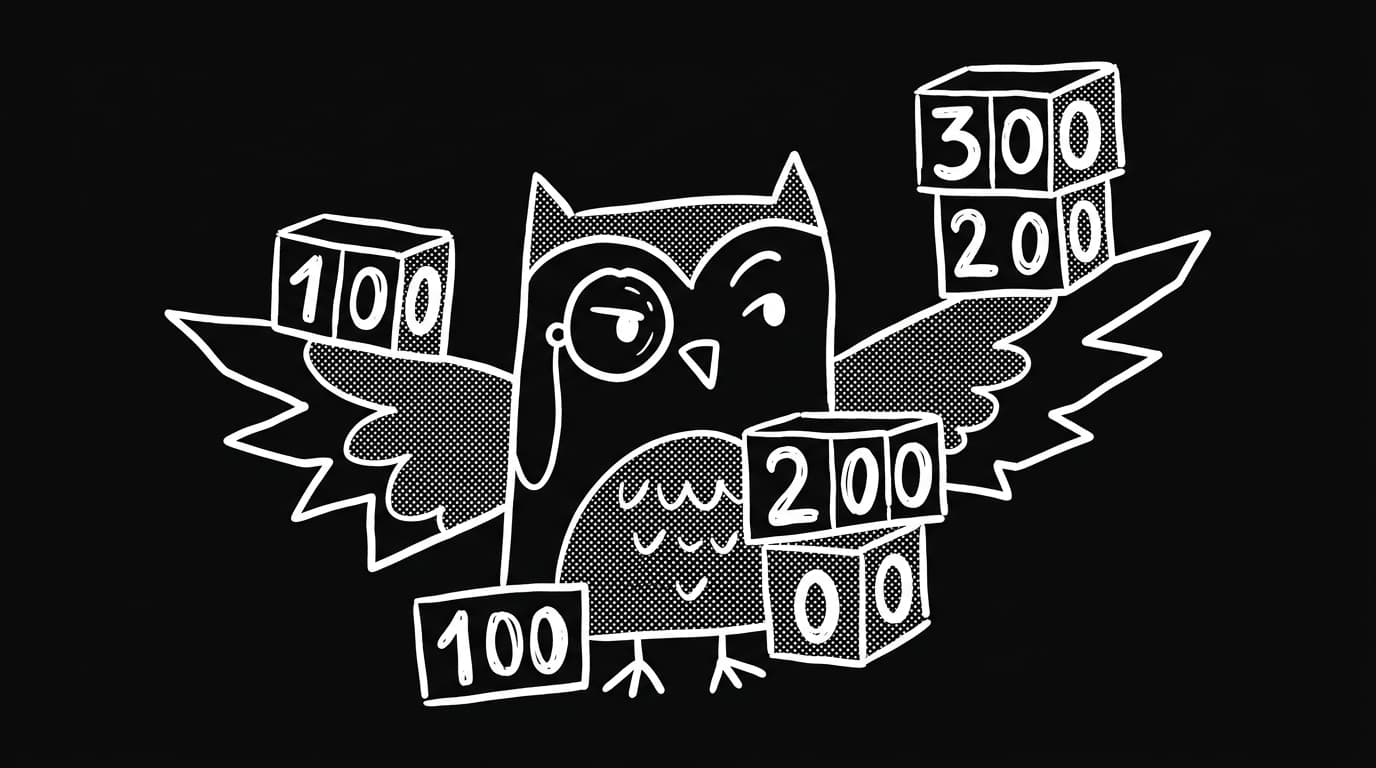
Number bonds are the addition reflexes that let you finish a Mathness round before clock pressure starts. Pairs that sum to 10, 100, and 1,000 cover most of the additive moves you will see on /daily and /menu boards. Drilling them turns five-second additions into half-second ones, which compounds across every round you play. The four bond families below are the ones that pay back fastest.
Pairs to 10: The Foundation
Pairs to 10 are the nine combinations a Mathness player should recognise without thinking: 1+9, 2+8, 3+7, 4+6, 5+5, and the reverses. Every two-digit addition on a board decomposes into bonds to 10 once you split the ones column from the tens. A round that asks for 47 + 36 becomes 7 + 6 = 13, carry the 1, then 4 + 3 + 1 = 8, which lands at eighty-three in under a second. Players who freeze on the carry are the ones who never drilled the bonds in isolation. Fixing that is a ninety-second drill: list the nine pairs, cover the right column, name the partner for each number twice through.
The same bonds power subtraction. When a board on /daily gives you 13 and you need 6, you ask which number pairs with 6 to make 13, not what thirteen minus six equals. The bond mental model halves the cognitive cost because addition uses fewer working-memory slots than subtraction for most players. Switching subtraction questions into bond questions is the single biggest accuracy gain a beginner can make in week one.
Pairs to 100: The Middle Lever
Pairs to 100 decide whether a two-step Mathness round closes in three seconds or eleven. The full set is forty-nine pairs: 1+99, 2+98, up through 49+51, plus 50+50. Memorising the first twenty pairs covers around 80 percent of the bonds that appear on standard boards, because targets cluster between 50 and 150. When a target reads 100 and you have a 37 on the board, you should see 63 as the partner instantly, not compute it as 100 minus 37.
A simple shortcut covers the rest: for any number n below 100, the partner has tens-digit (9 minus n's tens digit) and ones-digit (10 minus n's ones digit), with one caveat. If the ones digit is 0, the partner ends in 0 and the tens digits sum to 10. The caveat is why drilling the boundary cases, numbers ending in 0 or 5, matters more than the middle cases. Five minutes a day for a week locks the full set.
Pairs to 1,000: The Endgame Bond
Three-digit targets show up on harder Mathness boards and on late ranked rounds. Pairs to 1,000 use the same shortcut as pairs to 100, scaled up: the hundreds digits sum to 9, the tens digits sum to 9, the ones digits sum to 10. So 1,000 minus 347 is read as 6, 5, 3, which is 653, with no borrowing. A player who borrows three times on every three-digit subtraction loses around two seconds per round, which over a fifty-round session on /leaderboard is more than a minute of pure clock waste.
The drill that locks pairs to 1,000 is structurally the same as pairs to 100. Write twenty random three-digit numbers, name each partner aloud, time the set. A reasonable target is twenty partners in thirty seconds by the end of week two. Players who hit that pace stop hesitating on three-digit boards and start treating them as two-digit boards with one extra column.
Pairs to 50 and 25: The Hidden Bonds
Two less-known bond sets do heavy work on Mathness boards: pairs to 50 and pairs to 25. Pairs to 50 show up when the target is a round multiple and you are halfway there from one tile. Pairs to 25 show up around quarter-target plays and on boards that involve multiplication by 4. Knowing that 18 pairs with 7 to make 25, or that 31 pairs with 19 to make 50, gives you a second move without computing.
These bonds get drilled with the same flashcard method but with a smaller deck. Pairs to 50 has twenty-five pairs, pairs to 25 has twelve. A combined deck of thirty-seven cards covers both sets, and a daily two-minute pass through it holds the reflex once it is built. The anchor numbers post explains why 25 and 50 keep appearing as intermediate values on boards that look unrelated to them.
The Two-Week Bond Drill
A structured plan beats random practice for bonds because the reflex you want is recall under time pressure, not conceptual understanding. The plan below covers the four bond families in fourteen days and uses around eight minutes a day. The minute counts are minimums; players who can hold focus longer should extend each day by another three minutes rather than skip days.
Days one through three cover pairs to 10 only, two minutes a day. Days four through seven add pairs to 100, three minutes per session. Days eight through eleven add pairs to 1,000, three minutes. Days twelve through fourteen add pairs to 50 and 25, two minutes. By day fifteen the full set lives in recall, and the daily refresh drops to three minutes total.
- Two-digit additions finish before you finish reading the tiles.
- Three-digit subtractions happen without borrowing.
- You stop translating subtraction questions into a separate operation.
- Round times on standard boards drop by two to four seconds.
- You name the closing bond out loud after a win without thinking about it.
Common Mistakes That Slow the Bond Reflex
The first mistake is drilling bonds with written numbers. Writing forces a slower pace than recall, so players who practise by writing pairs build a slower reflex than players who say partners aloud. The cure is to drill verbally with a flashcard app or a partner.
The second mistake is drilling all four bond families on the same day from day one. Mixed practice without a base layer leaves every set partially learned, and a partially learned bond fails under time pressure. The fix is the staged plan above: lock one set before adding the next.
The third mistake is treating bonds as separate from Mathness rounds. Every round on /menu is a chance to drill bonds in context. After a round, name which bond closed it. Naming the bond reinforces recall faster than another flashcard pass, because the recall happens with the same emotional load as live play.