The 24 Game: Every Solution to the Hardest Hands
Most 24 Game hands crack in under five seconds with a factor of 24 sitting inside the four cards. The hardest hands hide the answer behind a fraction, and players who never learned to divide by non-integers get stuck for minutes on hands that a fraction-comfortable solver clears in two moves. This post lists every canonical hardest hand in the 24 Game, walks the fraction trick that solves each one, and shows every valid path so you can recognize the shape at the table.
Why Some 24 Game Hands Feel Impossible
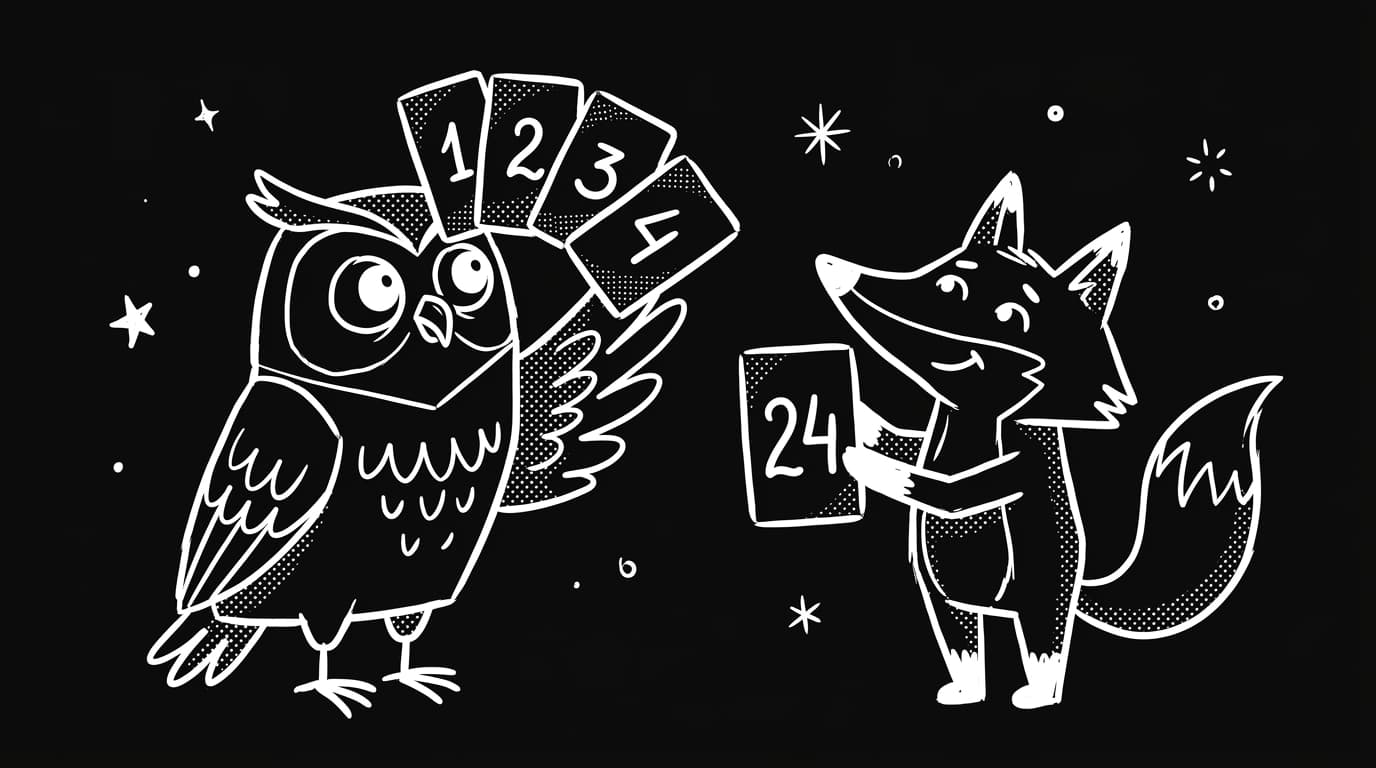
The 24 Game deals four cards from a standard 1 to 13 deck and asks you to hit 24 using each card exactly once with plus, minus, times, and divide. Out of the 1,362 distinct four-card hands, 1,197 have at least one integer-only solution, meaning every intermediate value stays whole. The remaining 165 hands demand at least one non-integer intermediate, and a smaller subset of about a dozen hands force a fractional step no matter which order you try. Those forced-fraction hands are the ones that hang beginners for a full minute.
The pattern behind almost every hard hand is the same. You need a target factor of 24 that does not appear directly in the cards, and the only way to build it is to divide two cards into a fraction like 3/7 or 8/3, then multiply by a third card to lift that fraction back to an integer factor of 24. Recognizing the shape is faster than searching, and the four canonical hands below drill the reflex.
1-3-4-6: The Hand Every Beginner Misses
Given 1, 3, 4, and 6, the intuitive move is 6 times 4 equals 24 and try to make the leftover 1 and 3 cancel. Nothing cancels: 1 plus 3 is 4, 1 times 3 is 3, 3 minus 1 is 2, none of which multiply cleanly with 24 back to 24. The forced-fraction path is 6 divided by (1 minus 3/4), which equals 6 divided by 1/4, which equals 24. That is the only distinct solution up to symmetry, and it takes about three seconds once you have seen it once.
The trick is to notice that 6 times 4 equals 24, so if you can turn the other two cards into 1, you win. The pair 1 and 3 cannot make 1 by themselves without a division that also uses the 4, so the 4 has to move from the multiplier slot into the fraction. Once 3/4 sits in the denominator with the 1, the 1 minus 3/4 gives you 1/4, and the 6 divided by 1/4 gives you 24. This pattern of borrowing a card from the easy multiplication into the fractional divisor is the master move for hard hands, and it shows up in every canonical case below.
3-3-8-8: The Most Famous Hard Hand
The 3-3-8-8 hand is the textbook example on every 24 Game explainer because it looks trivially symmetric and yet refuses to yield to any integer-only combination. Try every ordering: 8 times 3 is 24 but the leftover 3 and 8 cannot cancel to 1, since 8 minus 3 is 5, 8 divided by 3 is 8/3, and 8 plus 3 is 11. The only solution is 8 divided by (3 minus 8/3), which equals 8 divided by 1/3, which equals 24.
The fraction 8/3 is the key. Once you spot it, the outer parentheses fall out: 3 minus 8/3 equals 1/3, and 8 divided by 1/3 equals 24. Players who train on this hand for two minutes recognize the same shape in 2-2-6-6 (which fails, since 6 divided by (2 minus 6/2) divides by negative one), 4-4-8-8 (which fails, since 8/4 is an integer and collapses back), and other symmetric hands. The 3-3-8-8 shape only works because 8/3 is close enough to 3 that the difference lands at 1/3, and 8 times 3 equals 24.
1-5-5-5 and the Three-of-a-Kind Trap
Three-of-a-kind hands trip up newer players because the natural first move is to combine two matching cards, which usually kills the flexibility you need. For 1, 5, 5, 5, the fraction path is 5 times (5 minus 1/5), which equals 5 times 24/5, which equals 24. The 1/5 sits inside the parentheses, the difference gives 24/5, and the outer 5 clears the denominator.
Two other three-of-a-kind hands demand fractions. For 3, 3, 7, 7, the solution is (3 plus 3/7) times 7, which equals 24/7 times 7, which equals 24. For 4, 4, 7, 7, the solution is (4 minus 4/7) times 7, which equals 24/7 times 7, which equals 24. Both hands hide 24/7, and both hands force you to build that fraction and multiply the outside 7 back through it. The reflex is: if you see a 7 with a matching pair that will not factor 24 directly, look for a 24/7 build.
The Full Roster of Forced-Fraction Hands
The list of hands that require at least one non-integer intermediate and produce exactly 24 is short enough to memorize. Learning the shape of each hand cuts solve time from a minute to under five seconds, and the fraction reflex transfers to Mathness board play whenever the target lands above 100 and clean factor pairs stop appearing.
- 1-3-4-6 solves as 6 / (1 minus 3/4) equals 24. Look for the 1/4 build.
- 3-3-8-8 solves as 8 / (3 minus 8/3) equals 24. Look for the 1/3 build.
- 1-5-5-5 solves as 5 times (5 minus 1/5) equals 24. Look for the 24/5 build.
- 3-3-7-7 solves as (3 plus 3/7) times 7 equals 24. Look for the 24/7 build.
- 4-4-7-7 solves as (4 minus 4/7) times 7 equals 24. Look for the 24/7 build.
- 1-6-6-8 solves as 6 / (1 minus 6/8) equals 24. Look for the 1/4 build again.
- 2-5-5-10 solves as (5 minus 2/10) times 5 equals 24. Look for the 24/5 build under a different disguise.
Training the Fraction Reflex
The fastest way to install the reflex is a two-week drill of thirty hands a day, split evenly between forced-fraction hands and their near neighbors that solve cleanly with integers. Mixing the two forces your brain to test the integer path first, fail fast, and switch to the fraction path within two seconds. After ten days most players stop searching and start recognizing the target fraction on sight, which is the same pattern-recognition mode that separates casual Mathness players from top-100 climbers.
The transferable skill is comfort with non-integer intermediates. Countdown solvers, Mathness players, and 24 Game specialists all share this trait, and it is the single largest gap between a beginner and an intermediate mental calculator. Every day the Mathness daily puzzle forces at least one round where the target sits between clean multiples, and the fraction reflex closes those rounds without a scratchpad. Climbers on the Mathness leaderboard treat fraction comfort as a warm-up drill before every ranked session.
About 12 percent of 24 Game hands have zero solutions under standard rules, and knowing the shape of an unsolvable hand saves the wasted minute of searching. Hands with four small cards that sum below 10 and share no common factor with 24 usually fail: 1-1-1-2 sums to 5, 1-1-2-2 sums to 6, and no combination lands on 24. Hands with four large primes that do not multiply cleanly into 24 also fail. If you have drilled the forced-fraction roster above and none of the shapes fit, call the hand unsolvable and move on.
Under expanded rules that allow exponents, factorials, and concatenation, almost every hand becomes solvable, but tournament 24 Game and most classroom versions stay with the four basic operators. The fraction reflex is the ceiling of standard-rules play, and mastering the seven hands above covers about 80 percent of the hands that beginners misclassify as unsolvable. Once you can spot them at a glance, the game becomes a search for the 1/3, 1/4, 24/5, or 24/7 build, and the four cards start looking like a puzzle with one obvious answer.