Sudoku vs Mathness: Which Number Puzzle Builds Math Skill
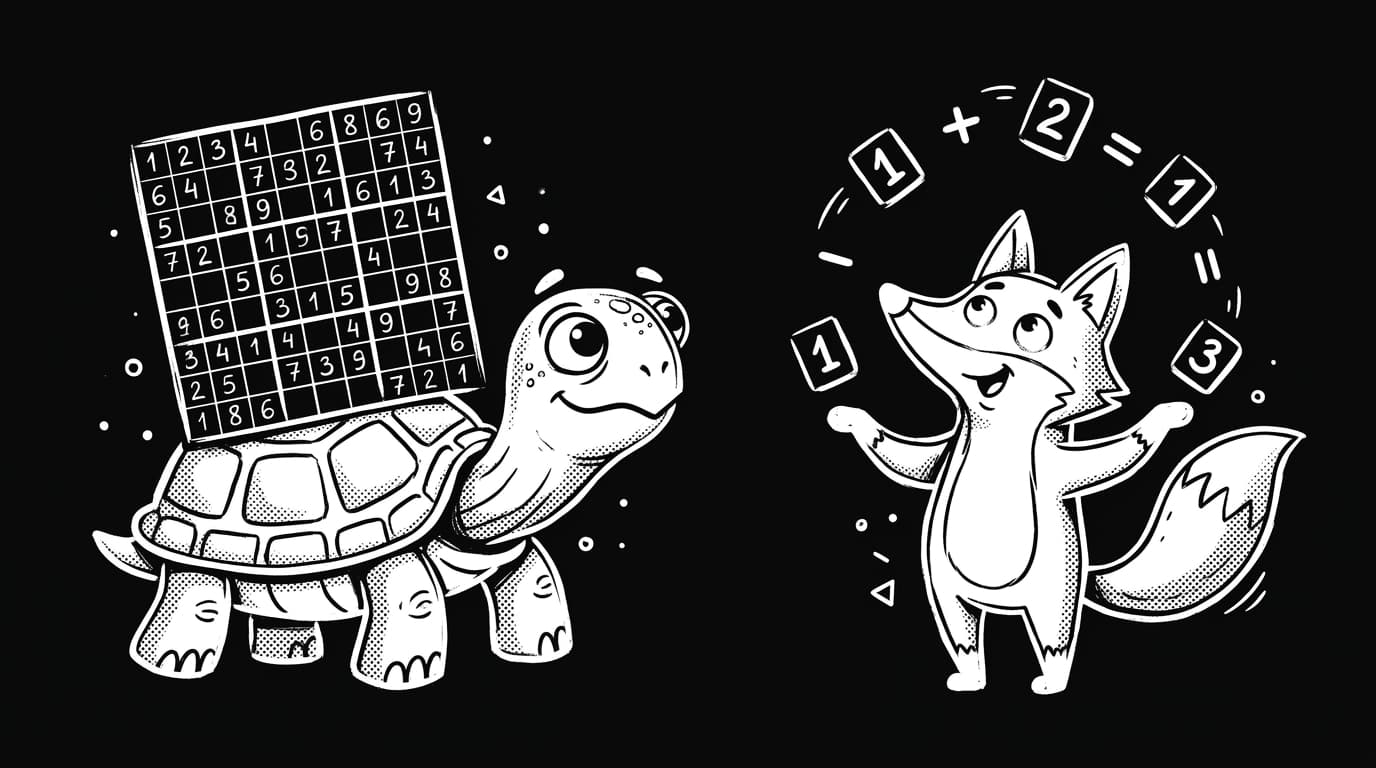
Sudoku fills a nine by nine grid with digits and asks for zero arithmetic. Mathness hands you six tiles and one target and asks for four operations under a clock. Both use numbers as glyphs, and only one trains the number system underneath them. This is the honest comparison that most puzzle roundup lists skip.
What Sudoku Asks the Brain to Do
Sudoku is a Latin square puzzle with three constraint families: rows, columns, and 3x3 boxes. Every digit from 1 to 9 must appear once per row, once per column, and once per box. Solving reduces to constraint propagation, which means scanning a line, eliminating candidates, placing a certain digit, and propagating the effect through the rest of the grid. The digits are labels, not quantities. A player who swapped every 7 for the letter G and every 4 for the letter D would solve the same puzzle at the same speed. Skill in Sudoku is about tracking sets, not adding, multiplying, or comparing sizes.
What Mathness Asks the Brain to Do
Mathness gives you six tile numbers between 1 and 100 and a three digit target between 100 and 999. You combine tiles with plus, minus, times, and divide to land on the target inside a fixed round timer. The digits are quantities, not labels. Swapping a 25 for a 27 changes every downstream product. Skill sits on reading the tile set in one glance, spotting a factor pair or an anchor multiple, and running arithmetic left to right without paper. New players climb fastest when they drill factor pairs and anchor numbers before they touch strategy.
The Arithmetic Gap
A twenty year record of cognitive research on puzzle games repeats one finding: transfer follows the operations you perform in the session. Sudoku practice improves Sudoku speed and generalizes to constraint tasks and short term set tracking. It has not improved mental arithmetic in any replicated study. Randomized arithmetic training trials show effect sizes of 0.4 to 0.7 standard deviations on calculation speed inside six weeks. Sudoku training trials on the same protocol measure near zero transfer to arithmetic tasks. Target number puzzles, where four operations run under time pressure, train the same circuits used in mental addition, subtraction, multiplication, and division. Working memory research going back to Alan Baddeley shows that arithmetic under load recruits the phonological loop, the visuospatial sketchpad, and the central executive together. Sudoku recruits mostly the sketchpad. That is the honest neurological difference between the two puzzles.
Speed and Time Pressure
Newspaper Sudoku grids target ten to thirty minutes of solving time, and hard grids often pass one hour. Solving is asynchronous by design, so most players pause and resume on the same grid across a commute or a lunch break. Mathness rounds run under one time budget per round, commonly thirty to sixty seconds. A typical Mathness round loads four to six calculations into the working buffer inside 45 seconds, roughly one operation every seven seconds. A Sudoku scan loads zero calculations and instead cycles through 81 candidate lists across 20 minutes. The clock changes which subskill matters most: pattern recognition wins in Sudoku, reflex arithmetic wins in Mathness. Time pressure forces forward computation instead of full precomputation, which is the same load pattern that mental math warm up drills install over seven to fourteen days.
Which One Improves Mental Math
If the goal is faster mental arithmetic, Mathness wins by definition because it is a mental arithmetic drill run under time. If the goal is deductive stamina, Sudoku wins because a hard grid holds sustained set tracking for close to an hour. Neither game builds the other's skill by transfer, and the transfer research has been consistent on this point since the early 2000s. A player who solves two Sudokus a day for a year will still stall on a two digit multiplication like 47 times 23 if they never trained arithmetic. A player who runs thirty Mathness rounds a day for a month will still miss Sudoku uniqueness proofs. Pick the game that matches the skill you want to build.
There is a middle path worth naming. Killer Sudoku sits between the two formats: the variant adds a cage sum constraint that forces small mental additions in the low tens, usually one to three per cage across 20 to 25 cages per grid. It is the closest a Sudoku variant gets to Mathness, and it still does not train multiplication or division. A player who wants both arithmetic speed and constraint stamina can alternate the puzzles by day of week and see measurable gains in both inside four to six weeks.
- Two Mathness ranked sessions for arithmetic reflex
- One Killer Sudoku grid for light arithmetic plus constraint work
- One standard Sudoku medium grid for tracking stamina
- One rest day per week to let both skills consolidate
A Weekly Split That Uses Both
A split that alternates skill types will keep both sharp without one crowding out the other. Weekdays get five minutes of Mathness daily and fifteen minutes of medium Sudoku for stamina. Weekends run one ranked Mathness session for climbing plus one Killer Sudoku grid for combined work. This layout gives roughly seventy five minutes of Sudoku and thirty five minutes of Mathness per week, which is enough to move both skill curves inside a single month. Track the Mathness side through the leaderboard so arithmetic progress stays visible against a rank number.