Factor Pairs to Memorize for Mathness: Targets 24 to 144
Most Mathness rounds end when a player sees a target and instantly knows what it factors into. That recall is separate from a times table. Times tables answer 8x7=56 forward. Factor pairs answer 56 backward as 7x8, 4x14, or 2x28. On the board those alternates decide which tiles you use and which you leave. This post gives you the twenty-two targets from 24 to 144 that appear most in Mathness rounds, the pairs to memorize for each, the three patterns that make the list stick, and a seven-day drill to lock the habit.
Why Factor Pairs Beat Times Tables Here
A times table runs one direction. It answers what 8 times 7 equals in under a second. Mathness runs the question backward: given 56, which two tiles land you there. A player who only owns the forward direction burns two to three seconds searching for a route. A player who owns both directions reads off 7x8, 4x14, and 2x28 the instant the target appears. Every extra pair opens another candidate path on the board, so a target with three pairs becomes three parallel solve attempts instead of one linear search.
The board-reading approach depends on this recall. Without factor pairs in memory, patterns look like noise. With them, the tile grid partitions into candidates and non-candidates in the first second of the round. Ranked players report a two-to-four second gain per composite target once the pairs are fluent, which compounds across the 30-round session that decides most leaderboard climbs.
The Twenty-Two Targets to Memorize
Pull enough Mathness rounds and the same targets keep surfacing. Composite numbers under 150 with three or more factor pairs dominate. The list below is ordered by frequency of appearance in ranked rounds. Memorize the pairs, not the count.
- 24 = 2x12, 3x8, 4x6
- 30 = 2x15, 3x10, 5x6
- 36 = 2x18, 3x12, 4x9, 6x6
- 40 = 2x20, 4x10, 5x8
- 42 = 2x21, 3x14, 6x7
- 48 = 2x24, 3x16, 4x12, 6x8
- 56 = 2x28, 4x14, 7x8
- 60 = 2x30, 3x20, 4x15, 5x12, 6x10
- 63 = 3x21, 7x9
- 64 = 2x32, 4x16, 8x8
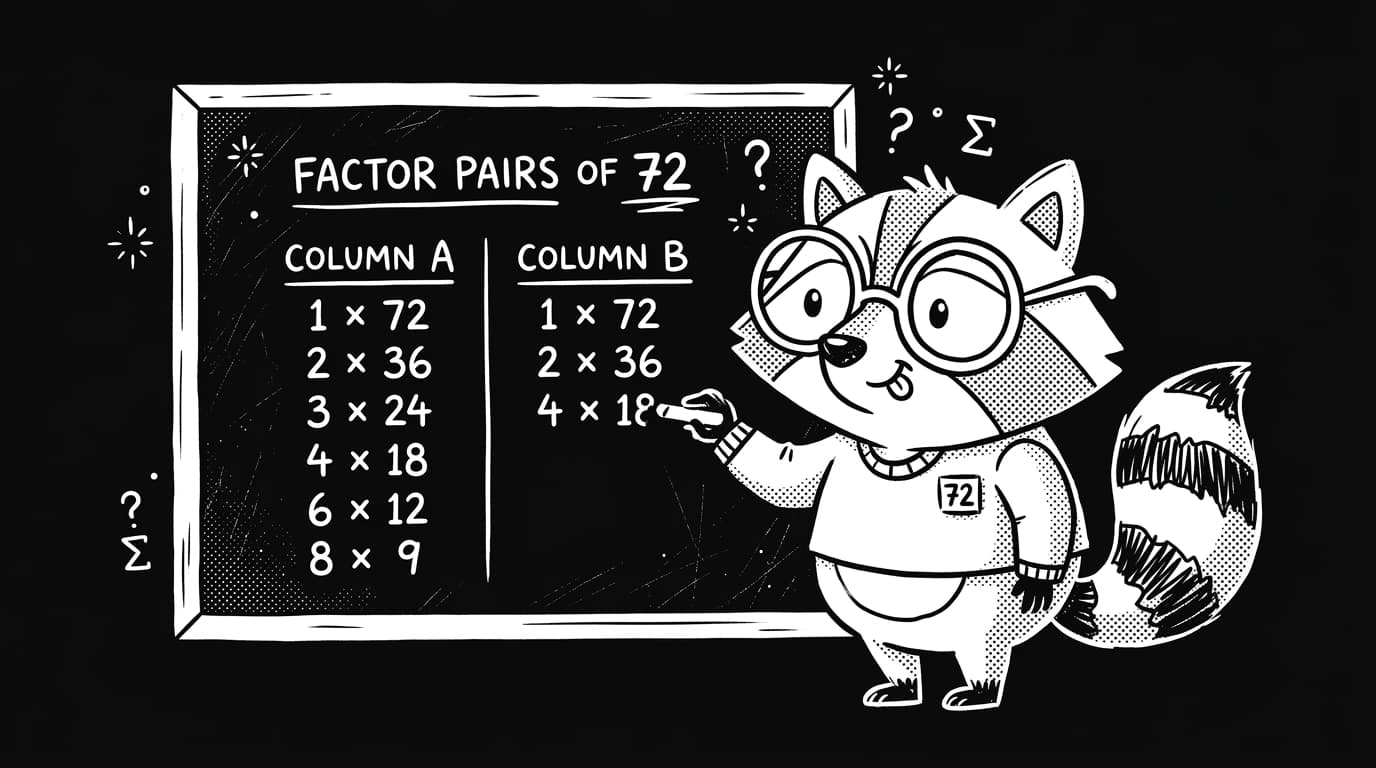
- 72 = 2x36, 3x24, 4x18, 6x12, 8x9
- 80 = 2x40, 4x20, 5x16, 8x10
- 84 = 2x42, 3x28, 4x21, 6x14, 7x12
- 90 = 2x45, 3x30, 5x18, 6x15, 9x10
- 96 = 2x48, 3x32, 4x24, 6x16, 8x12
- 100 = 2x50, 4x25, 5x20, 10x10
- 108 = 2x54, 3x36, 4x27, 6x18, 9x12
- 120 = 2x60, 3x40, 4x30, 5x24, 6x20, 8x15, 10x12
- 126 = 2x63, 3x42, 6x21, 7x18, 9x14
- 132 = 2x66, 3x44, 4x33, 6x22, 11x12
- 140 = 2x70, 4x35, 5x28, 7x20, 10x14
- 144 = 2x72, 3x48, 4x36, 6x24, 8x18, 9x16, 12x12
The Three Patterns That Make Recall Stick
Rote memorization of twenty-two rows takes weeks. Recognizing structure cuts that to seven days. Three patterns cover the entire list. First, highly composite targets like 24, 36, 48, 60, 72, 120, and 144 share overlapping factor sets, so once 60 is in memory the pairs of 120 are the same set with a 2 attached, and 144 mirrors 72 with an extra doubling. Second, square targets 36, 64, 100, and 144 always carry a square-root pair (6x6, 8x8, 10x10, 12x12) and never a middle-heavy prime pair, so recall of squares runs on a shorter list.
Third, any target ending in 0 splits into a factor-of-5 pair, so 40, 60, 80, 90, 100, 120, and 140 all carry a x5 pair as a shortcut anchor. Learn the three patterns first, then the individual rows fall in behind them. Players report the biggest jump on the day the square-root pattern clicks, because 36, 64, 100, and 144 together appear in about one ranked round out of six.
Reading a Mathness Board with Factor Eyes
Once the pairs are in memory, board reading changes shape. A target of 72 no longer prompts a search, it prompts a scan for any of five pairs: 2x36, 3x24, 4x18, 6x12, 8x9. The scan takes one second because it is a parallel check across the six tiles for matching multiplicands. If two tiles match a pair directly, the round is one operation. If one tile matches a factor and another sits one or two away from its partner, an anchor-and-adjust play closes the round in two operations.
If no tiles match any pair, the target likely wants an additive split, and the target decomposition method takes over. Factor pairs give you the first decision fork one second into the round instead of six seconds in. That five-second gap is the entire margin between a top-quartile ranked run and a middle-of-pack finish across a 30-round session.
The Seven-Day Memorization Drill
Twenty-two rows, split into tiers, spread over seven days. Set a two-minute timer each day. Read each target, speak the pairs aloud in ascending order of the smaller factor, then verify against the list and mark misses. Miss the same pair twice in one week and it moves onto a personal repeat card for the next session.
- Day 1: 24, 30, 36, 40. Ten pairs across four low targets, plus the first square at 36.
- Day 2: 42, 48, 56, 60. The first five-pair target arrives at 60.
- Day 3: 63, 64, 72, 80. Two squares in one day (64) alongside the five-pair 72.
- Day 4: Cold recall of Days 1 through 3 with no notes. Mark every miss.
- Day 5: 84, 90, 96, 100. The 100 square anchors the day.
- Day 6: 108, 120, 126. The seven-pair 120 is the hardest single row on the list.
- Day 7: 132, 140, 144, then a full 22-row cold recall against the timer.
Where Factor Recall Fails
Two failure modes cost rounds. The first is over-relying on pairs when no tile matches. A board with target 72 and tiles 25, 5, 4, 6, 3, 8 has no clean 8x9 or 6x12, so the round wants an additive composition, not a factor lookup. Committing to factor-first thinking on a factor-hostile board wastes four seconds before the pivot. The second failure is confusing near-neighbors: 63 and 64 differ by one but share zero factor pairs, and a player who misreads 64 as 63 will search for 7x9 while 8x8 sits obvious on the tiles.
Cross-check the target with a last-digit check before committing to a pair, and re-read the target once between the scan and the first operation. Head to /daily to test the recall against a fresh board, or start a full drill session from the /menu with the four highest-frequency targets (60, 72, 120, 144) already locked in memory.