The Trachtenberg Method: Multiply Big Numbers in Your Head (With Examples)
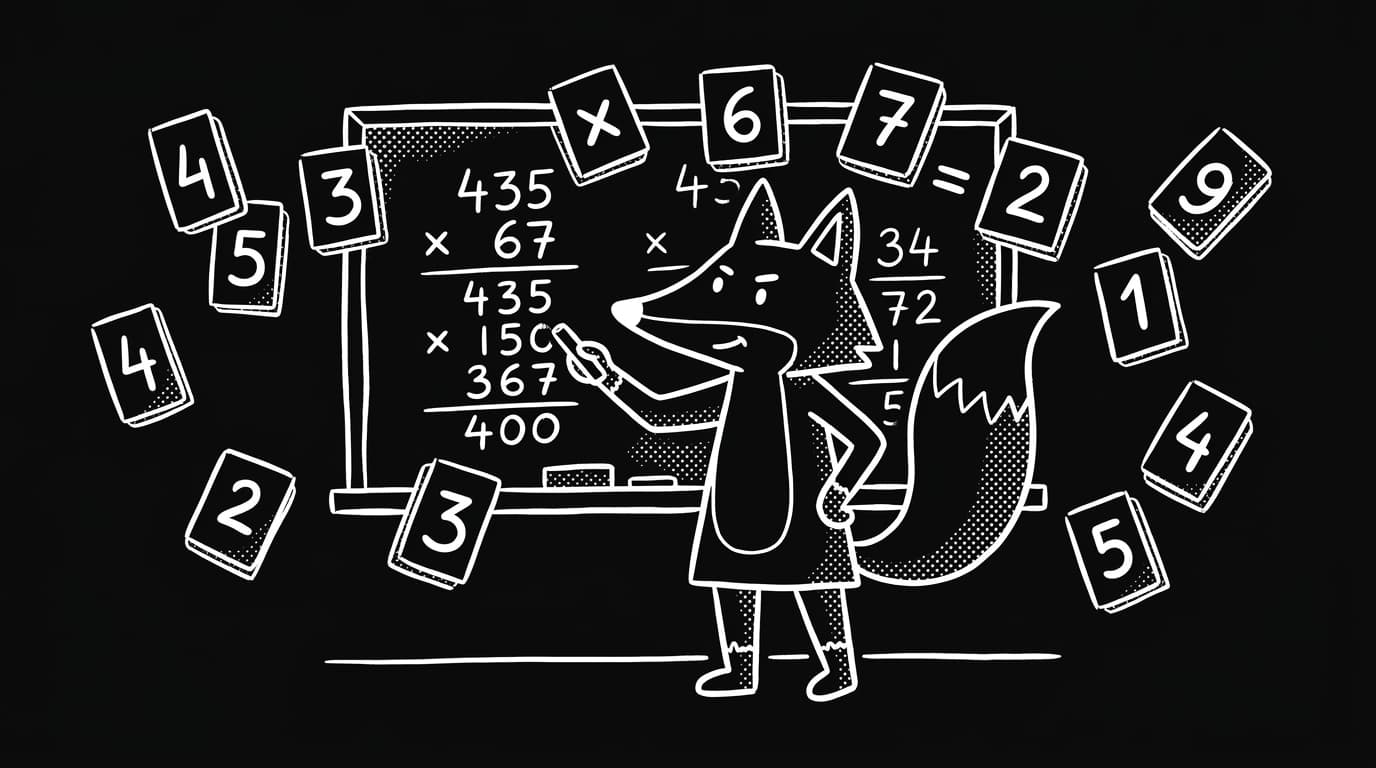
Multiplying 7384 by 12 in your head takes four seconds with the Trachtenberg method and close to forty with long multiplication. The gap comes from three digit-manipulation rules that let you walk a number right to left, writing one answer digit per step, with carries that stay one place deep. This post works four Trachtenberg multiplications end to end, pulls the two rules worth memorizing in 2026, and gives a five-day drill schedule that locks them in by Friday.
Times-11 Walked Through on 3452
The times-11 rule reads each digit as itself plus its right neighbor, with a final write of the leftmost digit and a leading carry if any sum overflows ten. Take 3452 times 11. Write the rightmost digit, 2, as the ones place. Add 5+2 to get 7 for the tens place. Add 4+5 to get 9 for the hundreds. Add 3+4 to get 7 for the thousands. Write the leftmost digit, 3, in the ten-thousands slot. The product reads 37972 and the whole operation takes three seconds once the pattern is drilled. A carry case like 5678 times 11 forces the same pattern with one wrinkle: 7+8 is 15, so you write 5 and carry 1 into the next column, giving 62458. A heavier carry case like 9999 times 11 cascades through every column: write 9, then 9+9=18 writes 8 carry 1, 9+9+1=19 writes 9 carry 1, 9+9+1=19 writes 9 carry 1, final leftmost 9+1=10 writes 10, giving 109989. The split-and-add explainer covers the carry case in more depth with eight worked examples.
Times-12 Walked Through on 2314
The times-12 rule doubles each digit and adds the right neighbor, working right to left with one carry pass. Take 2314 times 12. Double the 4 to get 8, add the implied right-of-ones zero, write 8. Double the 1 to get 2, add the right neighbor 4, write 6. Double the 3 to get 6, add 1, write 7. Double the 2 to get 4, add 3, write 7. Then double the implied leading zero and add the leftmost digit 2, writing 2 at the front. The product reads 27768. The rule needs one hour of practice before the doubling and the neighbor-add fuse into a single move. Inputs over 5000 add carry logic, since doubling 7 then adding 8 produces 22, where you write 2 and carry 2 into the next column. A clean carry walk through 7384 times 12 produces: double 4 plus 0 is 8, double 8 plus 4 is 20 write 0 carry 2, double 3 plus 8 plus 2 is 16 write 6 carry 1, double 7 plus 3 plus 1 is 18 write 8 carry 1, double 0 plus 7 plus 1 is 8 write 8. The product reads 88608 and the entire run takes under five seconds.
The Two-Finger Method on 46 Times 73
Trachtenberg's general multiplication, the two-finger method, scales to any factor length. For 46 times 73, scan digit pairs from right to left. Multiply the rightmost pair, 6 and 3, to get 18. Write 8 and carry 1. Cross-multiply the inside pair: 6 times 7 is 42, plus 4 times 3 is 12, sum 54, plus the carried 1 is 55. Write 5 and carry 5. Multiply the leftmost pair, 4 and 7, to get 28, plus the carried 5 is 33. Write 33 to the left. The product reads 3358. The same cross-product identity drives Vedic Urdhva-Tiryagbhyam and the standard cross-multiplication taught in modern mental-math programs. Our breakdown of two-digit multiplication methods walks three variants of the same move with timing data on each.
Which Rules Save Time in 2026
Three Trachtenberg techniques hold up against modern methods and the other eight lose to simpler moves. The times-11 rule is the strongest; no competing method matches its three-second ceiling for four-digit inputs. The times-12 rule is a close second once an hour of drilling is in place. The two-finger general method ties with cross-multiplication on accuracy and runs about ten percent slower on first-pass drilling, since it locks you into right-to-left order with no option to reorder partial products. The times-5 rule loses to halve-then-append-zero, which runs in one second on any input. The times-9 rule loses to the 10n minus n move, which runs in under a second even on four-digit inputs: 847 times 9 is 8470 minus 847, which equals 7623 in two steps. The times-6, times-7, and times-8 rules all add bookkeeping without a speed payoff on numbers that fit in working memory. For a fuller ranking of which parts of the system still rank in 2026, read the reader's guide.
- Times-11 rule, three seconds on four-digit inputs after twenty minutes of drilling
- Times-12 rule, five seconds on four-digit inputs after one hour of drilling
- Two-finger method on factor pairs above 25 by 25, forty hours of drilling to full fluency
A Five-Day Drill Schedule
Monday runs twenty minutes on times-11 with clean four-digit inputs where no neighbor pair sums past ten (1234, 2345, 3456). Tuesday runs twenty minutes on times-11 with carry cases (5678, 6789, 7891) so the leading-carry wrinkle lands in muscle memory. Wednesday runs forty minutes on times-12, inputs under 5000, so the double-and-add fuses without carry pressure. Thursday runs forty minutes on times-12 with inputs between 5000 and 9999, where every column triggers the carry logic. Friday runs thirty minutes on the two-finger method applied to 25-by-25 up to 99-by-99 pairs. Running the schedule end to end puts both direct rules in long-term memory and seeds the two-finger pattern for later deeper work. The /daily puzzle delivers the same reflex load in five-minute bursts if the full schedule is more time than you have this week.