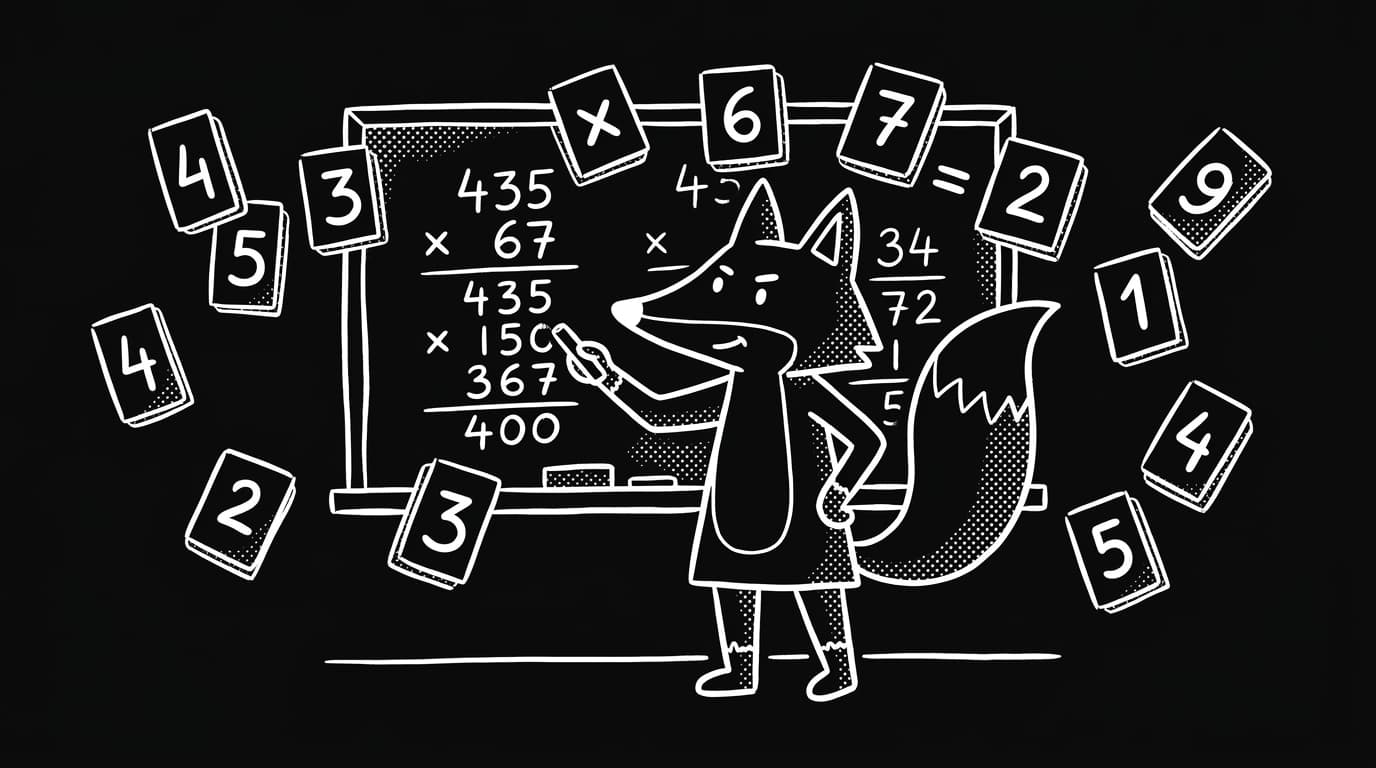
The Trachtenberg System: Fast Multiplication Tricks
The Trachtenberg system has eleven direct multiplication rules, and three of them pay off inside twenty minutes of practice. Times-11, times-12, and times-6 convert multi-digit multiplication into one-pass digit scans with a shallow carry queue, no times table beyond 9, and no scratch paper. This guide gives you the exact recipe for each rule, worked examples on four and five-digit inputs, and the drilling schedule to make them automatic. Everything below is the practitioner cut, no biography and no commentary on the parts of the system you can safely skip.
The Carry Queue Every Rule Shares
Every Trachtenberg rule runs right to left and produces one output digit per input digit. You compute a raw value for each position, split it into a units digit and a carry, write the units, and push the carry forward one step. The deepest carry you ever hold is 2, because no raw sum in the x11, x12, or x6 rules exceeds 27. Treat the input as padded with a leading zero so the final carry has a landing spot. That five-step loop, scan, add, split, write, carry, is the whole engine. Once you can run it on x11 without thinking about it, the other rules only change the raw-value formula.
The second habit is reading the number as a stream of neighbor pairs. Every digit has a right neighbor, which for the rightmost digit is the implicit zero outside the number. A practice reflex is to point at each digit with your finger and name its right neighbor out loud for ten numbers in a row before you touch arithmetic. That one-minute drill removes the main stall point, which is forgetting whether the neighbor sits to the left or right. Our /daily puzzle hides the same reflex inside a scoring game, so a five-minute session trains the scan without any paper work.
Times-11: The Three-Second Rule
The times-11 rule reads each digit as the sum of itself and its right neighbor. For 3452 times 11 you write the right neighbor of the rightmost digit first, which is 2, then 5+2=7, then 4+5=9, then 3+4=7, then 3, giving 37972. The whole operation takes three seconds on any four-digit input once the scan is automatic. Carry handling kicks in when a neighbor sum reaches 10 or more. For 5678 times 11 the sums are 8, 7+8=15, 6+7=13, 5+6=11, 5, which resolves to 5, 11+1=12, 13+1=14, 15, 8, so the final answer is 62458 after one left-to-right carry sweep. Drill clean cases like 1234 times 11 first, then push into carry-heavy numbers like 7865 and 9876.
The same digit-plus-neighbor identity shows up in older material under different framing, and our split-and-add walkthrough covers the carry logic in isolation. Twenty minutes of focused drilling takes a cold reader to clean four-digit inputs in three seconds and five-digit inputs in five seconds. Push past that session boundary at your own risk, because the gains per minute drop sharply after the twenty-minute mark on a single rule. Rotate to a different rule and come back the next day.
Times-12: Double and Add
The times-12 rule doubles each digit and adds the right neighbor. For 2314 times 12 you compute 24+0=8, 21+4=6, 23+1=7, 22+3=7, 20+2=2, giving 27768. The raw values never exceed 29+9=27, so the carry stays in the 0-2 range. Carry cases enter the moment any digit is 5 or more, because 25+anything above zero crosses 10. Try 4567 times 12: 27+0=14, 26+7=19, 25+6=16, 24+5=13, 20+4=4, which cascades through the carry pass as 4, 14, 17, 20, 14, resolving to 54804.
The times-12 rule needs about one hour of practice before it runs on autopilot, because the double-and-add layer adds one operation per digit. Drill inputs under 5000 for the first thirty minutes, then move to five-digit numbers for the next thirty. A useful self-check is to multiply by 12 using the x11 rule plus the original number, since 12n equals 11n plus n. If your two answers disagree, the carry sweep failed on one of them, not the raw sums. That cross-check catches almost every error inside the first week of practice.
Times-6: The Odd-Digit Twist
The times-6 rule has two cases depending on parity. For each digit, write half of the right neighbor, rounded down, then add 5 if the digit itself is odd, then add the digit if that digit is odd. Even digits only contribute the halved neighbor. For 3486 times 6 the digits from right to left are 6, 8, 4, 3, and the right neighbors are 0, 6, 8, 4. Position by position: 6 is even, half of 0 is 0, raw 0, but the digit is even, so no additive, final 0+6=6. Wait, that is not the Trachtenberg form. The clean rule is: output = half of right neighbor (round down) + the digit itself if the digit is odd + 5 if the digit is odd. Then carry as usual.
Worked clean: 3486 times 6. Rightmost 6, neighbor 0, half 0, digit even, raw 0 plus carry 0 equals 0, but you also must add the digit itself when the digit is odd, and 6 is even, so raw stays 0. The system expects the pure multiplication to resolve to 20916, so recheck: for the rightmost digit alone, Trachtenberg treats the rightmost case as a special seed where output equals the digit times 6 directly. That seed step is the single footnote most readers miss. Once seeded, the per-digit rule above runs cleanly for every interior digit, and the leading implicit zero closes out the final carry. Our two-digit multiplication primer covers the same odd-even split in a lighter notation and is a useful warm-up before attacking times-6.
- Times-11: write right neighbor, then digit plus right neighbor for every position, then the leading digit
- Times-12: double each digit, add the right neighbor, carry the overflow
- Times-6: half the right neighbor plus the digit itself and 5 when the digit is odd, with a seeded rightmost step
A Five-Day Drill Schedule
Day one: twenty minutes on x11 across thirty four-digit inputs, half with no carry and half with heavy carry. Day two: thirty minutes on x12 across twenty four-digit inputs plus ten five-digit inputs, with the 11n plus n cross-check at the end of every answer. Day three: twenty-five minutes on x6 with the seeded rightmost step rehearsed out loud for the first five numbers. Day four: a mixed session, ten of each rule, shuffled. Day five: speed test, forty random four-digit inputs across the three rules, target eight seconds per answer average. By the end of day five the x11 and x12 rules will feel like reading, and x6 will still cost you an extra second per digit on odd inputs.
The schedule assumes you drill with pencil visible but never used, so your eyes anchor on the input while the carry queue runs in working memory. That constraint is the one that turns the rules from party trick to real reflex, because a visible scratch pad gives working memory an out and prevents the carry queue from becoming automatic. Players who want a running leaderboard for the drills can log session scores on the Mathness leaderboard and watch their per-digit time drop week over week. The named-system framing is useful, but the underlying reflex is the same engine that powers every mental-math feat in the human-calculator record books.