Vedic Math Sutras: Which of the Sixteen Save Real Time
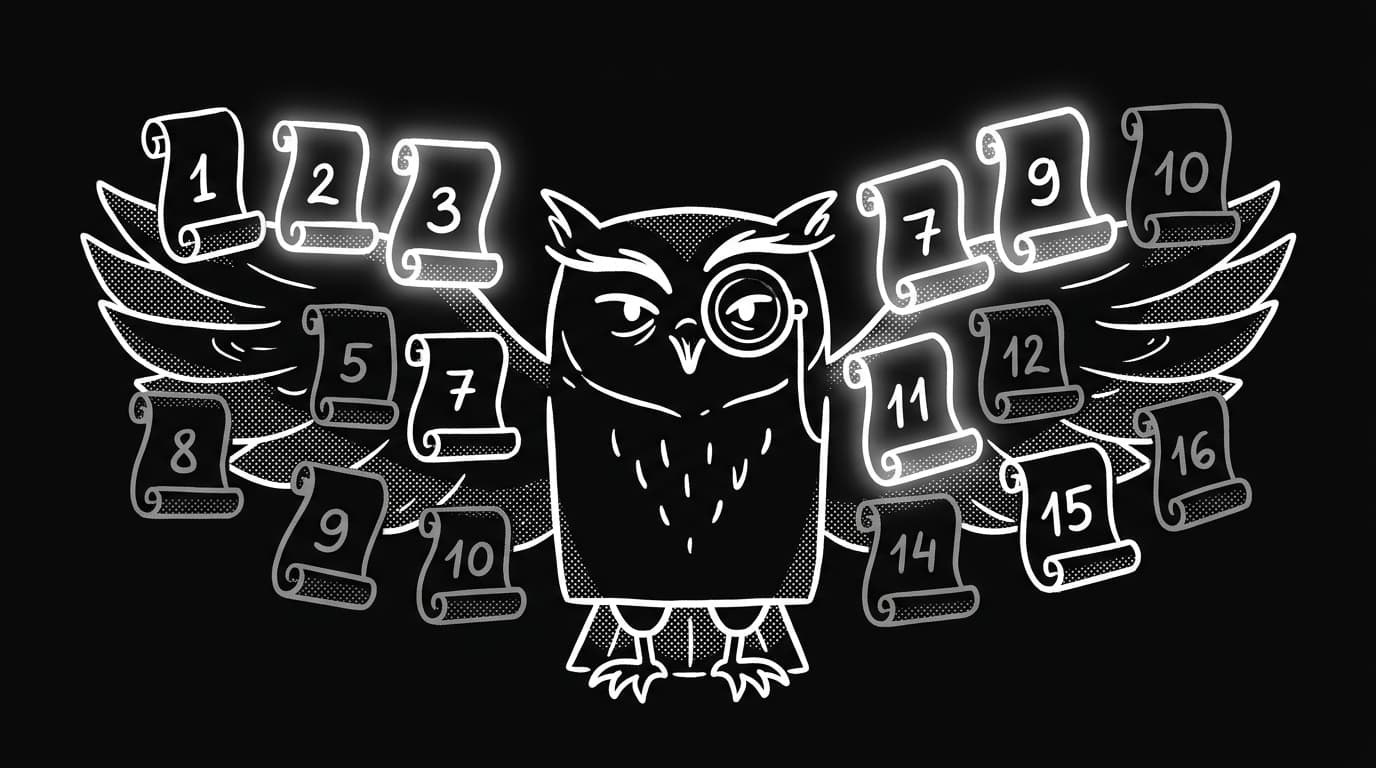
Vedic math promises a shortcut for every calculation, and most readers arrive expecting sixteen magic tricks. The sixteen sutras are aphorisms, most under ten words in the original Sanskrit, and only five of them do load-bearing work on numbers you meet outside a classroom. This piece is the honest map of which sutras save seconds and which are algebra in costume.
Where the Sixteen Sutras Came From
The sixteen sutras were compiled by Bharati Krishna Tirtha, a Hindu monk who served as Shankaracharya of Puri from 1925 to 1960. His manuscript was published posthumously in 1965 and claimed the sutras came from a lost appendix to the Atharvaveda. No independent scholar has found that source, and Sanskrit historians have rejected the Vedic attribution since the 1980s. The math itself is a real system built in the early twentieth century, not the ancient tradition the title implies. Readers who want the arithmetic do not need the origin story, and readers who want the origin story should know it fails a single citation check.
The Five Sutras That Do Real Work
Five sutras handle problems fast enough to earn a permanent seat in a mental-math toolkit. Ekadhikena Purvena, meaning by one more than the previous one, squares any number ending in five: for 65 squared, take the six in front, multiply by seven for forty-two, append twenty-five, and the answer is 4225. Nikhilam Navatashcaramam Dashatah, all from nine and the last from ten, turns 1000 minus 638 into 362 by subtracting each digit from nine and the final digit from ten. Urdhva-Tiryagbyham, vertically and crosswise, is the general two-digit multiplication algorithm that produces 23 times 47 as one cross-product plus two end-products in about three seconds. Yaavadunam, whatever the extent of the deficiency, squares numbers near a base: 98 squared reads as (98 minus 2) followed by (2 squared), giving 9604. Ekanyunena Purvena, by one less than the previous one, multiplies any digit sequence by a same-length run of nines: 574 times 999 becomes 573 followed by (1000 minus 574), or 573426.
These five earn their keep on live boards. Nikhilam and Yaavadunam together cover the entire 91 to 109 window, which is the same territory as the modern base method for near-hundred multiplication. Ekadhikena hits every squaring problem for numbers ending in five, from 15 squared up to 95 squared, in one beat.
The Four Sutras That Are Algebra in Costume
Four sutras teach algebraic identities that any secondary school student has already met under other names. Shunyam Saamyasamuccaye, when the sum is the same the sum is zero, restates the fact that if two sides of an equation share a common sum, that sum equals zero. Anurupye Shunyamanyat, if one is in ratio the other is zero, is proportional reasoning applied to simultaneous equations. Sankalana-vyavakalanabhyam, by addition and by subtraction, is the elimination method taught in every grade eight algebra textbook. Paraavartya Yojayet, transpose and adjust, is the standard rule for moving a term across an equals sign. None of these save time on arithmetic. They are algebra topics translated into aphorisms and then packaged as ancient wisdom. Learning them from a Vedic-math text costs more time than reading a two-page algebra chapter on the same idea.
The Remaining Seven: Checksums and Edge Cases
Two of the last seven sutras function as checksums. Gunitasamuchyah, the product of the sums equals the sum of the products, says that if you take the digit sum of two factors and multiply them, the result matches the digit sum of the product. It is casting out nines under a new name. Gunakasamuchyah, the factors of the sum equal the sum of the factors, extends the same idea to polynomial factoring. Together they catch about four fifths of arithmetic slips in one second, which is the exact function the modern last-digit and casting-out-nines check performs. Casting out nines has been documented in European arithmetic since the ninth century, which weakens the Vedic-origin claim further.
The other five sutras cover narrow cases that appear once in every hundred problems. They are worth knowing only if the exact shape shows up in front of you.
- Puranapuranabyham, by completion or non-completion, completes a square when solving quadratics and is useful for one chapter of secondary algebra.
- Chalana-Kalanabyham, differences and similarities, is a rule for calculus and is out of scope for mental arithmetic entirely.
- Vyashtisamashtih, part and whole, is the setup rule for partial fractions in symbolic algebra.
- Shesanyankena Charamena, the remainders by the last digit, is a divisibility screen for seven and thirteen.
- Sopaantyadvayamantyam, the ultimate and twice the penultimate, applies to one specific family of quadratic factorizations.
How to Learn the Five Efficiently
The efficient path skips the origin story and drills the five load-bearing sutras against real numbers. Twenty minutes a day for two weeks locks Ekadhikena for squares ending in five, Nikhilam for subtractions from any power of ten, and Urdhva-Tiryagbyham for two-digit products under one hundred. Add another week for Yaavadunam near bases of ten, one hundred, and one thousand, then one final session for Ekanyunena against runs of nines. Timed drills beat cold reading by a wide margin. A round of the daily target puzzle puts each sutra against a live clock, and the leaderboard exposes which of the five saves the most seconds under pressure. The other eleven can wait until a specific problem asks for them.
The Honest Verdict
Vedic math delivers what it promises when you strip it back to five sutras and set the origin myth aside. Those five save two to five seconds on the calculation shapes they target, matching or beating the modern branded techniques for near-base multiplication and end-in-five squaring. The remaining eleven are algebra, calculus, and verification rules that already have clearer names in the standard curriculum. Buying a full Vedic-math course to acquire five useful tricks is a bad trade. Reading a three-page summary of Ekadhikena, Nikhilam, Urdhva-Tiryagbyham, Yaavadunam, and Ekanyunena is a good one. If raw speed is the goal, drill those five and open a target round to test them against a live clock.