How to Convert Fractions to Decimals in Your Head
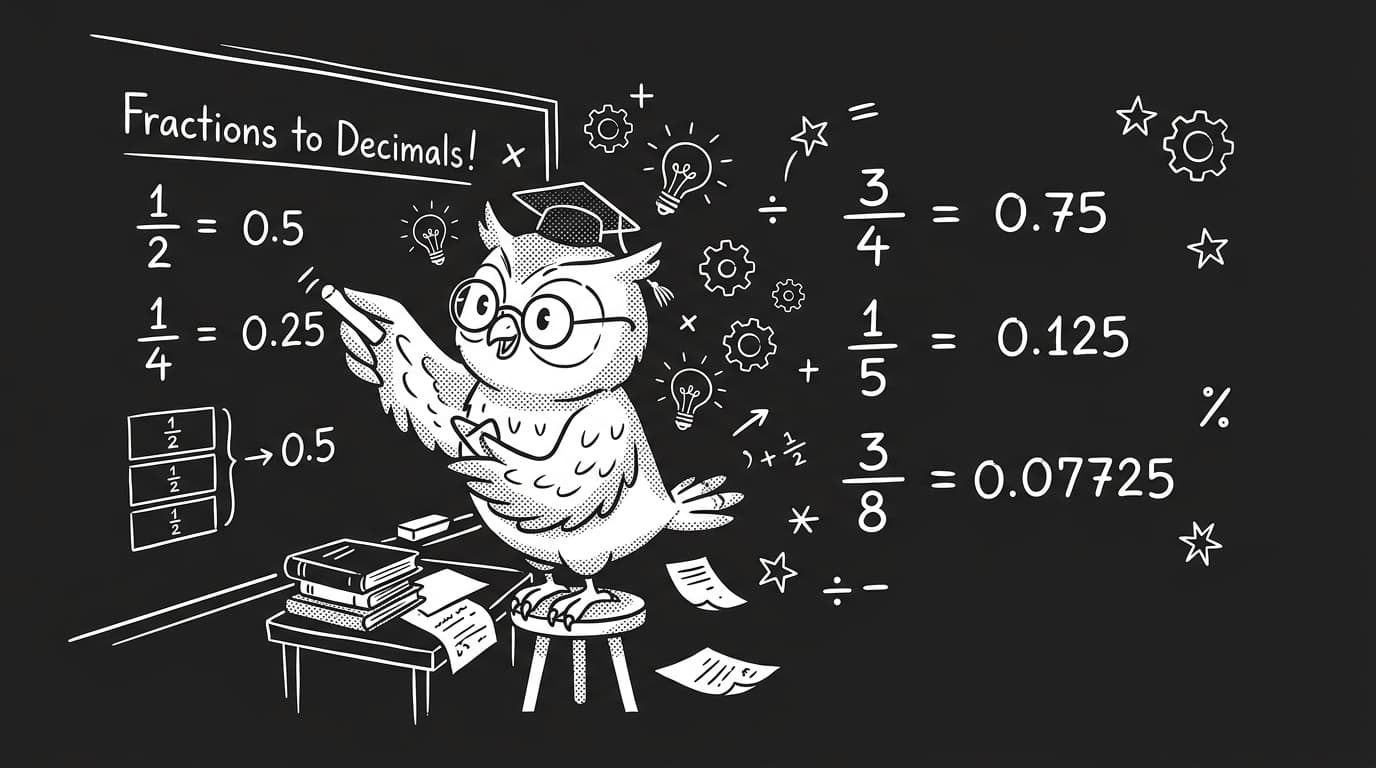
A fraction like 5/8 or 7/12 should not need a calculator or paper. Twelve memorized anchors and one long-division shortcut convert almost every fraction to a decimal in under three seconds. This post is the anchor list, the divide-numerator method for anything off the list, the repeating patterns behind sevenths and ninths, and a ten-day drill that locks the conversions into recall.
The Twelve Anchor Fractions to Memorize
The whole system rests on twelve fractions whose decimals cover roughly 80 percent of the cases you hit in shopping, cooking, timing splits, and puzzle work. Halves, thirds, quarters, fifths, sixths, and eighths give a dense grid between 0 and 1 with gaps no wider than 0.083. Once you can call any of these twelve in under one second, every other fraction becomes a small adjustment from a known point. The list is short enough to drill in one sitting, and it pays back every day.
- 1/2 = 0.5
- 1/3 = 0.333, 2/3 = 0.667
- 1/4 = 0.25, 3/4 = 0.75
- 1/5 = 0.2, 2/5 = 0.4, 3/5 = 0.6, 4/5 = 0.8
- 1/6 = 0.167, 5/6 = 0.833
- 1/8 = 0.125, 3/8 = 0.375, 5/8 = 0.625, 7/8 = 0.875
Notice a few patterns that cut the memorization load in half. The fifths all end in a clean digit because 5 divides 10 evenly. The eighths run in steps of 0.125, so once you know 1/8, the rest are additions. The thirds and sixths repeat because 3 does not divide any power of ten. Knowing why a decimal terminates or repeats tells you which category a new fraction lands in before you compute.
Divide the Numerator, Not the Fraction
For any fraction outside the anchor list, the fastest mental method is to divide the numerator by the denominator using left-to-right long division, appending zeros as needed. Take 7/16. You know 16 goes into 70 four times with 6 left, then 16 goes into 60 three times with 12 left, then 16 goes into 120 seven times with 8 left. That gives 0.4375. Every step is a small multiplication you can do in one beat, and you stop as soon as you hit the precision you need.
Two habits speed this up. First, round the denominator's fit early: if 16 goes into 70 about 4 times, do not stop to double-check because the next step catches any drift. Second, cap the answer at three decimal places for most real-world use. Anything past 0.001 rarely changes a shopping, cooking, or Mathness decision, so extending the division wastes time. If the fraction resists this pattern, the add-and-compare workflow usually gives a faster answer by ranking rather than converting.
The Repeating Families: Sevenths, Ninths, and Elevenths
Three denominators produce repeating decimals with beautiful structure worth memorizing. The ninths are the easiest: 1/9 = 0.111, 2/9 = 0.222, up through 8/9 = 0.888. The digit is the numerator, repeating forever. The elevenths pair up: 1/11 = 0.0909, 2/11 = 0.1818, 3/11 = 0.2727, and each pattern is the numerator times 9 written as a two-digit block. The sevenths cycle through the same six digits 142857 starting at different positions.
Sevenths break the standard shortcut approach, so most players memorize the six starting points: 1/7 = 0.143, 2/7 = 0.286, 3/7 = 0.429, 4/7 = 0.571, 5/7 = 0.714, 6/7 = 0.857. These come up in split-the-bill math, race pacing, and any board where a target divides awkwardly. A percentages drill that includes sevenths saves seconds when a receipt has an odd party size.
Round-and-Correct for Ugly Denominators
When a denominator is close to a friendly number, round it, convert, then correct. For 7/13, note that 13 is close to 12. 7/12 = 0.583, and since 13 is larger than 12 by about 8 percent, the true value drops by roughly 8 percent to 0.538. The exact answer is 0.5385, so the estimate is off by less than 0.001. The rule generalizes: if the true denominator is p percent larger than your anchor, subtract about p percent from your first estimate.
This shortcut wins on fractions like 5/17, 4/19, or 9/23 where the divide-numerator method costs three or four beats. Round 17 to 16, 19 to 20, or 23 to 24, then adjust. The correction is small because the curve 1/x flattens as x grows, and by the time you reach two-digit denominators, a 5 percent rounding error in the denominator moves the decimal by less than 0.02. That is inside the tolerance of every real decision you will make with the number.
A Ten-Day Drill That Locks Conversions Into Recall
The gap between recognizing a decimal and recalling one under time pressure is roughly two weeks of daily reps. Ten minutes a day for ten days is enough to move all twelve anchors, the ninths, the sevenths, and the elevenths pattern from working memory into automatic recall. The routine has five blocks each session.
- Two minutes: flash the twelve anchor fractions at random, aim for under one second per answer.
- Three minutes: divide-numerator drill on fractions with denominators 13 through 25, three-digit precision.
- Two minutes: repeating families, calling out a random ninth, seventh, or eleventh.
- Two minutes: round-and-correct on ugly denominators, checking against a calculator for one in ten.
- One minute: mixed review, alternating anchor and computed fractions to prevent pattern lock.
Track two numbers: median response time on anchors, and error rate on divide-numerator. Both should drop below one second and below 5 percent by day seven. If accuracy stalls, cut speed and rebuild from 80 percent of your current pace. A round on the daily puzzle at the end of each drill applies the reflex in mixed conditions and catches any conversions that only work in isolation.