How To Divide In Your Head: Three Shortcuts For Any Divisor
Divide 847 by 11 before your phone unlocks. Most adults stall because school teaches long division, a column algorithm that collapses the second you lose the paper. Mental division runs on three shortcuts instead: snap to the nearest multiple, double the divisor, or cast out factors before you start. Pick the right move for the shape of the pair and the quotient arrives in three to five seconds. The answer to 847 by 11 is 77, and the method that lands it fastest is covered below.
Why Long Division Dies In Your Head
Long division asks you to hold the dividend, the current remainder, the running quotient, and the next trial digit at once. That is four live values, and human working memory tops out at around four chunks under light load, fewer under time pressure. The algorithm works on paper because the paper carries three of the four values for you. In your head, the third digit of the quotient usually arrives after the first two have faded. The fix is to stop running long division and start running shape-first methods that only hold one or two values at a time. Each shortcut below is a toolkit for one family of divisors, and together they cover almost every two-digit or three-digit division you meet in daily life or on Mathness.
The Nearest-Multiple Snap For Dividing By 7, 11, And 13
Seven, eleven, and thirteen are the three divisors that scare mental calculators most, because their multiples look irregular. The fix is to memorise ten multiples of each and snap any dividend to the nearest one. For 847 by 11, the nearest multiple of 11 at or below 847 is 836, which is 11 times 76. The remainder is 11, which is 11 times 1, so the quotient is 77. For 500 by 7, the nearest multiple of 7 at or below 500 is 497, which is 7 times 71. The remainder is 3, so the answer is 71 remainder 3. The move depends on fluent recall of the first ten multiples, so a two-minute morning warmup on 7, 14, 21 through 70 pays off faster than any other single drill.
Thirteen works the same way once you memorise 13, 26, 39, 52, 65, 78, 91, 104, 117, 130. A dividend like 400 by 13 snaps to 390, which is 13 times 30, leaving a remainder of 10, so the quotient is 30 remainder 10. The trick fails on four-digit dividends because the nearest multiple becomes hard to locate without pen and paper. For those, chain the snap: divide the dividend's first three digits, carry the remainder, then divide the next block. The cube-root shortcuts use the same chunking idea, which is why the two skills reinforce each other.
Doubling The Divisor For Clean Quotients
When the divisor is 5, 25, or 50, double it and halve the dividend to land on a power of ten. Dividing by 5 becomes dividing by 10 after doubling the dividend: 345 by 5 equals 690 by 10 equals 69. Dividing by 25 becomes dividing by 100 after multiplying the dividend by 4: 875 by 25 equals 3500 by 100 equals 35. Dividing by 50 becomes dividing by 100 after doubling: 1450 by 50 equals 2900 by 100 equals 29. The reason the move is faster is that dividing by a power of ten is a shift, not a computation. The same shift works for divisors of 125 (multiply by 8, shift three places) and 625 (multiply by 16, shift four places), though those pairs are rare outside finance and engineering.
Casting Out Factors Before You Divide
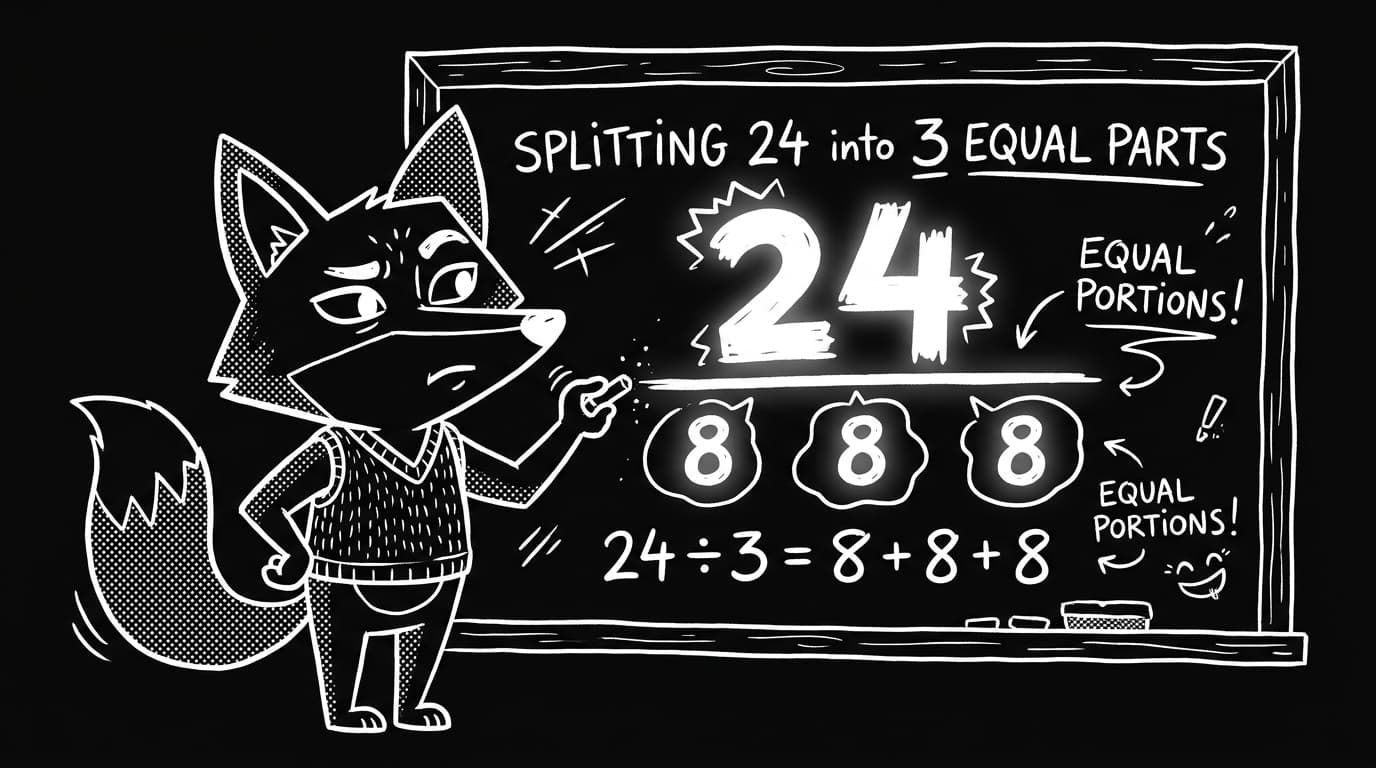
Most division problems carry factors on both sides that a one-second scan would cancel. Dividing 144 by 18 looks ugly until you notice that both share a factor of 18: the answer is 8, and the real work is recognising the pair shape, not running the algorithm. The move extends to any divisor with small prime factors. Cancel the common factor first, then finish with the smallest possible division. The checklist below runs in under a second once the divisibility rules are automatic.
- Both ends even: halve both, repeat until one is odd.
- Both ends in 0 or 5: divide both by 5.
- Both ends have a digit sum divisible by 3: divide both by 3.
- Both ends have a digit sum divisible by 9: divide both by 9.
- Nothing cancels: fall back to the nearest-multiple snap.
The Decision Rule In Under A Second
Strong mental dividers do not pick the right method after thinking, they pick it before computing. The shape scan runs in under a second: check for a common factor first, since cancellation removes the hardest work. If nothing cancels, check for a divisor in the 5, 25, 50 family, since the shift move is always the cleanest. Default to the nearest-multiple snap for 7, 11, 13, and for any prime divisor you have drilled. This loop is the habit that converts a 12-second answer into a 4-second answer, and it is the step most self-taught mental calculators skip. The daily puzzle forces the loop because the timer punishes indecision more than a wrong method.
A Two-Week Division Drill That Builds The Reflex
Two weeks of 10-minute daily drills convert the three methods into reflex. Week one: five minutes of 7, 11, and 13 multiples up to the tenth, then five minutes of random three-digit by one-digit divisions using the nearest-multiple snap. Week two: five minutes of 5, 25, and 50 divisions with the double-and-shift move, then five minutes of mixed problems where you announce the method before the quotient. Log the pairs you missed and rerun them the next morning. Most adults hit sub-five-second accuracy on random three-digit by two-digit pairs by day 12.
The reason the drill works is spacing plus retrieval, the same cognitive mechanism behind multiplication fluency. Massed practice on a single afternoon fades inside a week. Ten minutes spread across 14 mornings builds a retrieval trace that still fires six months later. The Mathness leaderboard gives an honest read on progress because the round timer forces the method-first habit, not the theory. A climb of 20 ranks across the drill window is a realistic target for a motivated adult, and a flat line after day seven usually means the methods are not being announced out loud before the quotient.