Mental Division: Three Patterns for 80% of Everyday Math

Three division patterns cover roughly 80 percent of the division you do in a day: dividing by a single digit, dividing by a power of ten, and dividing by a two-digit number that factors cleanly. Each pattern has one core rule and one carry trap, and twenty minutes of focused drilling moves the reflex from paper to working memory. This guide walks through each pattern with four-digit worked examples, the exact failure modes to tag during practice, and a seven-day schedule that locks the three patterns in under one hour of total drill time.
Why Division Lags Multiplication in Mental Math
Multiplication runs right to left with a shallow carry queue, so most mental-math training programs start there and never leave. Division runs left to right and keeps a running remainder that compounds every step, which pushes working-memory load about 30 percent higher than the equivalent multiplication. The result is a measurable gap: adults who can multiply two four-digit numbers in six seconds typically take 11 to 14 seconds to divide a four-digit number by a two-digit number. Closing that gap is almost entirely about drilling the remainder step until it stops consuming attention. Our two-digit multiplication primer covers the right-to-left carry queue, and division is the mirror operation with a left-to-right remainder queue.
The second reason division lags is schooling. Most primary curricula teach long division as a written algorithm with scratch paper, which trains the opposite habit from mental speed. The written form rewards neat column alignment and penalizes guessing, while mental division rewards fast remainder estimation and recovers from wrong guesses cheaply. Breaking the written-first habit takes about four sessions of deliberate practice on dividing by 7, 8, and 9, which are the three single-digit divisors with the highest working-memory cost.
Pattern One: Single-Digit Divisor
The core rule for single-digit division is left-to-right digit-by-digit extraction with a running remainder under 10. For 4825 divided by 7: 4 divided by 7 gives 0 remainder 4, bring down 8 to make 48, 48 divided by 7 gives 6 remainder 6, bring down 2 to make 62, 62 divided by 7 gives 8 remainder 6, bring down 5 to make 65, 65 divided by 7 gives 9 remainder 2, so the answer is 689 remainder 2. The whole operation runs in four tight steps once the single-digit times tables are automatic. The failure mode is the remainder step: readers lose the previous remainder when they bring down the next digit, which forces a restart.
Drill the three hard divisors first: 7, 8, and 9. The easy divisors (2, 3, 4, 5, 6) run on cached times tables and do not need separate practice time. Target under three seconds per answer for 7, 8, and 9 across 20 random four-digit inputs. The practice set that moves the needle fastest is dividing numbers of the form 1000 to 9999 by 7, because the remainder cycles through all seven residues within six consecutive answers and forces the full remainder-queue reflex. A short five-minute block on this pattern inside our daily puzzle can replace a longer written drill once the reflex is established.
Pattern Two: Powers of Ten and Close Neighbors
Dividing by 10, 100, or 1000 is a shift, not a computation, and the mental cost is zero once the decimal placement is automatic. The useful extension is dividing by 11, 9, 25, and 50, which all admit shift-plus-adjust forms. Dividing by 25 is the same as multiplying by 4 and shifting two places, so 4825 divided by 25 is 4825 times 4 divided by 100, which gives 19300 divided by 100, which gives 193. Dividing by 50 is multiplying by 2 and shifting two places. Dividing by 11 uses the alternating-digit test for the integer part and a quick adjustment for the remainder. These four cases cover a surprising share of everyday math because unit conversions, split bills, and percent calculations rely on them.
The failure mode for this pattern is misplacing the decimal shift. The fix is to say the shift out loud before the arithmetic, which commits the final digit count to working memory before the multiplication step runs. For 4825 divided by 25, speak two shift places first, then compute 4825 times 4 equals 19300, then apply the shift. Readers who skip the pre-commit step misplace the decimal on about 15 percent of answers, which is high enough to disqualify the whole pattern from fast daily use. The pre-commit habit kills the error rate inside one drill session.
Pattern Three: Two-Digit Factorable Divisors
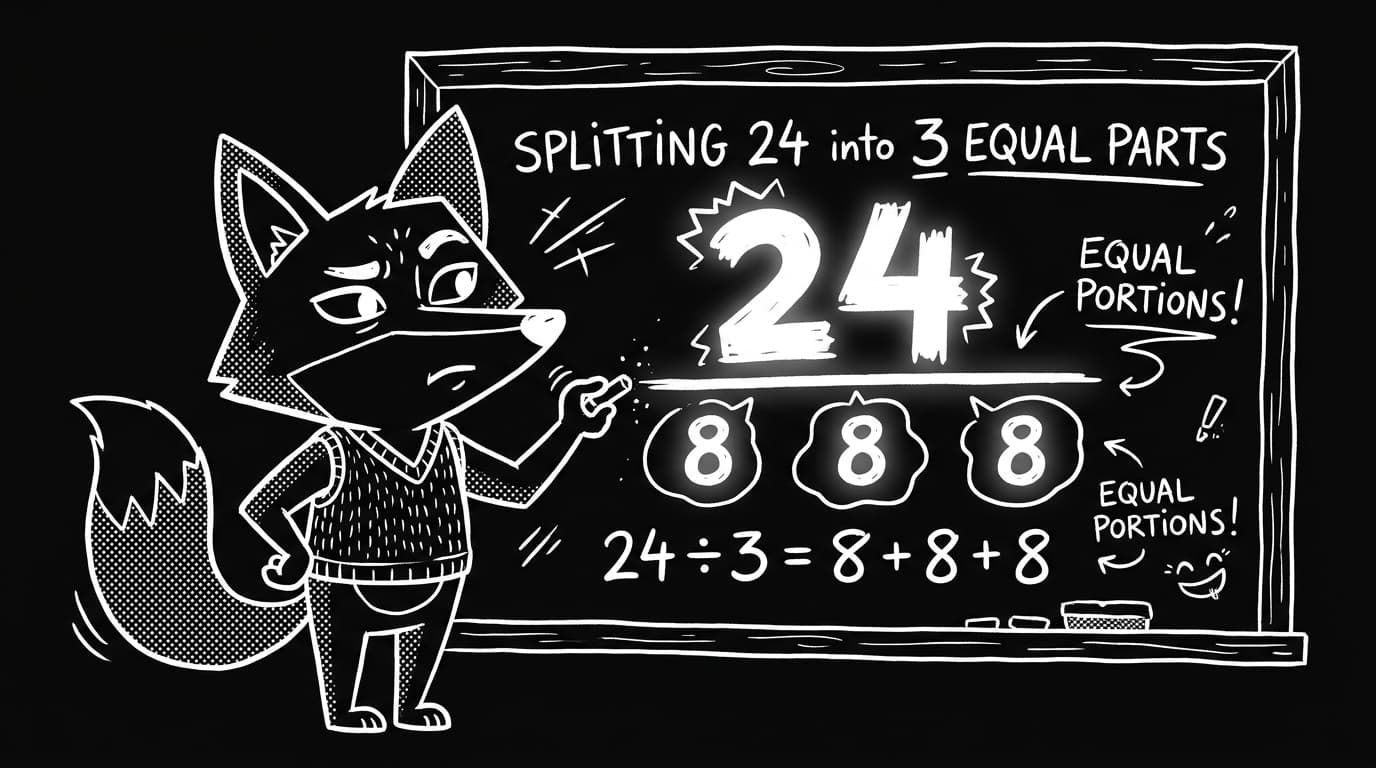
The third pattern handles two-digit divisors that factor into two single-digit numbers: 12 is 3 times 4, 14 is 2 times 7, 15 is 3 times 5, 16 is 2 times 8, 18 is 2 times 9, 21 is 3 times 7, 24 is 3 times 8, 27 is 3 times 9, 28 is 4 times 7, 32 is 4 times 8, 35 is 5 times 7, 36 is 4 times 9, 42 is 6 times 7, 45 is 5 times 9, 48 is 6 times 8, 49 is 7 times 7, 54 is 6 times 9, 56 is 7 times 8, 63 is 7 times 9, 64 is 8 times 8, 72 is 8 times 9, 81 is 9 times 9. For 4825 divided by 24, divide by 3 first to get 1608 remainder 1, then divide 1608 by 8 to get 201. The two-step chain keeps every intermediate remainder in single-digit range, which is where working memory handles arithmetic fastest.
Non-factorable two-digit divisors (13, 17, 19, 23, 29, 31, 37, 41, 43, 47, 53, 59, 61, 67, 71, 73, 79, 83, 89, 97) need the long-form approach and sit outside this three-pattern coverage. Fortunately they appear in everyday math about 10 percent of the time, which is why the three patterns above cover roughly 80 percent of real-world division. For the stubborn primes, memorize the first ten multiples once and use the standard long-form remainder queue. That table takes about ten minutes to build and three sessions to lock in.
- Single-digit divisor: left-to-right extraction, running remainder under 10, drill 7, 8, 9 first
- Powers of ten and 11, 9, 25, 50: shift-plus-adjust, pre-commit the decimal places out loud
- Two-digit factorable divisor: factor into two single-digit steps, each remainder stays single-digit
A Seven-Day Drill Schedule
Day one: ten minutes on single-digit division by 7 across 25 four-digit inputs, target under four seconds each. Day two: same drill with divisor 8, then divisor 9, five minutes each. Day three: ten minutes on powers-of-ten and the 25/50/11/9 extensions, pre-commit the shift out loud for every answer. Day four: ten minutes on two-digit factorable divisors with the two-step chain. Day five: a mixed session across all three patterns, 20 answers, random inputs. Day six: speed test, 30 answers at mixed difficulty, target under five seconds average. Day seven: rest and review slow answers from day six with the stall-type tag applied.
The seven-day plan assumes no scratch paper and no pauses to re-read the input. The input stays visible but untouched while the remainder queue runs in working memory, which is the exact training constraint elite mental calculators use for their own drill blocks. Readers who want a running score across the week can log attempts on the Mathness leaderboard and see per-answer time drop by day three. Our deeper piece on mental math and cognition covers why the no-scratch-paper rule is the single highest-impact habit in any mental-arithmetic routine.