How to Divide in Your Head: 5 Mental Division Tricks for 2026
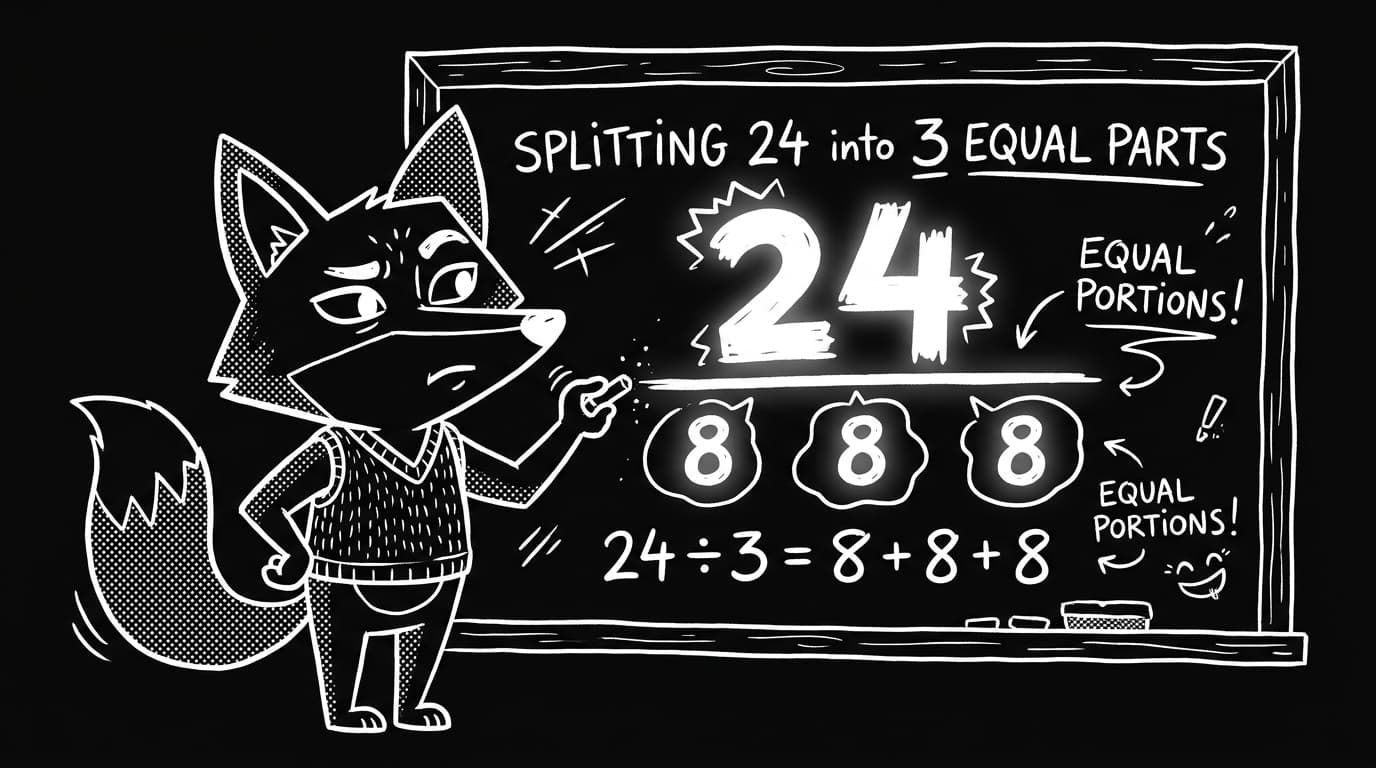
Most people reach for a phone the second a division problem gets wider than the twelves table, and that reflex is costing you about ninety seconds a day in friction. Division feels harder than multiplication because schools teach it as a single procedure, long division, that eats paper and time. The reality is that fast dividers do not do long division in their heads at all. They swap the problem for an easier one before any arithmetic starts, using five rewrites that each take under two seconds to set up.
Rewrite the Problem Before You Compute
The first move in any mental division is a rewrite, not a calculation. Dividing 144 by 8 is slow. Halving both sides twice turns it into 36 divided by 2, which lands in one beat at 18. This is the halving-and-doubling trick, and it works any time both numbers share a factor of 2. For divisors ending in 5, double the top and the bottom so the divisor becomes 10, which collapses to a decimal shift. 85 divided by 5 becomes 170 divided by 10, which is 17 with zero effort.
The habit to build is reading the divisor first, picking a rewrite, then starting the arithmetic. In timed drills on /daily the players who log sub-four-second division solves almost never divide the original numbers. They scale both sides to a cleaner pair, usually one with a divisor of 2, 5, or 10. Scaling by the same factor on top and bottom preserves the answer, which is the same rule that makes equivalent fractions work in grade school.
The Digit-Sum Shortcut for Dividing by 9
Dividing by 9 looks ugly and is one of the fastest cases once you know the digit-sum rule. Any number whose digits add to a multiple of 9 is itself a multiple of 9, so 522 is divisible because 5 plus 2 plus 2 equals 9. The quotient comes from a two-step read. For 522 divided by 9, start with the hundreds digit, 5, which gives 50 and a remainder of 72, and 72 divided by 9 is 8, so the answer is 58. For three-digit numbers under 900 you can skip the remainder tracking by noticing that the first digit of the quotient is almost always the hundreds digit of the dividend minus one, with the second digit filling in to hit the digit sum.
The digit-sum rule also works for 3, because any multiple of 3 has digits summing to a multiple of 3. Dividing 174 by 3 confirms itself before you start, since 1 plus 7 plus 4 is 12. The same digit-sum habit is the foundation of the Trachtenberg method, where it is used in reverse to audit multiplication answers. Treat the digit sum as a cheap sanity check that costs under a second and catches most arithmetic slips before they ship.
Chunking: Break the Dividend Into Clean Pieces
Chunking is how fast dividers handle the problems that will not rewrite cleanly. The move is to split the dividend into two numbers that each divide easily, then add the results. 168 divided by 7 is slow if you fight the whole number, so split it into 140 and 28. 140 divided by 7 is 20, and 28 divided by 7 is 4, giving 24. The split works for any divisor if you pick a chunk from the ten-times, hundred-times, or five-times table of the divisor.
The chunking table to memorize is small. For 7, the useful chunks are 70, 140, 210, 350, 700. For 8, lean on 80, 160, 240, 400, 800. For 6, the chunks are 60, 120, 180, 300, 600. You pick the largest chunk that fits under the dividend, subtract, and divide the leftover. 294 divided by 7 picks 280 as the chunk, which is 40, leaves 14, which is 2, and the answer is 42. Three steps, no paper, under four seconds once the chunks are second nature.
- Divide by 2: halve once. 86 divided by 2 is 43.
- Divide by 4: halve twice. 148 divided by 4 is 37.
- Divide by 5: double, then shift the decimal. 85 divided by 5 is 170 shifted to 17.
- Divide by 25: divide by 100, then multiply by 4. 325 divided by 25 is 3.25 times 4 which is 13.
- Divide by 8: halve three times. 192 divided by 8 is 24.
Check Divisibility Before You Start
The fastest mental division is the one you refuse to do, because you already know the quotient will be ugly. A one-second divisibility check filters those cases before you commit. Divisible by 2 means the last digit is even. Divisible by 3 means the digit sum is a multiple of 3. Divisible by 4 means the last two digits form a multiple of 4. Divisible by 6 is the AND of 2 and 3. Divisible by 11 uses the alternating digit sum, so 2794 passes because 2 minus 7 plus 9 minus 4 is 0.
Running these checks is the price of entry for timed arithmetic. On the Mathness board you often get a divisor dropped as a target, and your first move is to scan which numbers in play divide into it cleanly. Players who skip the check end up grinding chunking on numbers that were never going to resolve. The same filter applies when you estimate a tip in your head, since the number of diners controls which divisors are honest. For a six-person split the digit-sum test tells you in under a second whether the bill divides evenly or needs a rounded-up adjustment.
When to Switch to Estimation
Not every division wants an exact answer. For a check at a restaurant, you need the quotient to within a dollar, not to the cent, and the fast move is to round the dividend to the nearest multiple of the divisor. 437 divided by 6 is messy, but 420 divided by 6 is 70, and the real answer is 72.8, which is close enough for a tip anchor. The error you absorb by rounding is bounded by the gap between the dividend and the nearest clean multiple, divided by the divisor.
Estimation also unlocks the fastest mental percentage work, since one percent is a division by 100 and ten percent is a division by 10. If you already drill percentages under three seconds, you are halfway to mental division because the shift mechanics overlap. The habit worth building is deciding, before you start, whether the task wants an exact answer or an estimate, because the two paths use different tricks and mixing them wastes time.
Drill Patterns That Transfer
Mental division improves fastest when you drill it alongside multiplication, because every division problem is a multiplication problem read in reverse. If 7 times 8 is second nature, then 56 divided by 7 is second nature, and the same holds for every pair in the times tables. Players who build the inverse pairs explicitly, by chanting a product and immediately saying the two division facts that follow, convert multiplication fluency into division fluency inside a week. For two-digit speed, the drill that pays off is the one described in the two-digit multiplication guide, run in reverse so you are naming factors from products.
Three sessions a week of five minutes each is enough to move a casual mental calculator from fifteen-second division solves to five-second ones inside a month. The gain compounds because the time saved on division flows into whatever downstream calculation the division was serving, which is usually a comparison, a ratio, or an average. Those are the operations that run quietly behind every budget decision, recipe scale, and sports stat you encounter in a day, and they stop costing you friction once the division layer disappears.