Look-Ahead in Mathness: Plan the Next Move While You Compute
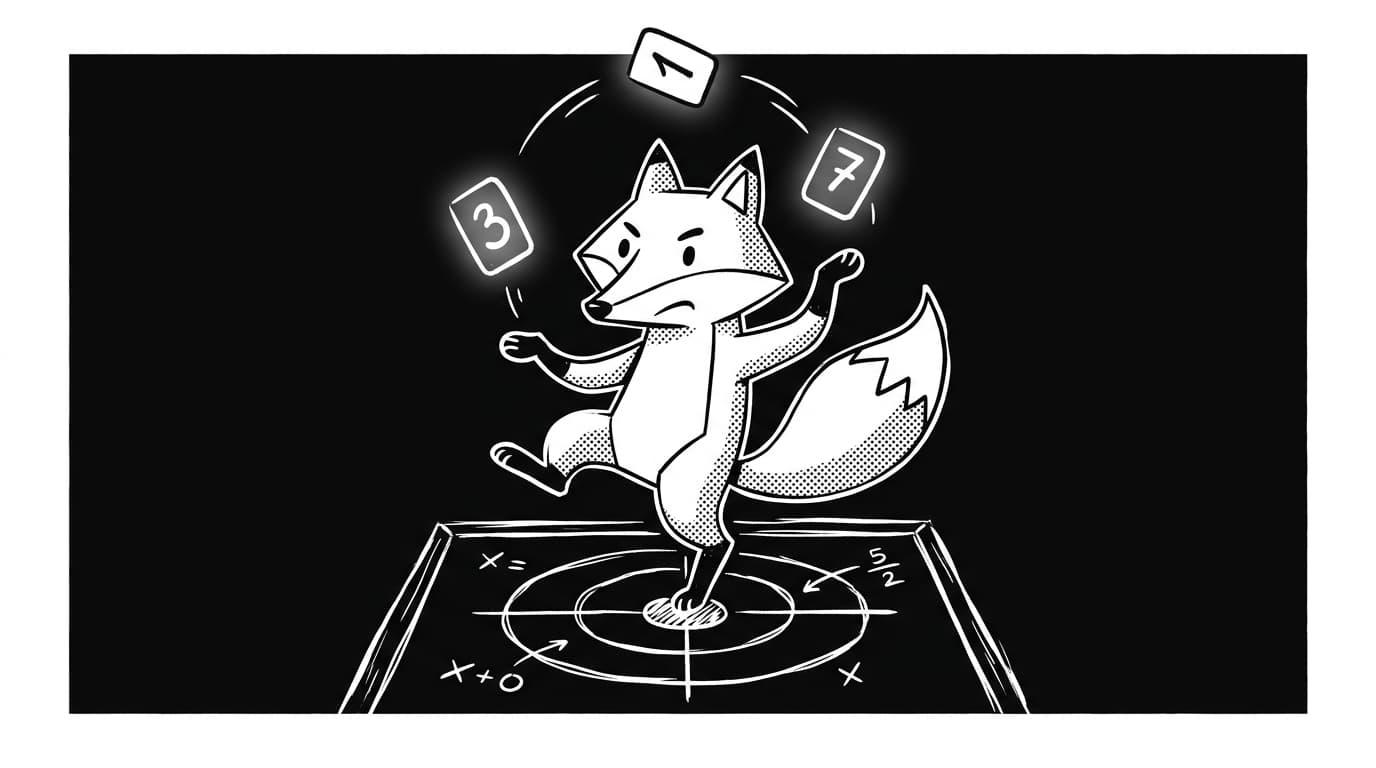
Strong Mathness players do two things at once. They finish the current operation in their head and at the same time line up the next one, so the answer to step one lands on a tile already promised to step two. That habit cuts two to four seconds per round and turns a wobbly run into a clean climb on the leaderboard.
What look-ahead means inside a single round
Look-ahead is the gap between picking your first operation and picking your second. Beginners pick step one, compute it, then stare at the new tile set and start fresh. Strong players pick step one with step two already half-decided. The intermediate result is not a surprise; it is the input slot you reserved before you started computing. The skill costs three to five extra seconds of reading time on the front end and pays back six to ten seconds on the back end.
The technique has two parts. First, the planning hand: you read the tiles, the target, and a candidate second move before you commit to the first. Second, the holding hand: you keep the second move alive in working memory while the first move runs. The two hands work in parallel, which is why this technique is also called pipelining in mental arithmetic. Pipelining shows up in chess endgames, in racing line selection, and in any timed task where step two depends on step one.
The two-slot pipeline: compute now, queue next
Treat your head like two slots. Slot A holds the operation in flight. Slot B holds the next operation as a promise: an operator, a target tile, and a rough expected magnitude. When slot A returns, slot B becomes slot A, and a new slot B forms while the new computation runs. That cycle is the whole technique. Two slots, swapped, refilled, repeated.
The magnitude promise matters more than the exact value. If slot B is multiply by 7, expect about 350, you can sanity check slot A's output as it lands. A value far from the expected range is a signal that step one was wrong, before you spend three more seconds compounding the error. Pair this with the last-digit check and your error rate on chained rounds drops sharply. The pipeline plus the verifier is the closest thing Mathness has to a safety net.
Which board shapes reward look-ahead the most
Not every board rewards the pipeline. The boards where look-ahead pays off share three traits, and you can spot them in the first second of the read.
- Targets above 200, where the final answer needs at least three operations to reach.
- Tile sets with two large numbers and two small ones, since the big tiles tend to chain through multiplication.
- Targets that factor cleanly, where the second operation is an obvious multiplication or division on the result of the first.
On those boards the queued move is usually a multiplication by a small tile (2, 3, 5, or 7) or a final addition that closes a gap of under 25. Boards with messy primes, or targets within fifteen of one of the starting tiles, reward serial play instead, since the first operation often is the answer. Reading the shape first costs about one second and saves the seven seconds you would have lost queuing a move that never executes.
The mistakes that break the pipeline
The first failure mode is losing the target. A player runs step one, lands a satisfying intermediate, and forgets the number they were aiming at. The fix is a fixed target rehearsal: every two seconds during slot A, repeat the target once silently. The cost is small and it survives any computation. Players who skip the rehearsal lose the target on roughly one in four chained rounds, which is enough to crater a ranked session.
The second failure mode is locking slot B too early. If you commit your second move before you finish reading all four tiles, you miss a better opener that uses a tile you reserved. Keep slot B revisable until slot A is about one second from finishing. That one-second window is enough to swap in a better second move if a cleaner path appears, and tight enough that you still execute without hesitation.
The third failure mode is queue overflow. New players try to hold three operations at once, run out of working memory, and drop the whole plan. The pipeline tops out at two slots for most players. If you reliably hold three, your bottleneck is no longer planning; it is raw calculation speed, and that is a separate problem solved by drilling times tables and squares, not by stacking more slots.
A seven-day drill to build the habit
Pipelining is a learned habit, not raw talent. The drill takes ten minutes a day for one week. Run it on daily Mathness with a paper notebook open next to you for the first half of the week.
- Day 1 and 2: play five rounds. Before each round, write down the candidate second move on paper before you begin computing. Speed does not matter yet.
- Day 3 and 4: play ten rounds. Same routine, but only write the operator and rough magnitude, not the full move. Start tracking which board shapes reward the queue.
- Day 5 and 6: play fifteen rounds. Skip the paper. Hold slot B in your head from the moment you commit to slot A. Accept the first two days of slippage.
- Day 7: play a normal session. Track how often slot B at the start of the round survived to become the real second move. Above 60 percent means the habit has stuck.
When to drop look-ahead and serialize
Pipelining is a tool, not a religion. Drop it on the last three rounds of a long session when fatigue makes working memory unreliable. Drop it when the target sits within fifteen of a single tile, since one operation usually solves the board. Drop it when you have already burned more than four seconds on the read; at that point a clean serial play beats a slow parallel one. The clock management routine has the timing rules for each window of the round. Practice the pipeline from the main menu and check your gains on the next ranked session.