Dyscalculia and Number Games: What Helps and What Frustrates
Dyscalculia affects roughly 5 to 7 percent of school-age children, a rate close to dyslexia, but the tools for it lag decades behind. A number game that trains a neurotypical player in ten minutes can push a dyscalculic learner into shutdown in ninety seconds. The difference sits in four design choices: time pressure, symbol density, penalty severity, and whether the interface shows quantity or only digits. This piece covers what those choices do to a dyscalculic brain, which formats help, and which ones to avoid.
What Dyscalculia Is, in One Paragraph
Dyscalculia is a specific learning difference in number processing, not low IQ and not math anxiety. The core deficit sits in the approximate number system, the mental circuit that lets most people see six dots and know they are six without counting. Diagnosed rates run 3 to 7 percent depending on criteria, with the DSM-5 folding it under Specific Learning Disorder with impairment in mathematics. Symptoms include slow finger-counting past age eight, trouble estimating quantity, place-value confusion at three digits, and inability to tell which of two prices is larger without paper. It co-occurs with ADHD in around 25 percent of cases and with dyslexia in around 40 percent, which is why a dyscalculia-friendly game usually helps other neurodivergent learners too. The working-memory load is covered in the three-number scratchpad piece.
Why Most Number Games Frustrate Dyscalculic Players
Four features push a dyscalculic learner off a game within a minute. A shrinking clock stacks working-memory load on top of an already-overloaded number system, and the visible countdown itself steals attention from the calculation. Dense digit-only displays with no dot-array or bar backup force the player to translate a symbol into a quantity before every step, an operation neurotypical brains skip. Harsh penalty structures like streak breaks, red flashes, and life loss trigger the shutdown loop that Butterworth and Kucian describe in their 2019 review of math anxiety in dyscalculic students. Adaptive difficulty that scales up on any correct-answer streak punishes the exact moment the learner is starting to click, which teaches the child that fluency causes pain.
Five Design Choices That Help
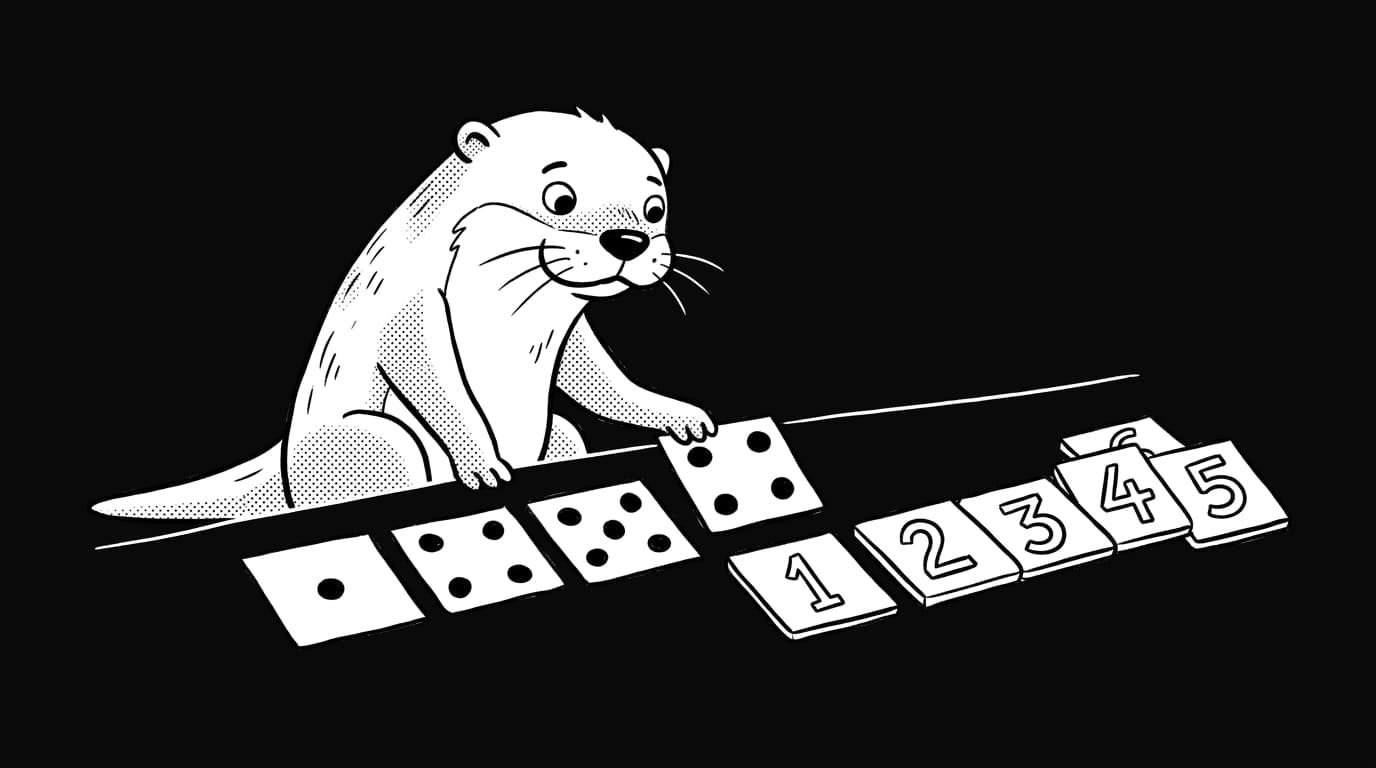
Dyscalculia-friendly games share five properties, and the presence or absence of each predicts retention better than the game's underlying math content. First, quantity is shown alongside notation, so a 24 appears next to two dice, a bar, or a set of dots. Second, the clock is optional or absent, so working memory only holds the problem, not the timer. Third, wrong answers are corrected without a penalty; the game shows the correct value and moves on. Fourth, the number range starts under 20 and grows after a plateau of stable accuracy, not after a streak of guessed hits. Fifth, session length is capped at 5 to 8 minutes to head off the fatigue collapse that lands on dyscalculic learners earlier than on peers.
Formats That Work
The formats below survive contact with dyscalculic players in classroom studies and clinical practice. No format works for every learner, so rotate weekly and let the child stop early without any narrative around quitting.
- Dot-array subitizing apps (Panamath, Subitize Tree): train the approximate number system directly, five minutes a day, no clock.
- Bar-model estimation tools (Number Frames, Ten Frame Mania): quantity-visible addition and subtraction in a 1 to 20 range.
- Physical dice and card games (Uno, Sleeping Queens, Prime Climb): tactile, no clock, an adult paces the round.
- Score-keeping board games (Mancala, Kingdomino, Qwixx): number handling in service of a non-math goal, which lowers threat.
- Rhythm-based counting apps (BeatCount, Skip-Count Songs): auditory encoding that routes around the visual number circuit.
Avoid drill-and-kill flashcard apps, timed multiplication games, and any format that shows a red X or plays a failure sound. Those cues stack aversive conditioning on top of the underlying processing gap, and the child learns to refuse the tool within a week. For a broader grade-by-grade rundown of what fits at each age, see the grade-by-grade game guide. The pattern approach to times tables is the prerequisite work most kids need before any timed number game.
Where Mathness Fits, and Where It Does Not
Mathness is a timed target-number game, and the timer alone rules it out during the diagnostic and early-intervention phase. Once a learner has built stable number sense to 100 and no longer counts on fingers past 12, the daily puzzle can serve as a low-stakes rep with a fixed board and no ranked pressure. Skip the ranked leaderboard for dyscalculic learners entirely; the visible rank change acts as a penalty signal that suppresses future engagement. Parents introducing Mathness after a dyscalculia diagnosis should start with the rules page at the child's side, cap sessions at three rounds, and treat every landing on the target as the endpoint regardless of score. The goal at this stage is repeat visits, not points.
What Parents and Teachers Should Track
Two weekly measurements tell you whether a game is helping or entrenching avoidance. Track the child's willingness to start a session on a three-point scale (yes without prompting, yes with one prompt, refusal) and the length in minutes before they ask to stop. A rising start-rate combined with stable or growing session length means the format is working and the range or difficulty can nudge up. A falling start-rate with shortening sessions means the format is triggering shutdown, and switching is required within the week rather than at the end of the term. Progress in dyscalculia is measured in months of sustained engagement, not weeks of accuracy gains, and any tool promising fast fluency should be treated with the skepticism it has earned.