Teaching the Multiplication Table Without Rote: The Pattern Approach
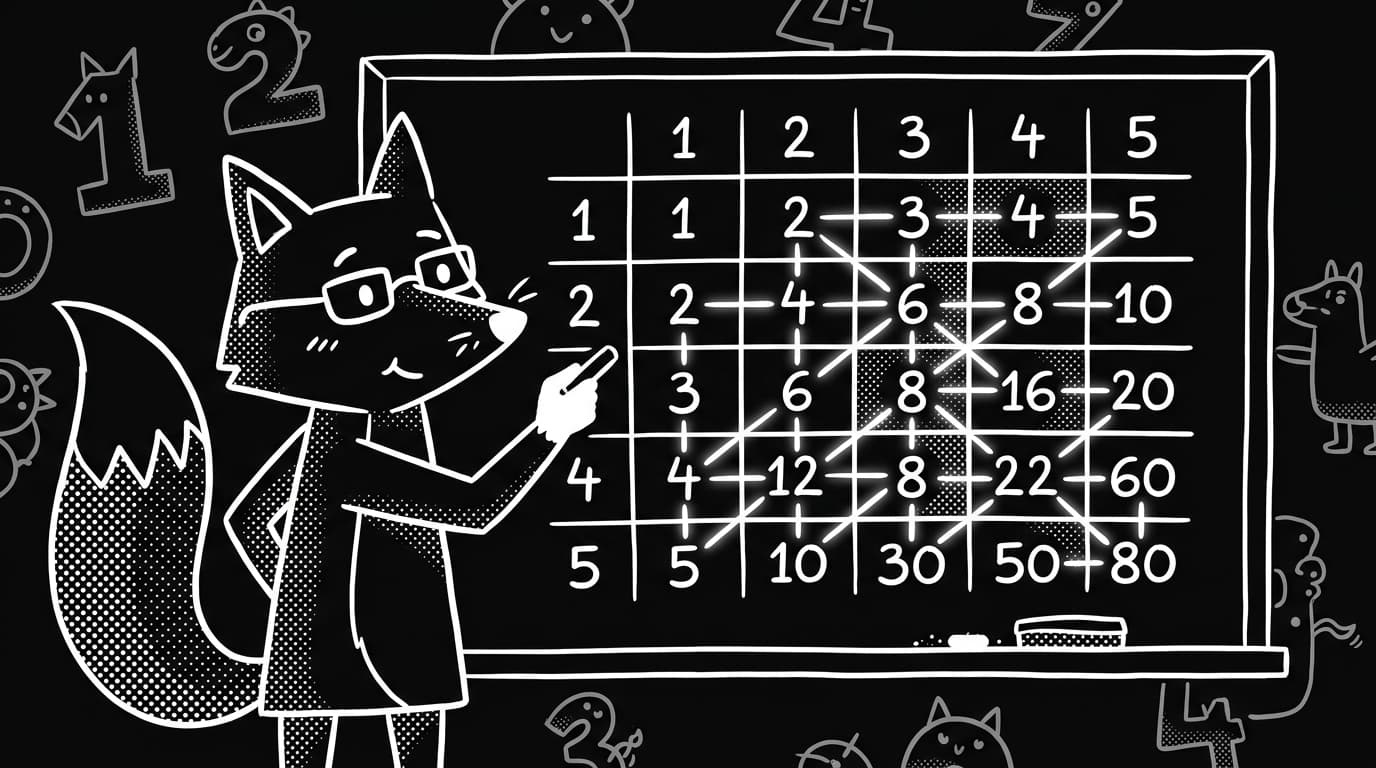
A child who memorizes 8x7 as one flashcard fact stores 144 unrelated items by the end of the 12x12 grid. A child who learns the six patterns underneath the grid stores about twenty. The pattern approach trades brute recall for structure that a student can rebuild in three seconds when memory slips, which happens under every test, timer, and classroom cold-call. This guide lays out the six blocks in the order a teacher should introduce them, the anchor facts each block leans on, and the drills that turn each pattern into a reflex.
Rote memorization holds up to about 45 facts before recall time doubles. That break point falls right at the 6s and 7s for most students, which is why teachers see fluency collapse there. The grid has 144 cells but only 78 unique products once you strip the duplicates across the diagonal, and 21 of those are trivial 0s and 1s. That leaves 57 real facts, and 40 of them fall inside patterns that need one rule and one anchor, not 40 separate flashcards. A student who has to reach for 8x7 by counting up from 8x5 has already learned the distributive property without naming it, which is the exact cognitive move standardized tests measure three grades later.
The pattern approach front-loads the rules and the anchors, then lets the products fall out. This inverts the usual sequence, where students memorize products first and only later discover the patterns. Teachers who teach the patterns first report that grade 3 students recover a forgotten fact in under four seconds using the rule, versus 12 to 15 seconds guessing from rote. That four-second recovery is the difference between finishing a timed page and stalling on row two.
Block One: Doubling Chains for 2, 4, and 8
The doubling chain covers 36 of the 144 grid cells with one rule. Doubling any number is the first arithmetic reflex most children develop, usually by grade 2, and it extends naturally to x4 as two doublings and x8 as three. Teach the chain 2, 4, 8 as a single lesson: 6x2 is 12, 6x4 is double 12 which is 24, 6x8 is double 24 which is 48. Students who stall on 7x8 can rebuild it in three doublings from 7: 14, 28, 56. The chain also unlocks x16, x32, and every power-of-two multiplier a student will meet in algebra.
Anchor the chain with a wall reference of the eleven powers of two from 2 to 2048, because those numbers repeat across math class from fractions through binary. The drill that locks the chain is a two-minute daily round where students call out the double of any number you shout, then the double of that, then the double of that. Grade 3 classrooms hit reliable four-digit doubling in about three weeks of this drill.
Block Two: The x5 and x10 Shift
Multiplying by 10 shifts every digit one place left. Multiplying by 5 is half of that, which reduces 24 more grid cells to a two-step reflex: halve, then shift. For 8x5 a student halves 8 to 4 and shifts to 40. For 7x5 a student halves 7 to 3.5 and shifts to 35. That half-and-shift move survives into decimals, percentages, and unit conversion, which is why it belongs in the second block rather than deep in the schedule. It also gives students their first taste of a two-operation trick they can execute faster than a lookup.
Pair this block with a five-minute percentage drill, because 10 percent of anything is the same shift, and 5 percent is the same halve-and-shift. A grade 4 student who owns this block calculates a tip on a restaurant bill in her head faster than her parents open the calculator app, and that public win locks the pattern for good.
Block Three: The x9 Complement Trick
The x9 column has three patterns stacked on top of each other, any one of which beats rote. The digit sum of every x9 product equals 9, so 9x7 = 63 and 6+3 = 9. The tens digit is always one less than the multiplier, so 9x7 starts with 6. The finger trick uses ten fingers as a physical lookup: fold the seventh finger, six fingers stand on the left, three on the right, giving 63. Teach all three in one lesson and let each student pick the one that clicks. About 40 percent of grade 3 students prefer the finger method, 35 percent the tens-minus-one shortcut, and the rest the complement identity.
The complement itself is 9x = 10x minus x, which is a distributive move disguised as a shortcut. A student who names it out loud in grade 3 has a running start on distributive-property proofs in grade 6.
Block Four: The Square Spine and Near-Squares
The twelve perfect squares from 1x1 to 12x12 are the spine of the entire grid. Any product one step off the diagonal is a square plus or minus the diagonal number. 7x8 is 7 squared plus 7, which is 49 plus 7, which is 56. 6x7 is 6 squared plus 6, which is 42. This is the (n)(n+1) identity in plain English, and it turns 22 grid cells into a two-step move from a memorized square. The near-square pattern also introduces the difference-of-squares identity that shows up later in factoring pairs like 47x53, which becomes (50-3)(50+3) = 2500 minus 9 = 2491.
- Squares to memorize first: 6² = 36, 7² = 49, 8² = 64, 9² = 81, 12² = 144.
- Then the near-square rule: (n)(n+1) = n² + n. So 7x8 = 49 + 7 = 56.
- Then (n)(n-1) = n² - n. So 8x7 confirms as 64 - 8 = 56, a self-check in two seconds.
Block Five: Distributive Splits for the Ugly Middle
The middle of the grid, 6x7, 7x8, 6x8, and 7x9, is where rote breaks and pattern wins. Distribute one factor over a friendly split: 7x8 becomes 7x5 + 7x3, which is 35 + 21 = 56. 6x8 becomes 6x10 minus 6x2, which is 60 minus 12 = 48. The teacher's job is to model three splits per fact and let the student pick the one that runs fastest in their head. Most students settle on a favorite decomposition within a week, which is exactly the point. Rote gives every student the same slow retrieval; distributive splits give each student a personal shortcut.
This is also the block where a game format outperforms worksheets. A round of Mathness forces the student to pick a split against a clock, which trains the decision faster than any pencil drill. Ten minutes of mixed-factor rounds delivers roughly the same distributive practice as an hour of paper.
Block Six: The 11 and 12 Bookends
x11 has a two-digit trick that every grade 3 student loves: for 11x34, write 3, then 3+4=7, then 4, giving 374. For 11x7, use 7x10 + 7 = 77. x12 is x10 + x2, which is a shift and a double. Both patterns take one lesson and close out the standard 12x12 grid. Students who own these six blocks can also stretch the grid without new memorization, using the extended times tables from 13 to 19 with the same distributive move they learned in block five.
The pattern approach does not skip practice. It reorders it. Students still drill, still see products on flashcards, still race against a clock. What changes is what they store between drills: five rules and twelve squares instead of 78 unrelated products. When a fact slips, the student rebuilds it in three seconds using the rule, and each rebuild strengthens the rule for the next slip. That compounding effect is why the pattern approach keeps scaling into algebra, where a student meets 23x27 or (n-3)(n+3) and reaches for the same distributive move learned in grade 3.