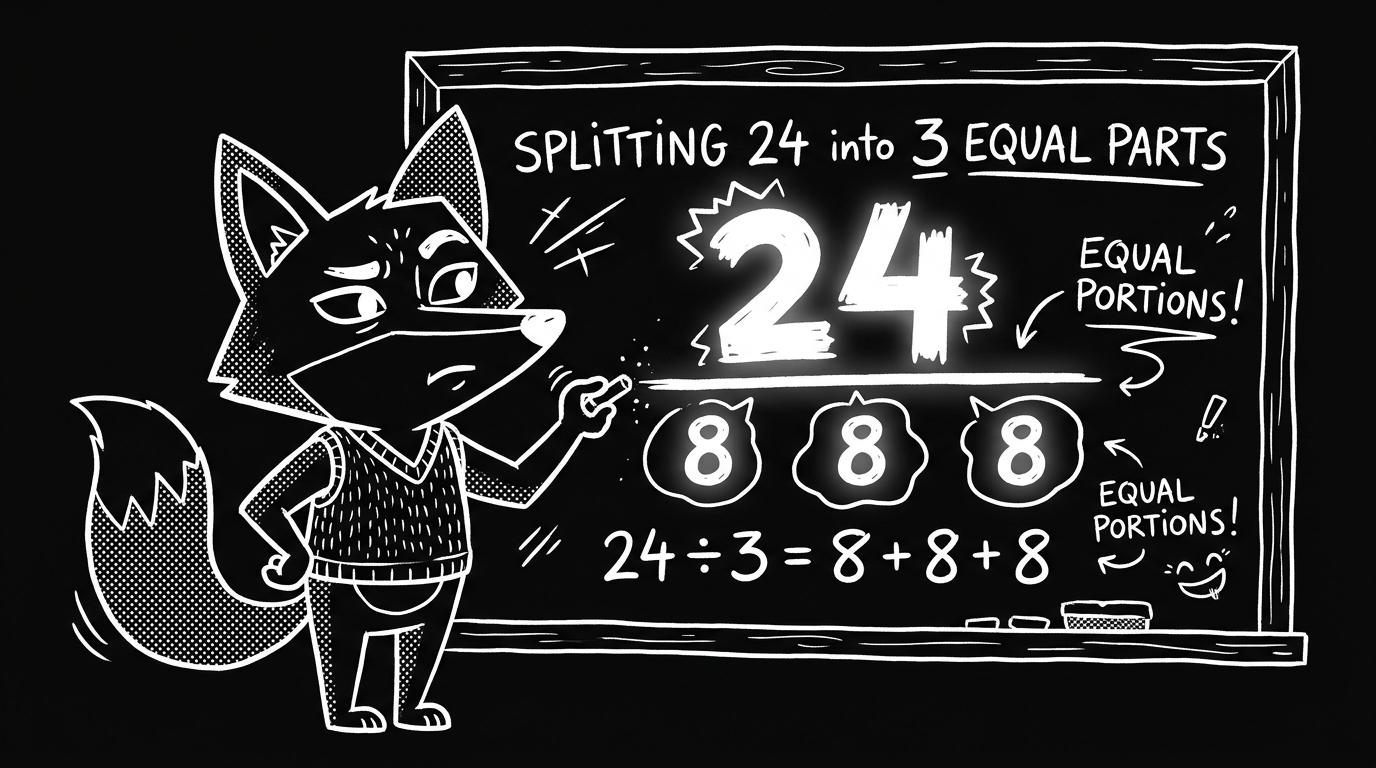
Mental Division Tricks: Divide Any Number in Your Head

Division feels harder than multiplication for a single reason: school taught it as one procedure, long division, that eats paper and stalls under pressure. Fast dividers do not run long division in their heads. They swap the problem for an easier one using six rewrites, each under two seconds to set up, and they pick the rewrite based on the divisor alone. This guide names the six, maps each to a divisor range, and gives a drill plan that converts a casual mental calculator to five-second solves inside a month.
The six rewrites, indexed by divisor
Every fast division runs one of six moves. Picking the right one takes a glance at the divisor, which is why the first habit to build is reading the divisor before the dividend. Dividing by 2, 4, or 8 means halving once, twice, or three times. Dividing by 5 means doubling the dividend and shifting one decimal place left. Dividing by 25 means doubling the dividend twice and shifting two places. Dividing by 3 or 9 uses the digit-sum rule to confirm divisibility and then applies a two-step read of the dividend. Dividing by 7, 11, or 13 uses chunking: split the dividend into pieces that each divide cleanly, then sum the quotients. Dividing by 6 or 12 factors into 2 and 3 and applies the earlier rewrites in sequence.
The deeper reference at How to Divide in Your Head: 5 Mental Division Tricks for 2026 walks through chunking tables and the digit-sum rule with twelve worked hands. This post sits above it, mapping each rewrite to a decision rule you can run before any arithmetic starts.
Halving stack: 2, 4, 8, 16
The halving stack is the cheapest division trick. Divide by 2 means halve once. Divide by 4 means halve twice. Divide by 8 means halve three times. 192 divided by 8 runs as 96, 48, 24. Divide by 16 means halve four times, and 256 divided by 16 runs as 128, 64, 32, 16. Each halving step costs about 0.3 seconds for two-digit numbers, so the full chain stays under 1.5 seconds even for divide-by-16. The error is zero because halving is exact whenever the number stays whole.
Odd dividends in the halving stack produce a 0.5 residue, which signals that the answer has a .5, .25, .125, or .0625 tail depending on how many halvings remain. 50 divided by 4 halves to 25 then to 12.5, and the tail reads off without carrying decimals through the earlier steps. The halving reflex is the first drill to lock, because it unlocks divisors 2, 4, 8, and 16 at once and acts as a building block for the compound rewrites below.
Double-and-shift: 5, 25, 50
Dividing by 5 is division by 10 with a doubling in front. 85 divided by 5 doubles to 170 and shifts one place left to 17. 240 divided by 5 doubles to 480 and shifts to 48. Dividing by 25 is division by 100 with a doubling twice in front, or equivalently a multiply-by-4 followed by a two-place shift. 325 divided by 25 equals 325 times 4 shifted two places, which is 1300 shifted to 13. Dividing by 50 doubles the dividend once and shifts two places.
These three rewrites cover every divisor ending in 5 or 0 under 100, which is a surprisingly large share of real-world division problems. Tip splits often land on 5 or 25, retail percentage marks sit at 20 percent (divide by 5) or 4 percent (divide by 25), and unit conversions between quarters and wholes constantly run divide-by-four or divide-by-25. The drill pattern that pays off is pairing this family with the percentage reflex, since the shift mechanics overlap.
Digit-sum and compound: 3, 6, 9, 12, 15, 18
Divisibility by 9 is a two-second check: if the digits sum to a multiple of 9, the number is divisible. 522 passes because 5 plus 2 plus 2 equals 9. The quotient for three-digit multiples of 9 reads as hundreds-digit-minus-one in the tens slot of the answer, with the units slot filling in to hit the digit sum. 522 divided by 9 reads as 5 minus 1 equals 4 in the tens, then 522 minus 450 equals 72, and 72 divided by 9 equals 8, giving 58. For 3, the digit sum rule is identical and the ceiling check saves you from grinding a quotient that was never going to be whole. The digit-sum rule also acts as a sanity check at the end of any multiplication or division: your answer's digit sum should be congruent to the sum of the original numbers modulo 9, and a mismatch catches most arithmetic slips before they ship.
Compound divisors run two of the earlier rewrites back to back. Divide by 6 is divide by 2 then divide by 3. 282 halves to 141, and 141 divided by 3 is 47 (digit sum 12, quotient reads as 4 and 7). Divide by 12 is divide by 4 then divide by 3. 348 halves twice to 87, and 87 divided by 3 is 29. Divide by 15 is divide by 5 then divide by 3: 435 divided by 5 is 87, then 87 divided by 3 is 29. Divide by 18 is divide by 9 then halve, or divide by 2 then by 9, whichever lands on cleaner intermediates. This family shows up constantly in time, currency, and recipe math: 6 is minutes into hours, 12 is months and inches, 15 is quarter-hour arithmetic, 18 appears in golf and age thresholds. The reps you build on the daily board convert these into reflex inside two weeks.
Chunking: 7, 11, 13 and everything awkward
Chunking handles divisors that resist the other rewrites. Split the dividend into two numbers that each divide cleanly, then sum the quotients. 168 divided by 7 splits into 140 and 28. 140 divided by 7 equals 20 and 28 divided by 7 equals 4, giving 24. The chunks to memorize are small and align with the ten-times, five-times, and hundred-times entries of each awkward divisor.
- Divisor 7: chunks 70, 140, 210, 350, 700.
- Divisor 8 (if halving does not fit): chunks 80, 160, 240, 400, 800.
- Divisor 11: chunks 110, 220, 440, 550, 1100.
- Divisor 13: chunks 130, 260, 390, 520, 650.
- Divisor 17: chunks 170, 340, 510, 850.
The move is to pick the largest chunk that fits under the dividend, subtract, divide the leftover, and sum the two quotients. 294 divided by 7 picks 280 as the chunk for 40, leaves 14 for 2, and sums to 42. Three steps, no paper, under four seconds with practice. Chunking is also the last-resort rewrite when a divisor resists everything else, which is why the chunk tables for 7 and 13 are worth drilling first.
Thirty-day drill plan
Days one through five lock the halving stack on 2, 4, 8, 16 with twenty two-digit dividends per day. Days six through ten add the double-and-shift family on 5, 25, 50, with a mixed set that forces a divisor check before the move. Days eleven through fifteen introduce digit-sum on 3 and 9. Days sixteen through twenty-two drill chunking on 7, 11, 13 with the memorized chunk tables above. Days twenty-three through thirty mix all six rewrites at random, ten hands per day, with a five-second timer per hand.
Pair the drill with a reverse-multiplication session: pick a product, name both factors, and the division fluency grows out of the multiplication fluency you already have. The full Mathness menu runs this reverse pairing automatically if you set the mode to mixed operations, and the leaderboard tracks sub-five-second division solves as a specific tier. A player who runs the thirty-day plan without skipping typically cuts their average division time from twelve seconds to under five across common divisors.