Powers of Two in Mathness: The Ladder From 2 to 2048
The powers of two from 2 to 2048 are the second reflex table every Mathness player needs after the standard times tables. Eleven numbers, memorized cold, turn a whole class of rounds into two-move plays. This post covers the ladder, where it wins on the board, when doubling chains beat direct recall, the halving route from the target, and the seven-day drill that locks the reflex.
The Ladder You Have to Memorize
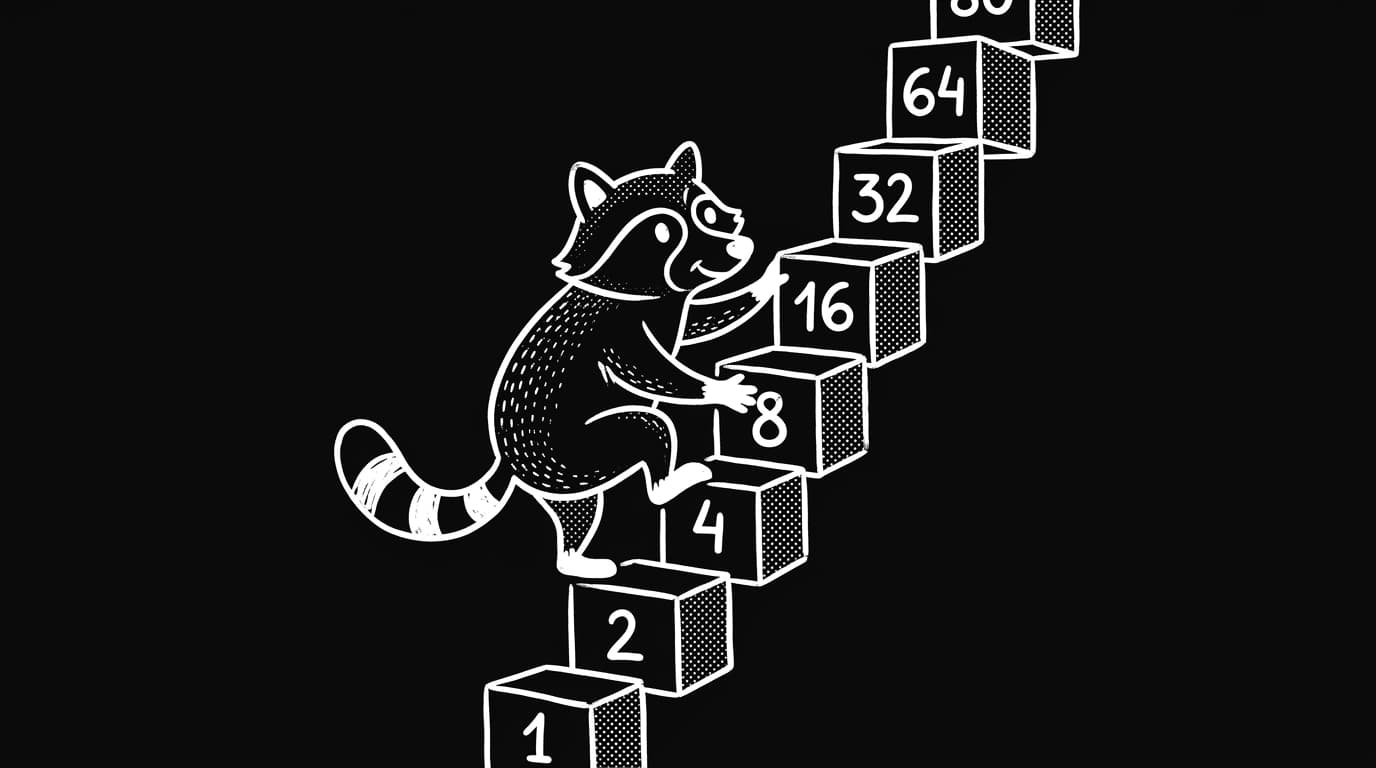
The powers of two from 2^1 to 2^11 are 2, 4, 8, 16, 32, 64, 128, 256, 512, 1024, and 2048. Add 2^12 = 4096 if your ranked sessions push into four-digit targets. Every player already knows the first four. Most stall around 128, and almost nobody has 512 and 1024 on instant recall. That gap costs three to four seconds every time a target lands on one of them or on a neighbor within two. Memorize the eleven numbers as a single chant. Speak them in order until you can call any one by index without counting up.
- 2
- 4
- 8
- 16
- 32
- 64
- 128
- 256
- 512
- 1024
- 2048
The index matters as much as the value. Index seven is 128, index nine is 512, index eleven is 2048. When a board hands you a 32 and a 16, index-five plus index-four multiplies to index-nine in one operation. Thinking in indices removes the recomputation step that slows most players by two seconds per power-of-two round.
Where Power-of-Two Targets Show Up
On /daily, roughly one round in eight lands on a power of two or a value one away from one. On ranked, the density is higher because the generator likes clean targets for tie-breaks. A tile board with an 8, a 4, and a 2 hands you 64 in one multiplication. A board with 16 and 32 hands you 512 the same way. Scan the tiles for even numbers first. Two even tiles with no odd bridge often mean the target is a power of two or a small multiple of one. If you see 6 and 8, check 48. If you see 4 and 16, check 64 and 128.
Powers of two also cluster near common ranked targets. 256 sits next to 250, 255, and 260. 512 sits next to 500, 510, and 520. 1024 sits next to 1000 and 1025. When the target is one of those neighbors, the fastest path is often hit the power, then add or subtract a small tile. That is a two-move play instead of a three-move one, and it saves the four seconds that decide most leaderboard climbs. See Endgame Mathness for the two-tile closes that pair with this.
Doubling Chains vs Direct Recall
Two routes reach a power of two: a doubling chain (2 to 4 to 8 to 16 to 32 to 64) or direct recall of a factor pair. Direct recall wins every time you have it. A doubling chain costs one operation per rung. Reaching 256 from a 4 tile takes six rungs. Recalling 4 x 64 = 256 or 16 x 16 = 256 takes one operation. The rule: recall first, chain only when no factor pair sits on the board.
Chains still matter on boards missing a helpful factor. If your tiles are 3, 7, 8, and 25 and the target is 512, no clean factor pair exists. The doubling route uses 8 to 16 to 32 to 64 to 128 to 256 to 512, which is six operations and blows the clock. The correct read is that 512 is not reachable here. Skip and keep the streak. See When to Skip a Mathness Round for the six-second skip decision.
For midladder targets like 128 and 256, memorize the factor pairs cold. 128 = 2 x 64 = 4 x 32 = 8 x 16. 256 = 2 x 128 = 4 x 64 = 8 x 32 = 16 x 16. 512 = 2 x 256 = 4 x 128 = 8 x 64 = 16 x 32. 1024 = 2 x 512 = 4 x 256 = 8 x 128 = 16 x 64 = 32 x 32. Twenty pairs total, one week to memorize.
The Halving Route: Working Backward From Power Targets
Working backward from a power of two is faster than forward search on most boards. If the target is 128, ask which pair on the board multiplies to it: 2 x 64, 4 x 32, 8 x 16. If none of those pairs sits ready, ask which pair sums or subtracts to a factor of 128. A 5 tile and a 3 tile give 8, and if a 16 also sits on the board you have 128 in two moves. Cross-reference Decomposing the Target in Mathness for the full factor-first approach.
The halving check also catches near-misses. If the target is 130 and your board contains 2, 5, 8, and 16, the power-of-two neighbor is 128 = 8 x 16. Adding 2 lands 130 in three operations. Without the halving check, most players chase 130 by adding smaller tiles and burn twelve seconds. Train the reflex: on any three-digit target, scan the two nearest powers of two before you scan anything else.
The Seven-Day Drill
Lock the ladder with three drills a day for seven days, five minutes total. Day one through three, chant the eleven numbers in order five times, then call them out of order (index eight, index four, index eleven) until zero hesitation. Day four through five, add the neighbors: 255, 257, 511, 513, 1023, 1025. Day six, play ten ranked rounds and mark every one where a power of two was one operation from the target. Day seven, review the marked rounds and rerun the misses.
- Chant the ladder five times cold, then call three random indices without counting up.
- Drill the twenty factor pairs for 128, 256, 512, and 1024 until each answers in one second.
- Log every board where a power of two sat one step from the target.
- Rerun the logged boards on day seven and time each attempt.
After the seven days, keep the ladder alive with one 60-second refresh at the start of each ranked session. See Warm-Up Routine for Ranked Mathness for where the power-of-two refresh fits into the full five-minute warm-up. The ladder decays fast without weekly touch, and a rusty index seven costs the same three seconds as a missing one.