Chisanbop: Count to 99 on Your Fingers (2026 Guide)
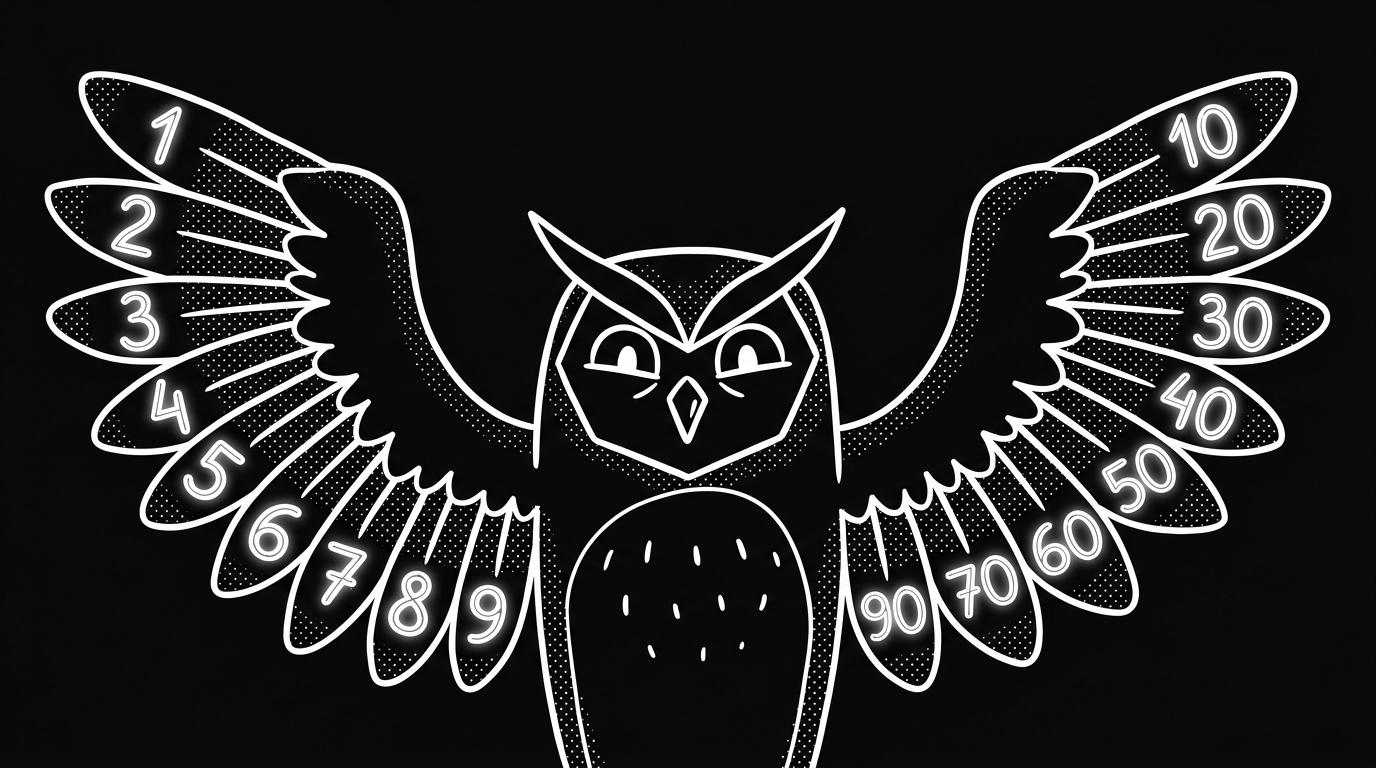
Ten fingers get most people to ten and stop. Chisanbop pushes that ceiling to 99 using the same ten fingers by assigning place value to each hand: the right hand holds the ones column from 0 to 9, and the left hand holds the tens column from 0 to 90. Press the right fingers you need, press the left fingers you need, read off the number. The system was formalized by Sung Jin Pai in late-1940s Korea and ran in roughly 5,000 American classrooms by 1980. By the end of this guide you will display any two-digit number in under three seconds and add with carries on your palms.
The Right-Hand Rule: Zero Through Nine
Start with the right hand flat on a table, palm down, all four fingers and the thumb extended. The four fingers each count as one unit, so pressing the index shows 1, pressing index and middle shows 2, and pressing all four shows 4. The thumb carries a value of five, which is the whole trick. To show 5, lift the four fingers and press only the thumb. To show 6, press the thumb plus the index; for 7, thumb plus two fingers; for 8, thumb plus three fingers; for 9, thumb plus all four. Ten distinct press patterns cover 0 through 9, and most learners read them without looking after a single training session.
The Left-Hand Rule: Ten Through Ninety
The left hand mirrors the right with every value multiplied by ten. Each of the four left fingers counts as ten units, and the left thumb counts as fifty. Pressing the left index alone shows 10, index plus middle shows 20, and all four left fingers down shows 40. The left thumb alone shows 50, thumb plus one finger shows 60, and thumb plus four fingers shows 90. Combining hands produces any integer from 0 to 99 with no ambiguity. 73 reads as left thumb plus two left fingers for 70, right thumb plus three right fingers for 3. The pattern is strict decimal, which is why the method installs place value as a motor reflex rather than a chalkboard rule.
Worked Examples: 37, 68, and 92
Display 37 by pressing the left index and middle fingers for 30, then the right thumb and two right fingers for 7. Total time for a fluent user: about 1.4 seconds. Display 68 by pressing the left thumb plus one left finger for 60, then the right thumb plus three right fingers for 8. Display 92 by pressing the left thumb plus four left fingers for 90, then two right fingers for 2. Each number has exactly one press pattern, which means a child shown the hands can read the value with zero guesswork. Try the same three numbers using a short daily number puzzle and compare the pattern against a mental image, since the goal is to recognize the shape of 37 on the hands as fast as the digits on a page.
The Carry: Adding 47 and 36 on Your Hands
The carry is where Chisanbop earns its reputation. Start with 47 displayed: the left thumb stays up, the left index and middle and ring fingers press down for 40, and the right thumb plus two right fingers press down for 7. Add 36. The ones column adds 6, but 7 plus 6 is 13, which exceeds the right hand's 9. Lift the entire right hand to clear 7, press the right thumb and three right fingers for 3, and carry one ten to the left hand by pressing one more left finger. The left column now shows 50, so swap three single fingers for the left thumb to display 83. The final total of 83 appears on the hands within two seconds for a fluent user, and the carry rule generalizes to any two-digit sum under 100.
A Five-Minute Daily Drill
Fluency arrives in roughly 20 sessions of five minutes each. The sequence below locks the single-digit reflex first, then the two-digit layout, then the carry, before mixing all three in a timed set. Use a stopwatch and record the times, since the biggest motivation signal for a learner is a dropping clock.
- Minute 1: flash twenty single-digit targets from 0 to 9 and press each on the right hand under one second.
- Minute 2: flash fifteen two-digit targets from 10 to 99 and press each in under three seconds.
- Minute 3: add ten pairs of two-digit numbers that do not require a carry, writing only the final answer.
- Minute 4: add ten pairs that do require a carry, using the swap-and-press rule above.
- Minute 5: run a mixed set of twenty problems and log the total time, aiming for under 90 seconds by session 20.
When the Method Stops Being Enough
Chisanbop handles addition and subtraction up to 99 cleanly, and it stops being useful almost everywhere else. Multiplication has no native pattern beyond repeated addition, so 7 times 8 forces seven pressings of 8 across the fingers. Division defaults to guess and check because no protocol tracks remainders on the hands. Numbers above 99 require a second learner acting as a hundreds column, which kills the elegance for any solo drill. A child chasing competitive mental arithmetic hits that ceiling inside two years and needs to migrate to abacus mental math and anzan, which pushes the range to four and five digits with full multiplication and division rules. For the Korean classroom origin story and the 1977 Lieberthal American rollout, our earlier guide covers the method's history and classroom evidence. The same number sense foundation underwrites both Chisanbop and anzan, and rotating through the full puzzle menu keeps the arithmetic muscle warm once the hands come off the table.